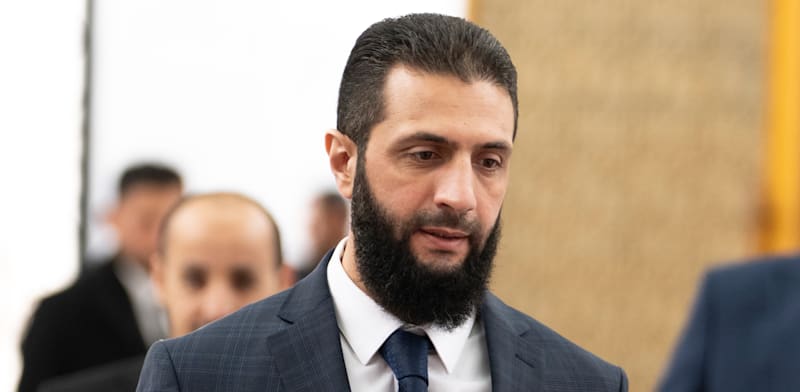
In recent days, Syria has been celebrating this year’s coup against the dictator Bashar Assad. The one who took his place, ex-al-Qaeda, Abu Muhammad al-Jolani who changed his official name to Ahmed al-Shara, received a warm embrace from the Western and Gulf countries. The US hoped that accepting Damascus back into the fold of the international community would make Non-Sharia think positively about joining the Abraham Accords, but with the lifting of the sanctions against him and against Syria, he actually turned his back on the move.
Inside Syria: many want to take advantage of the vacuum
The internal situation of the Sharia regime is very bad. It controls only about 60% of the country’s territory, with the rest including tribes in the Syrian desert; Kurds in the northeast, who control most of the oil fields; and the Druze under the leadership of Hakmat al-Hijri in the south. Added to all of this is Israel, which has created a strategic depth on Mount Hermon and the Sweida area, to prevent the jihadists there from attacking the Golan settlements.
A bit about the factors that take advantage of the vacuum in Syria became known at the end of November, when an activity by the forces of the 55th Brigade in the town of Beit Jen ended with the injury of six officers and reservists, three of them seriously. This was the result of an exchange of fire only 11 km from the Israeli border with Jama’ah Islamiyah, a terrorist organization that aims to establish a “caliphate” and is close to Hezbollah.
Such terrorist organizations are the reason why even in front of the cameras, in this year’s celebrations for the attempted coup, A-Shara’s fear of assassination stood out. When he arrived for prayer at the Umayyad Mosque in Damascus, he was surrounded by security guards. When he participated in a military parade, armed men surrounded him, also equipped with electronic warfare, for fear of drone attacks.
A military parade to mark the first anniversary of the Assad regime’s replacement, this week / Photo: Reuters, Mohammad Daher/NurPhoto
Turkey: kept the embers alive in the civil war
From the side, Turkish President Recep Tayyip Erdogan rubs his hands with pleasure. Throughout the civil war in Syria, Turkey preserved the embers of al-Sharia, which controlled only the Idlib area, by two means: the flow of food, ammunition and capital, alongside the entry of jihadists who formed the core of al-Sharia’s army. These made it possible to take advantage of the opportunity, when Russia was drowning in the Ukrainian mud and Hezbollah suffered mortal blows in the Northern Arrows operation in Israel, for a coup d’état against Assad.
The irony is that even though the Western world embraces Sharia, those jihadists still serve it – and do not hide their origins. In the exercises carried out by the Syrian army, mainly on the basis of military personnel that came from Turkey, there are fighters from Chechens, Tajiks, Uzbeks and other Asian countries, who remained in Syria after the coup. Some of them do not even try to hide their vision, as they wear patches with distinct jihadist characteristics.
Dr. Carmit Valensi, a senior researcher at the Institute for National Security Studies (INSS) and head of the Syria program at the institute, says that Turkey is the one that finances the foreign jihadists. “The foreign fighters are disciplined, that’s why the American ambassador to Turkey, Tom Barak, approved the integration of 3,500 foreigners into the Syrian army. A-Shara suffers from a manpower shortage. He failed to establish an orderly and significant army in terms of SDF. While he fielded an army with 30,000-50,000 soldiers, the Kurds have 70,000.”
Dr. Carmit Valensi, INSS / Photo: INSS
The Kurds: insist on not being assimilated into the government
Turkey has two main motives in Syria: the preservation of al-Sharia as a patron regime, and the weakening of the Kurds. These operate under the Syrian Democratic Forces (SDF), whose leader is Mazloum Abdi. In the shadow of this situation, reports in Syria and Turkey – some of them improved by Erdogan – pointed to the influx of Turkish forces into northern Syria. This is due to both the Kurdish Sadak and Abdi’s insistence on not being fully assimilated into the “transitional government” of A-Shara.
Ankara made it clear that they would refuse a situation in which senior officials of the YPG, the Syrian-Kurdish militia, would integrate into the Syrian government, being “connected to the PKK” – the Kurdish underground. But reality showed that the Kurds are not one piece. Thus, the Iraqi Kurdistan Regional Government (KRG), whose president is Nachirwan Barzani, conducts a unique policy in itself, which includes its own relations with Turkey, and of course Iraq – by virtue of being autonomous.
“The investment in Israel during the civil war in Syria and Ankara’s standing with the rebels leads to a situation where Turkey sees itself as a country that replaces Russia and Iran there,” says Dr. Chai Eitan Cohen Yanrojak, an expert on Turkey at the Moshe Dayan Center at Tel Aviv University and the Jerusalem Institute for Strategy and Security. “The Turks see Syria as an undeclared protectorate. This is reflected in the fact that US President Donald Trump congratulates Erdogan in front of the cameras because he ‘succeeded in fulfilling Turkey’s dream of conquering Syria.'”
Ankara also has economic interests in northern Syria: Erdogan needs oil, and a lot of it. The lack of control over oil sources is critical for Turkey, because geopolitical events could jump energy prices and accelerate the country’s inflation, whose annual rate from the beginning of 2022 varies between 31%-85%. Therefore, Erdogan is interested in a direct influence on strategic territories saturated with natural resources over which the Kurds are weak. Today, oil production in Syria is estimated at 85 thousand barrels per day, about 90% of which are produced east of the Euphrates River, in the territories of the Syrian Democratic Forces (SDF).
“One of the big challenges that Sharaa is unable to overcome is the integration of the minority groups,” explains Dr. Valensi. They demand to maintain organic capabilities and control as well as adequate representation in the government, and one of the patterns identified in A-Shara is a centralized concept of government. It is difficult for him to share power, there is some representation in the government and in the parliament of minorities, but it is very incomplete.”
The sense of disgust of the minorities in the Sharia regime was accelerated by the massacres, which the world turned a blind eye to. In the first phase, in March, approximately 1,700 Alawites were massacred in western Syria, members of the community from which the Assad family came. In July, the regime’s soldiers moved to slaughter Druze on the outskirts of Damascus, including humiliating by cutting off the beards of religious scholars. The same events brought Druze from Israel to break into Syria, and they were soon returned. For the time being, the situation has relatively stabilized, even though the Sweida area is under siege – which illustrates that a military conflict between the al-Sharia regime and Israel is a likely scenario. All the more so when the president of Syria and his people repeat the message that they will not even agree to an interim security arrangement, until Israel withdraws from the territories it invaded about a year ago.
“A-Shara’s negotiations with the Druze were interrupted following the massacre in July,” notes Dr. Valensi. There are reports of militias of Assad supporters who operate with the funding of former senior officials in his regime, hoping to create local uprisings.”
The maritime domain: the scene of a possible conflict with Israel
Factors in the West and the Gulf will be happy to stop the disintegration in Syria, because such disintegration will testify to their failure to recognize developments, especially those that are contrary to the image that Turkey has tried to create. Saudi Arabia was quick to pour in funds and encourage the international legitimacy of al-Sharia, Qatar joined in paying debts to the World Bank, and various countries flocked to Damascus in an attempt to take over the infrastructural void left by Russia when Syria left.
The Emirati giant DP began operating the Port of Tartus last month, in a contract signed for 30 years worth 800 million dollars. The Dubai-based company took advantage of a move by Al-Shara, which decided in June to cancel the contract signed by Assad in 2019 with the Russian company Stroitransgaz, on the grounds that it did not invest half a billion dollars in upgrading the infrastructure at Tartus port – as required by the contract.
At the same time, in Damascus they defined the contract as “unfair”, since it included the transfer of 35% of the revenues to Syria, and the rest to the Russian company. The Syrian government’s policy on the matter is reflected in the contract signed in May with the French shipping giant CMA CGM. This includes an agreement to operate the port of Latakia for 30 years, in which a French investment of 260 million dollars is guaranteed in its upgrade, as well as a revenue distribution model that is completely different from the one that the Assad regime concluded with the Russians. In the first phase, the parties agreed on 60% for the Syrian government, with adjustments to be examined in the future according to the increase in activity at the port.
The maritime domain may be the scene of another conflict between Turkey and Syria and Israel. Recently in Ankara they were outraged that the Lebanese government, with American encouragement, approved the maritime border agreement with the Republic of Cyprus. Turkey does not recognize the maritime borders of the Cypriots, because it does not see eye to eye on the borders of the economic waters in the eastern Mediterranean with the countries of the region and the world. Moreover, it demands economic water for the Turkish Republic of Northern Cyprus, an entity that only Turkey itself recognizes.
The expectation is that Erdogan will soon sign a maritime border agreement with Israel, which will ignore Cyprus. This may lead to a situation where drilling ships will operate in maritime spaces adjacent to the State of Israel, and ignore it as well. Finding natural gas will benefit Erdogan’s interests at home, but also not Sharia, whose economy is going from bad to worse.
At least outwardly, Damascus is trying to convey optimism. During the “Reuters Next” conference held in New York, Central Bank Governor Abdel-Hussari stated that he believes that the return of approximately 1.5 million refugees to the country will encourage the local economy, whose growth in 2025 will be higher than the World Bank’s forecast – 1%. However, even after Trump suspended the Caesar Act for the Protection of Syrian Citizens, which cut off Syria from the international clearing network, Syria is finding it difficult to rise.
The World Bank estimated in October that the cost of reconstruction from the civil war that took place in the years 2011-2024 amounts to approximately 216 billion dollars. The World Bank defines this huge amount as a “conservative estimate”, because some believe that the extent of property damage is about 345 billion dollars. The war damaged nearly a third of the Syrian capital that preceded it, and the damages to infrastructure, residences and buildings alone amount to 108 billion dollars.
Economy: More than 16 million need humanitarian aid
Added to this are a host of other challenges. More than 90% of the population lives below the poverty line, and the United Nations Office for the Coordination of Humanitarian Affairs (OCHA) reported last month that more than 16 million Syrians are in need of humanitarian aid, and hundreds of thousands are still displaced from their homes. When this is related to the social divide and ethnic tension, it is clear why Al-Shara fears his position so much.
Dr. Cohen Janrojak concludes that in the current situation of Syria, the Turks provide many infrastructures, including technological means for airports. They do this in light of their success in the political axis – the removal of Western sanctions on Syria and the creation of international legitimacy for it.
“The Turks want to take advantage of the opportunity to improve the capabilities of the Syrian army through the cooperation agreements they have signed with them. They are turning Syria into a reliable market for the Turkish military industry. Ankara’s influence in Syria is deepening, but there is always room for improvement. Besides the ambition to drill in the economic waters of Syria or in Cyprus in the name of Syria, the Turks have a plan to inaugurate military bases in the center of Syria, and if possible – also to go down south.”
For your attention: The Globes system strives for a diverse, relevant and respectful discourse in accordance with the code of ethics that appears in the trust report according to which we operate. Expressions of violence, racism, incitement or any other inappropriate discourse are filtered out automatically and will not be published on the site.
https://logospress.ru/content/pgs/?turnirnue_igru_i_atmosfera_azarta_v_pinko_kazino___chto_stoit_znat_.html
https://www.foto4u.su/kf/inc/onlayn_kazino_pinco___programma_loyalnosti_s_bonusami_i_nagradami.html
https://ural-hifi.ru/fonts/inc/turniru_i_prizu_v_onlayn_kazino_pinco_kz___azart__strategii_i_pobedu.html
https://nestone.uz/assets/pages/?otvetstvennaya_igra_na_sayte_pinco__kak_sohranit_kontrol_i_azart.html
http://skifltd.com/smt/pgs/polnuy_gid_po_kazino_pinco__registraciya__bonusu_i_chastue_voprosu.html
https://svetofor.market/home/news/kak-vybrat-divan-praktichnye-sovety.html
https://realfear.ru/molniya
https://www.kazanskoi.ru/letopis/Na_svyatki_sjostry_miloserdiya__posetili_veteranov/
https://www.autoezda.com/remauto/1027-zamena-tormoznogo-shlanga.html
https://gtbike.ru/js/pgs/?zghivoe_kazino_pinko___atmosfera_nastoyashego_kazino_u_vas_doma.html
http://www.medtronik.ru/images/pages/pinko_kazino_oficialnuy_sayt_dlya_kazahstana_s_bonusami_i_turnirami.html
https://chairman.ru/html/cust/turniru_pinko_kazino_onlayn_do_25_millionov_tenge_ezghednevno.html
https://www.apelsin.su/wp-includes/articles/otzuvu_realnuh_igrokov_o_nad_zghnosti_i_udobstve_na_sayte_pinco.html
https://www.mobill.ru/news/sluzhba-tehnicheskoy-podderzhki-online.html
http://www.tzmagazine.ru/news.php?uid=3758&what=2
https://logospress.ru/content/pgs/?sovremennoe_onlayn_kazino_s_udobnum_interfeysom_i_shedrumi_bonusami.html
https://yd58.ru/catalog/pgs/pinko_casino_mobile_app__secret_download_guide_for_android___ios.html
https://softwarehouse.au/pages/history_of_online_casinos_in_azerbaijan_and_their_development_1.html
https://audium.com/img/pages/online_casino_reality_in_azerbaijan_advantages_and_hidden_risks.html
https://www.mobill.ru/news/razrabotan-kompleks-cti-na-baze-plat-kompyuternoy-telefonii.html
https://youlooks.ru/chto-podarit-nachalniku/
https://leipzigersparschwein.de/die-preiswertesten-computer-reparaturen-in-leipzig/
https://gspholding.com/news/complex-rescue-operation-at-sea-grup-servicii-petroliere/
https://www.in4.pl/news-MSI-wprowadza-do-sprzeda%C5%BCy-dwa-nowe-produkty,34801.html
http://www.medtronik.ru/images/pages/preimushestva_igrokov_v_pinco_casino_azerbaijan__loyalnost_i_vip.html