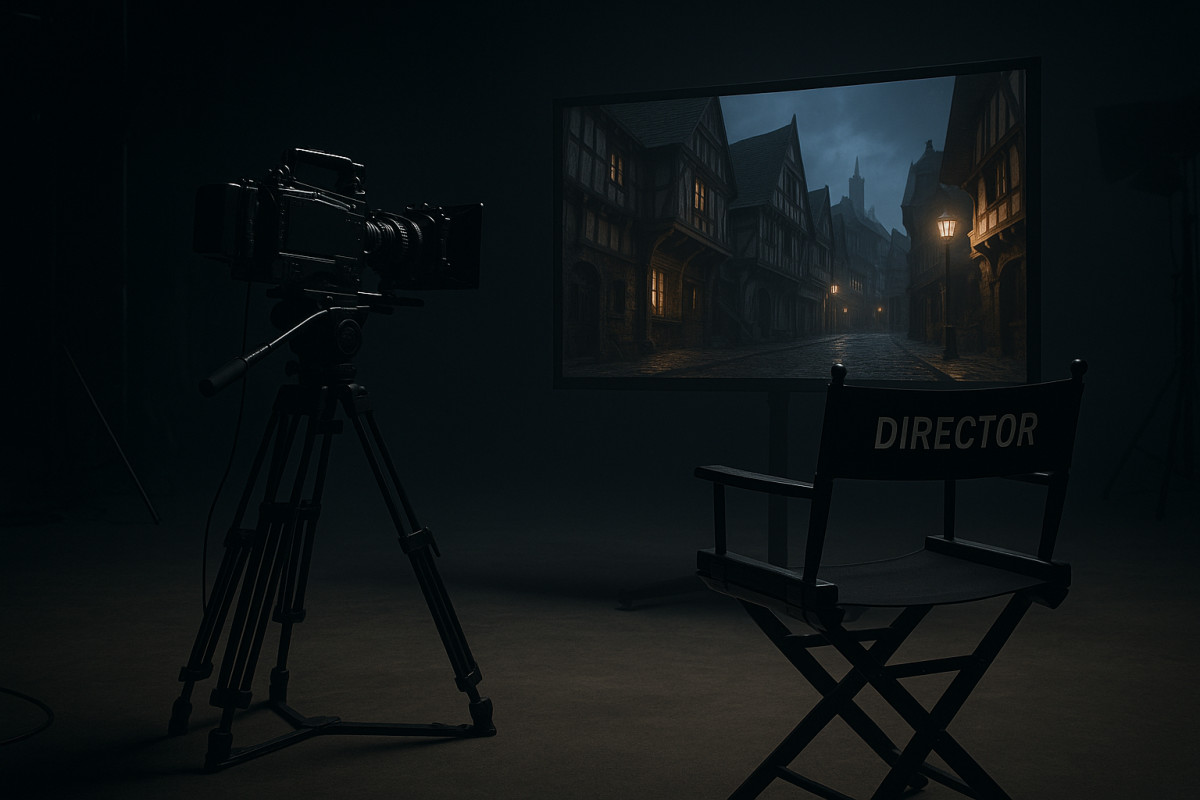
The great directors surely did not imagine that a day would come when typing a simple paragraph would lead to the creation of an entire film, not far from the one they had created over the years: what until a few months ago resembled science fantasy became an everyday working tool. Google, OpenAI and Chinese suppliers are launching models that produce short videos in minutes that look like live photography. The generative video is already integrated in advertisements, in political campaigns, in professional trainings and even in personal content that the users upload to the networks.
A slight panic, but also great curiosity, accompanies the appearance of the new tools. Prof. Ofer Hadar from the School of Electrical and Computer Engineering at Ben Gurion University of the Negev is one of Israel’s most prominent researchers in artificial intelligence, and he recognizes the magnitude of the revolution. According to him, for the first time in the history of the media, it is possible to create a full video from only a verbal description. “What we are seeing now is a radical change,” he says. “You can write a short sentence and the computer already understands how to build an entire scene from it that looks real.”
For the non-computer science reader, the generative video production process may sound mysterious. But in fact the underlying mechanism is simple to understand, even if complex to execute. The model takes a sentence like a girl running on the beach at sunset and breaks it down into thousands of tiny numerical units that represent the meaning of each word. The system knows what a girl looks like, what continuous movement is, what a beach looks like, how light changes in the evening and how a camera follows an object.
In practice, the creative process actually starts with absolute noise, like an old TV screen showing snow. The model cleans noise particles at each step and adjusts them to match the textual description. Unlike previous image processing technologies, here existing images are not stitched together. The system builds the scene from scratch. She also does this over time, not separate frames, so she understands continuity between movement and continuity. That’s why the new intelligence videos look like live photography and not like computer animation.
Prof. Hadar emphasizes that the revolution is not limited to creative talent. It challenges fundamentals of human discernment. In studies he carried out with colleagues in Germany, it was found that artificial intelligence systems identified video fakes with absolute 100 percent accuracy, while humans only recognized some of the fakes. “Artificial intelligence already understands subtleties of faces, lighting and movement at a level that surpasses human vision,” he explains. “This creates a situation where it is very difficult to know what is real and what is created inside a computer.”
The meaning is especially profound in an era where video distribution is done at the click of a button on any social network. The possibility of producing a person who says things he never said raises real public concern. “We are entering a reality where a scene can look completely authentic even though it never existed” says Hadar. “The main challenge for the states is to create a framework that protects public trust.”
The question of whether countries will have to intervene in the regulation of generative video is no longer theoretical. Prof. Hadar is convinced that this is inevitable. “We will not stop the technology, it is too strong” he says. “But we will need a clear marking of generative content, rules of consent, protection of privacy, and strong mechanisms that prevent manipulation.”
According to him, there are three immediate danger points. The first is public trust. Without permanent tagging of AI-generated videos, it will be impossible to distinguish between real documentation and a made-up scene. The second is to protect people from defamatory falsification of their image. The third is copyright protection at a time when artificial algorithms are able to copy the artistic style of a human painter with almost absolute accuracy.
In the research he is leading in collaboration with the Department of Arts at Ben Gurion University, mechanisms are currently being developed that distinguish between a work that was inspired and a deep imitation of a style. The goal is to allow free creation but to keep human artists. “Artificial intelligence not only creates new images,” Hadar explains, “it is capable of accurately imitating brushstrokes. There is a deep legal and economic question here.”
The growing power of generative models raises deep concerns in the production industry. As the tools improve, the traditional roles of photographers, set designers, lighting people, make-up artists and even actors may shrink. A process that once required weeks, large teams and a huge budget, may be carried out within hours and involve a limited number of prompt experts.
And yet, Prof. Hadar emphasizes that history teaches otherwise. “In every technological revolution new professions appeared” he says. “We will see fewer technical positions, but more positions that combine creativity with technological understanding.” According to him, in the future the producers will also have prompt designers, multidisciplinary editors and quality experts who will be able to check the physical tracking of movement or the level of hallucinations.
The implications go beyond the creative industry. Without the ability to identify anomalies in the content that is produced, it will be difficult to ensure that the public receives reliable information. Therefore, in laboratories around the world, and especially in Hadar’s research, methods for measuring the quality of generative video are currently being tested. The classical indices, which were based on matching between pixels, correspond to the era when the image was reproduced from the original. But in today’s age, video is invented, and the test should focus on the ability of the scene to be stable, continuous and free of distortions.
Valdi Shevtsov, thirty years old from Haifa, became within months one of the prominent creators of the new wave. He began experimenting with artificial intelligence tools out of technical curiosity and gradually realized that he could build videos that looked like cinematic scenes.
According to him, the great advantage of a model like Sura is actually its imperfection. “There is something more natural in its lack of smoothness” he explains. “The other models create figures that look like mannequins. In Sura, it looks more like a real photograph.” The cost is high and he is required to have a Pro account, but according to him the quality justifies the investment.
Shevtsov describes how the craft of creation is changing. Instead of long shooting days, he sits in front of the screen, formulates precise prompts, checks sequences and composes scenes. “It requires a lot of trial and error, but today almost anyone can learn it,” he says. “The most amazing thing is that it’s already possible to lip sync to Hebrew. It’s not perfect, but it’s getting close.”
Today the models can only produce short video episodes. But the experts in the field are sure that the length restriction will disappear in a short time. Shavtsov estimates that within six months models will appear who are able to produce videos of one or two minutes. Prof. Hadar goes further. According to him, the next generations of technology will not be based on video that is stored in a heavy file. Instead, a short semantic description will be sent to the viewer and his screen will produce the movie in real time.
“The transition will be from pixel compression to meaning compression,” he explains. “Television will build the scene at home. The viewer will be able to change characters, design the plot and even insert themselves into the film. These tools can hurt, but they can also empower. Whoever learns to use them will be able to lead the content world of the next decade. This is not the end of human creation, but the beginning of a new era where technology and human imagination work together.”
His Tiktok page moves between two worlds that he connects naturally. One is practical mathematics that is hidden within our lives, phenomena that most of us are familiar with but do not know that they have an exact numerical explanation. The second is learning about learning, observing the process in which a person faces a new challenge, with small successes and less simple moments. This is also where juggling comes in, a field he has been teaching since the age of 15 and serves as a living tool for learning, practicing concentration and understanding patterns.
Margalit says that he chooses the topics according to his personal wow moments, ones that make him stop and tell himself that it’s just cool. His motto is to stimulate active learning, to show that even within a short video it is possible to discover something new, relevant and sometimes even surprising about the world around us.
Are you still studying for the tests just by reading the summaries? It’s time to step into the AI revolution, and Google’s NotebookLM is doing it in a big way. This is one of the most innovative tools created for personal learning. Instead of sitting in front of long pages of material, you upload the document to the system and let it do the heavy lifting for you. The tool summarizes, sharpens concepts, generates repeat questions and also allows you to have a conversation with the material that will break down any complex topic into simple and clear ideas.
One of the impressive features is the production of a personal study podcast. The system creates a conversation between two speakers who explain the topic you raised, ask questions, offer examples and highlight the main points. It is a perfect solution for those who want to study on the road, by bus or while walking.
Another feature is the automatic creation of spectacular infographics: NotebookLM locates the key points, transfers them to a clear graphic, and makes it possible to understand processes, comparisons and structures in an intuitive and fast way. In other words, Google allows you for the first time to turn your summaries or boring book into something alive that you can talk to. You can ask for a simple formulation, examples, practice before a test, an understanding test or an in-depth explanation of a certain part. The tool is especially suitable for students, medical professionals, lecturers, and anyone who has to deal with information overload in a short time.
https://najlepszedywany.pl/skad-sie-bierze-efekt-deptanego-sladu-na-dywanie-prosta-ciekawostka/
https://toplistle.livepositively.com/how-high-elevation-impacts-gas-pressure-tests/
https://dynisco.com.pl/setgarden-poduszki-ogrodowe
https://najlepszedywany.pl/jak-dywany-mierzy-sie-na-metry-skoro-kazdy-ma-inny-ksztalt/
https://pieknedywany.com.pl/dywan-ktory-rosnie-z-dzieckiem/
https://najlepszedywany.pl/dlaczego-dywany-zawsze-wygladaja-inaczej-w-sklepie-niz-w-domu-2/
https://wiseintro.co/how-long-do-gas-pressure-tests-take?
http://internetesotthonimunka.network.hu/forumtema/befizetes-nelkuli-bonuszok-hogyan-mukodnek-es-kinek-ajanlottak
https://www.linkedin.com/pulse/why-does-certification-reshape-public-trust-gas-mohamed-fareed-r4ume/
https://www.intensedebate.com/people/autonomosegurom
https://www.behance.net/gallery/240272649/Are-You-Risking-Safety-With-Unsafe-Gas-Repairs
https://najlepszedywany.pl/czy-dywan-moze-ocieplic-pokoj-nawet-bez-ogrzewania/
https://devpost.com/shah-in-san-a-y9-9
https://doodleordie.com/profile/adeslasautnomo
https://docs.sgoncalves.tec.br/s/1x65nOH2q
https://fkb.org.pl/setgarden-poduszki-ogrodowe
https://www.jjp.org.pl/setgarden-poduszki-ogrodowe
http://www.adaptacje-domow.pl/
http://pc-mazsik.network.hu/forumtema/a-befizetes-nelkuli-porgetesek-okos-felhasznalasa
https://inetchoices.mystrikingly.com/blog/which-fields-depend-oncertified-gas-operators-today
https://hackmd.io/@TJjVMDavQjamwKkaRt05IA/how-do-detection-methods-shift-between-city-zones-and-rural-grounds
https://najlepszedywany.pl/czy-dywany-naprawde-tlumia-halas-czy-to-tylko-mit/
https://zomis.pl/setgarden-poduszki-ogrodowe
https://stackerdsuprt.gitbook.io/itsview/why-do-operators-track-odorant-strength-during-leak-detection