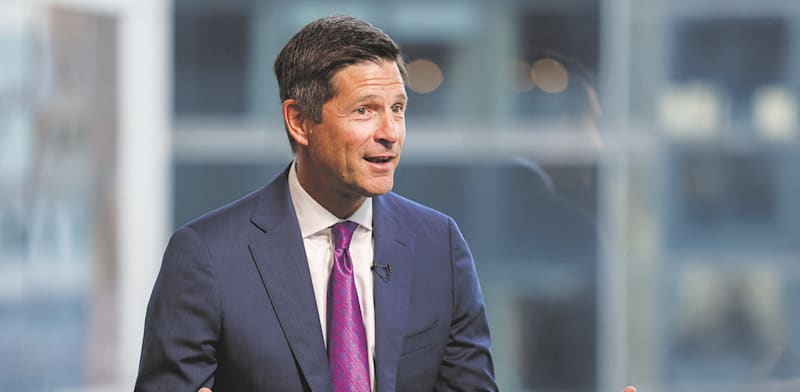
When it comes to whether to encourage clients to invest for the long term or take the fast lane, Rick Wurster knows well where his brokerage firm stands. And he’s not on the side of the man dressed as a race car driver (cue the Robinhood CEO).
Worcester, who was appointed CEO by Charles Schwab last January, has posted higher profits this year, thanks to increased confidence among private investors who trade everything from stocks and bonds to options and exchange-traded funds (ETFs).
A prolonged rally led some ordinary Americans to more dangerous and volatile markets. Today, investors can make leveraged transactions in cryptocurrencies, buy zero-day-to-expiry options, and bet on whether the Kansas City Chiefs will win a football game. These offers, and many others, are now widely available on major brokerage platforms.
Wall Street has long grappled with the question of what defines a prudent investment and what should be labeled a bold bet. Technological advances and changes in customer tastes may have made it difficult for some investors to distinguish between the two, but Wurster says he sees no ambiguity here.
“There is a very clear line between investing and gambling,” Vorster said in a comprehensive interview with the Wall Street Journal. “I’m really worried about the message being sent to young investors – that quick profits should be made.”
Robinhood CEO Vlad Tanev has become one of the most persuasive speakers for young investors. At the company’s annual conference for active traders earlier this year, Tanev compared trading in the markets to laps on a race track, where “the machine can make all the difference.” Trading, he said, is “high-risk,” and “one of the most intense lifestyles out there.” To illustrate his point, Tanev wore a racing driver’s jumpsuit on which Robinhood logo emblazoned.
On Robinhood’s platform, investors can participate in prediction markets, trade dozens of cryptocurrencies — and over the next year, even scroll through an in-app social network feed. Schwab does not offer event contracts (financial instruments that allow you to trade on the results of future events such as sports games or elections), has not launched spot trading in crypto, and recently invested precisely in a much older component of financial technology: its network of branches.
“We won’t always be in a bull market”
Worcester, a former McKinsey consultant who joined Schwab in 2016, prefers traditional business suits, like the gray one he wore in the Journal interview. “You won’t see me in a Formula One suit, and the reason for that is that I think it sends the wrong message to young investors,” he said. “Comparing investments to a race teaches the young investor that he must win today, must be fast, and if the stock does not rise today – then something is wrong.” According to him, this could be a real risk for those investors if and when the stock markets go down. “We’re not always going to be in a strong three-year bull market,” he said.
On the other hand, Robinhood managers claim that they are on the right side of a long-term trend in the markets, which aims to make all types of trading accessible to private investors. “I’m old enough to remember that when ETFs first came out, they were considered super-risky products,” said Steve Quirk, director of brokerage Robinhood, in an interview last month, referring to the low-cost funds that now dominate the asset management industry. “We are expanding the variety of assets and capabilities we offer to the public. This is what they want.”
The bull market may still be in full swing, but in the brokerage industry the battle lines have already been drawn. Schwab, which was a pioneer in the field of low-cost brokerage in the 1970s, is now part of the establishment that leads with wealth management, investment advice and banking services. On the other hand, young platforms like Robinhood are breaking into new markets that appeal to a new generation of risk-hungry customers.
Schwab’s bet: Will they attract the young?
Trillions of dollars are at stake, Generation Z and the Millennials are expected to inherit more than 100 trillion dollars of the assets of the Baby Boomer generation in the coming decades, according to the Merrill Company, a phenomenon known as the “Great Wealth Transfer”.
In implementing his strategy, Wurster is making his own bet: Many of the younger investors, who today may be enamored with short-term gains, will eventually mature into the banking services, face-to-face financial advice and other services that are Schwab’s hallmark. And as market conditions change, they’ll be less interested in getting early access to the hottest deals, or having the CEO of their brokerage platform respond to their posts on Network X (formerly Twitter).
But here lies the difficulty: the new generation of traders may begin to see prediction markets or cryptocurrencies as core services, similar to how their parents or grandfathers saw commission-free stock trading or cheap mutual funds, as basic services they expect a broker to offer.
Vorster says that Schwab is already “tearing up the market” among young investors, noting that the average new client is still in his 30s, and a third of them are younger than 24. Schwab remains a bigger player than Robinhood, with a market value of about $170 billion as of Friday (compared to about $106 billion for Robinhood). Schwab’s average daily transaction volume ranges from 7 to 8 million dollars; Robinhood and other competitors like Interactive Brokers are closer to 4 or 5 million.
However, Worcester chooses to avoid the business domain that has put Robinhood in a position where it can close the gap. Monthly trading volumes on prediction market exchanges have become more central and have quadrupled in recent months, according to a team of analysts at Piper Sandler. Robinhood, which has a partnership with the Kalshi prediction exchange, said event contracts are its fastest growing line of business ever. Charles “Chuck” Schwab himself was an early investor in Kelsey’s A round.
“I have no problem with gambling”
Will Worcester ever reconsider his stance on event contracts? “It’s not high on our list right now. If we find that prediction markets become a competitive necessity in the brokerage space … that’s something we’ll have to consider clearly,” he said, but added that Schwab isn’t hearing much interest from clients. “The blacksmith is still really in the sport.”
Not that Worcester has a problem with sports. The CEO was the captain of his golf team in college, and coached his son’s basketball, baseball and football teams. Nor is he ideologically opposed to gambling: “I have nothing against sports betting,” he said. “I just don’t want people to think it’s the route to financial success.”
A turbulent bull market now makes it difficult to see the benefits of choosing another path. But Worcester says he’s playing the game for the long haul. “This is what sets us apart and what will continue to set us apart,” he said. “Especially if and when the markets may not continue to rise in a straight line every year.”
For your attention: The Globes system strives for a diverse, relevant and respectful discourse in accordance with the code of ethics that appears in the trust report according to which we operate. Expressions of violence, racism, incitement or any other inappropriate discourse are filtered out automatically and will not be published on the site.