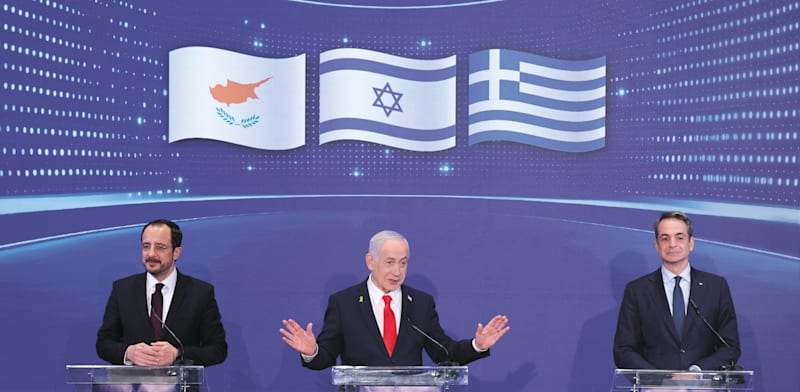
Israel, Greece and Cyprus intend to start laying the submarine power cables as early as 2026 as part of the Interconnector project. This, after Prime Minister Benjamin Netanyahu hosted Greek Prime Minister Kyriakos Mitsotakis and Cypriot President Nikos Christodoulidis in Jerusalem this week for a tripartite summit, where they emphasized the need for strategic cooperation in the face of threats in the Eastern Mediterranean. The funding issue is the main issue that still remains open. This is what a senior official in Greece tells Globes: “This will be the big project of next year. In Israel they attach great importance to him – and so do we.”
● Dissatisfied: the reactions in Turkey to the meeting between Israel, Greece and Cyprus
● The American decision that raises concerns about the Elbit deal with Greece
The project aims to connect the electricity grids of Israel and Cyprus by means of a submarine cable with a length of about 330 km, and enable mutual feeding with a power of up to 2,000 megawatts, about a tenth of Israel’s production capacity. At the same time, the project includes another connection by means of a cable from Cyprus to Crete in Greece, over a distance of about 900 km. “We will move forward with both cables at the same time,” says the Greek official. “The section between Israel and Cyprus is expected to be completed sooner, due to its relatively short length.”
Islands of geopolitical disputes
Although all parties are interested in promoting the project, the main obstacle facing it is the common threat from Turkey. Ankara is at odds with most countries in the region regarding the limits of the economic waters (EEZ) in the Eastern Mediterranean, primarily because Turkey is not a signatory to the Convention on the Continental Shelf and the UN Convention on the Law of the Sea (UNCLOS).
While the prevailing view in the international community holds that islands are independent units entitled to a continental shelf and territorial waters of up to 12 nautical miles, Turkey sees the Greek islands as a direct continuation. According to them, earthquakes caused water to enter between the mainland and the islands, including Cyprus. These differences in perception actually led to a sort of compromise, according to which each island is currently entitled to only six nautical miles.
Another issue concerns the status of Cyprus. Following a Greek-nationalist military coup in 1974, Turkey invaded Cyprus. The move led to the establishment of the Turkish Republic of Northern Cyprus in 1983 – a de facto entity recognized only by Ankara. Based on this recognition, Turkey claims economic water rights on behalf of Northern Cyprus. In the meantime, Ankara has recently expressed strong opposition to the ratification of the maritime border agreement between the Republic of Cyprus and Lebanon, and is even holding talks to form a Turkish-Syrian maritime border agreement with Ahmed al-Shara, the president of Syria supported by Erdogan. A senior Cypriot states that the project fits into the IMEC corridor, which is designed to connect energy, communication and transportation infrastructures from India to Europe through the United Arab Emirates, Saudi Arabia, Jordan and Israel.
For Cyprus, whose electricity prices are among the highest in the European Union, this is also an economic opportunity. Turkey, which was not included in the corridor when it was introduced in September 2023 due to the refusal of Indian Prime Minister Narendra Modi, expresses similar opposition to the interconnector project, which it claims ignores its demands for economic water.
Recep Tayyip Erdogan, President of Turkey / photo: ap, Achmad Ibrahim
Erdogan’s blue homeland
Turkish aggression is not only expressed in statements, but also in actions. As published in Globes, Greece tried to make progress this year and even declared a closed maritime zone for the purpose of starting the deployment of cables in the area of the islands of Kasos and Karpathos, between Rhodes and Crete. However, on April 12, Athens decided to postpone the works – even though the Italian ship NG Worker was already ready for operation.
The Greeks understood from the messages from Ankara that if they advanced, the Turkish navy would cut the power cables – a step that would inevitably lead to escalation. Now, the three countries choose to look directly at Turkey and make it clear: the project will be launched jointly. This move is expected to place the President of Turkey Recep Tayyip Erdogan in an internal and not easy political trap, among other things against the background of the public pressure that has already led to the imposition of a trade embargo on Israel, which was exposed in Globes, and may put additional pressure on him to respond to the disregard of the borders of the economic waters as defined by Ankara.
Moreover, one of the cornerstones of the neo-Ottoman concept of Turkish President Recep Tayyip Erdogan is the “Blue Homeland” (Mavi Vatan) doctrine, according to which Turkey is entitled to extensive control over the maritime spaces of the eastern Mediterranean, the Aegean Sea and the Black Sea. It is not just about sovereignty over natural resources, but a broader strategic concept, according to which maritime control will allow Ankara to expand its influence to another regional circle, extending to the Red Sea and even the Persian Gulf. This perception was also reflected in Turkey’s recent announcement of its intention to drill for natural resources in the economic waters of Somalia, another patron state of Erdogan.
The topical connection to this move is sharpened by the tripartite summit that took place in Jerusalem. At the press conference after the meeting, Netanyahu delivered a sharp message: “For those who fantasize about establishing empires and ruling our lands – forget it. We are committed and capable of defending ourselves, and cooperation with partners strengthens these capabilities.”
The conflict with Turkey – will it start from the sea?
This background, and the distinct gap between Erdogan’s positions and the Israeli-Cypriot-Greek move, sharpens the need to tighten the security relationship between the three countries – including joint military exercises and foreign reports about the possibility of establishing a joint response force. Although these are only reports, they receive extensive coverage in the Turkish media. Another security aspect concerns the cyber space. The three leaders agreed on the establishment of an Israeli-Cypriot maritime cyber security center, with the encouragement of Greece and the hope that the US would also agree to the move. “We also want to attract regional players, private or public cyber companies,” explains the Cypriot official. The establishment of the center would not have been possible without a clear understanding of the existing threat.
In conclusion, although the Al-Sharia coup led to fear of a direct military conflict with Turkey in Syria, the threat posed by Erdogan in the maritime space leads to further developments. With the progress in the interconnector project, while ignoring Ankara, the direct conflict may actually start from the sea – where Turkey has a significant quantitative advantage against all the countries of the region.
The Ministry of Energy responded: “The Ministry of Energy and Infrastructure continues to promote the project together with the partner countries – Greece and Cyprus. The project is currently in the construction phase in the section between Greece and Cyprus and in the formulation of the conditions in the section between Israel and Cyprus. The timetables will depend on the progress of the project and the conditions that will be established between the countries.”
For your attention: The Globes system strives for a diverse, relevant and respectful discourse in accordance with the code of ethics that appears in the trust report according to which we operate. Expressions of violence, racism, incitement or any other inappropriate discourse are filtered out automatically and will not be published on the site.
https://DesPlaineslandscaping.us/yard-clean-up
https://DownersGrovelandscaping.us/gardening/brush-removal
https://DownersGrovelandscaping.us/gardening/flower-bed-maintenance
https://DownersGrovelandscaping.us/gardening/flower-planting
https://DownersGrovelandscaping.us/gardening/hedging
https://DownersGrovelandscaping.us/gardening/mulching
https://DownersGrovelandscaping.us/gardening/plant-removal
https://DownersGrovelandscaping.us/gardening/pruning
https://DownersGrovelandscaping.us/gardening/weeding
https://DownersGrovelandscaping.us/gardening
https://DownersGrovelandscaping.us/lawn-care/artificial-grass-installation
https://DownersGrovelandscaping.us/lawn-care/dethatching-lawn
https://DownersGrovelandscaping.us/lawn-care/fertilizing-lawn
https://DownersGrovelandscaping.us/lawn-care/hydroseeding
https://DownersGrovelandscaping.us/lawn-care/lawn-aeration
https://DownersGrovelandscaping.us/lawn-care/lawn-edging
https://DownersGrovelandscaping.us/lawn-care/lawn-grubs-control
https://DownersGrovelandscaping.us/lawn-care/lawn-installation
https://DownersGrovelandscaping.us/lawn-care/lawn-leveling
https://DownersGrovelandscaping.us/lawn-care/lawn-mowing
https://DownersGrovelandscaping.us/lawn-care/lawn-renovation
https://DownersGrovelandscaping.us/lawn-care/lawn-seeding
https://DownersGrovelandscaping.us/lawn-care/sod-installation
https://DownersGrovelandscaping.us/lawn-care/weed-control
https://DownersGrovelandscaping.us/lawn-care