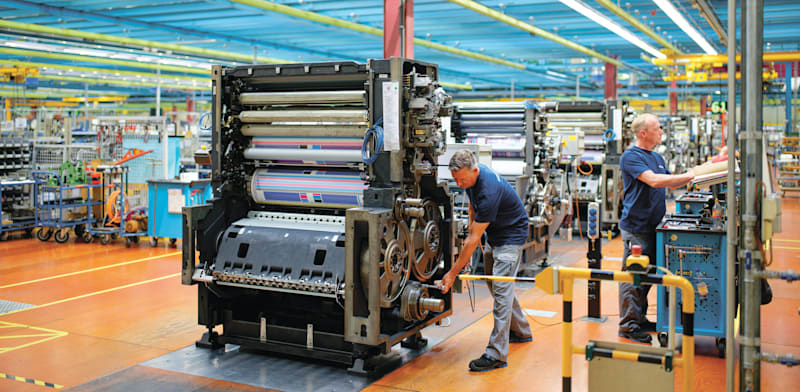
All over Germany, railroad car factories are being converted to build military vehicles, auto suppliers are joining defense contractors, and ex-soldiers are suddenly in high demand on the job market.
With Berlin pledging to spend more than half a trillion dollars on defense over the next decade, manufacturers facing stubborn economic stagnation and declining exports to the US and China are rushing to reinvent themselves as military suppliers.
The number of members in the main trade body for the German defense sector has almost doubled in the past year. Many new members come from civic-oriented sectors, and especially from the automotive industry, says Peter Shaban, the union’s spokesman in Berlin.
The defense industry is “probably not the first use case that comes to mind when you think of food,” says Hendrik Suzmihl, CEO of goodBytz, a Hamburg-based maker of automated kitchens. Suzmihl is now making a sharp turn into the defense sector. He recently supplied an autonomous robotic kitchen to the US military in South Korea, and he is discussing supply options to all major NATO member states. He predicts that the defense sector will will provide a third of his future income.
In the transition to the security sector lie critical advantages: an abundance of government money and protection against Chinese competitors who sell cheaply. Against the backdrop of growing hostility from the US and a growing threat from Russia, Germany plans to almost triple its annual military spending in the coming years, to about $180 billion in 2029.
An increase in military spending
The wave of spending is already evident in the economic data. German industrial production for October showed significant increases in sectors targeting military spending, said Holger Schmiding, chief economist at Berenberg Bank. These increases helped offset, and more importantly, the declines in other industries, which are considered pillars of German industry, such as vehicles and chemicals.
For Germany’s struggling manufacturing sector, it’s a godsend, having shrunk steadily for seven years due to high energy prices, aggressive competition from China and US tariffs. Economists hope that some of this capital will be invested in research and development, driving Germany’s productivity growth and leading to the establishment of start-ups and exports in new fields – just as government money helped sow the seeds of Silicon Valley in the US.
“Defense spending is so large that it will really change the rules of the game in terms of basic research and military-applied research,” said Gunter Wolff, professor of economics at the Free University of Brussels.
This is a significant change for Europe’s largest economy, but it also has its drawbacks. Economists say the export potential in the defense industry is limited – since it is forbidden to sell to China, and the US has a buying strategy focused on American products – and productivity growth is weak in parts of the sector.
Military investments generally benefit the economy as a whole less than spending on machinery or infrastructure, because weapons sit in warehouses or are destroyed and have no productive use.
In the southern German university city of Heidelberg, Michael Wallenson, chief executive of printing machine maker Heidelberger Druckmaschinen, is looking for ways to employ hundreds of engineers as demand for the company’s traditional products declines.
His plan is to establish a defense business focused on autonomous ground vehicles and energy systems, with a target of approximately 100 million euros in annual revenues, an amount equivalent to approximately 117 million dollars, for the business sector that includes defense, which will be produced mainly in Germany. “We don’t need to hire more workers … we can do everything with the people here,” said Walenzon.
Other large industrial companies are making similar moves, leveraging their expertise in large-scale construction and managing complex global supply chains. This new demand is helping to offset the loss of jobs in the auto sector, which has reached about 112,000 since 2019, according to Ernst & Young.
Schaeffler, a major German auto supplier, recently signed a deal with Munich-based defense startup Helsing to help ramp up drone production. They intend to produce 10,000 to 20,000 drones per year, with the capacity to increase the quantity to 100,000 in the event of a crisis.
Trumpf, a large mechanical engineering group based in southwestern Germany, announced in October that it would use its expertise in lasers to build defense systems against drones, teaming up with a local electronics group.
This change is not as controversial today as it was in the past in a country with a strong tradition of pacifism after World War II. Most Germans support increasing military spending, even if some are worried about the possibility that this trend could make the country a target, according to Timo Graf, a sociologist at the Center for Military History and Social Sciences of the Bundeswehr (German army) in Potsdam.
Friedrich Mertz, Chancellor of Germany / photo: ap, Ebrahim Noroozi
Looking for military experience
Martin Bergerhausen, who deals with the placement of workers in Hamburg, is currently looking for a project manager with artillery experience to work for a large defense contractor in Munich. The salary, which ranges from 90,000 to 120,000 euros, is similar to that of similar positions in the automotive industry, he said. A large consulting firm recently approached Bergerhausen and was looking for several people with military experience to work on a procurement project.
The growth of the defense industry is a return to Germany’s past. Beginning in the early 19th century, German industrialization was closely linked to the country’s arms industry. The steel manufacturer Krupp, founded in 1811, was the largest industrial company in Europe for much of the late 19th and early 20th centuries. It became synonymous with German military power, producing the “Big Bertha” cannon during World War I, and later built tanks and submarine components for the Nazis.
Germany’s defense industry was completely dismantled after World War II, and military production was banned. But starting in the 1950s, Germany began to slowly rebuild its military and defense industry with the support of the United States, serving as a sort of protective wall against the Soviet Union. “Germany, in a sense, is returning to its old form,” says Graf, the sociologist.
At the White House discussion on Germany’s rearmament plans in June, with Chancellor Friedrich Mertz, President Trump expressed some reservations regarding Germany’s rapid rearmament.
“I’m not sure that General (Douglas) MacArthur (a senior US military officer during World War II) would have said that it was positive,” Trump joked. “I think it’s a good thing — but, you know, up to a point. There will be a point where I’ll say, ‘Please don’t arm yourself anymore, if you don’t care.'”
For your attention: The Globes system strives for a diverse, relevant and respectful discourse in accordance with the code of ethics that appears in the trust report according to which we operate. Expressions of violence, racism, incitement or any other inappropriate discourse are filtered out automatically and will not be published on the site.
https://forums.botanicalgarden.ubc.ca/members/mick-mctominay.80598/
https://peatix.com/user/28469822/view
https://craigslistdirectory.net/Glasgow-Roofmasters_442562.html
https://www.ultimate-guitar.com/u/mickmctominay
https://writexo.com/share/28de1c96516d
https://imageshack.com/user/mickmctominay
https://pastebin.com/u/mickmctominay
https://letterboxd.com/mickmctominay/
https://webdigitalonline.com/page/business-services/glasgow-roofmasters
https://startupxplore.com/en/person/mick-mctominay
https://opencollective.com/glasgow-roofmasters
https://www.n2local.com/us/ca/glasgow/services+offered/other/20251222082744at3aovyge1h
https://www.classifiedads.com/home_services_stores/zx8zxlhwp3dx9
https://friendpaste.com/4VgKV6iXfPzhZf2rfMWnS3
https://addirectory.org/details.php?id=465598
https://johnnylist.org/Glasgow-Roofmasters_321155.html
https://deeply-slash-195.notion.site/Attorney-Mortgage-Guide-How-Lawyers-Secure-Better-Home-Loans-2c72c177db3780708bb2ec32e3c4510e?source=copy_link
https://medium.com/@dhbgjdv/attorney-mortgage-programs-designed-specifically-for-legal-professionals-f09a3fbcf096
https://share.evernote.com/note/050ff849-9b55-9d07-0458-374537654ea6
https://demo.jcow.net/blogs/viewstory/95677
https://attorneymortgage7.wordpress.com/2025/12/12/how-attorney-mortgage-loans-help-lawyers-buy-homes-faster/
https://notebook.zohopublic.com/public/notes/zliyfad41faf00d80433b99de5a87634cd8b4
https://penzu.com/p/8853d496e021b517
https://www.tumblr.com/attorneymortgage/802751579966128128/attorney-mortgage-secrets-to-getting-approved-with?source=share
https://www.diigo.com/item/note/bpog9/j5x1?k=bd3d257fb2ea50c6f6f35bda5cd4e021