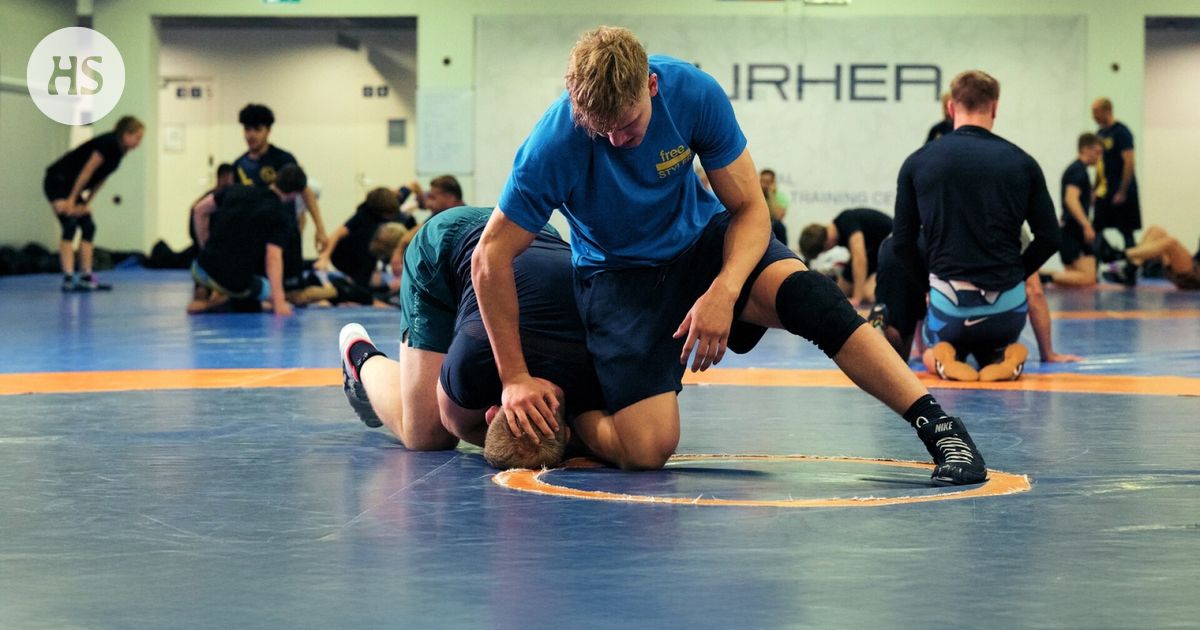
Helsinki Painimieht sets records in the number of enthusiasts and competitors. How did wrestling become pop in the capital?
Wrestler knows another by appearance.
Came to Finland from Ukraine as a refugee in the summer of 2022 Viktor Kara was in Helsinki’s Urhea hall watching her little sister’s gymnastics exercises. He saw a man there with cauliflower ears and asked him how to get into wrestling.
Kara was 12 years old at the time and had started wrestling a few months earlier in her hometown of Odessa. The cauliflower-eared man advised Kara to the Helsinki Wrestlers’ training.
Now Kara, from Espoo, is a European Championship bronze medalist in under-15 freestyle wrestling and guides children’s wrestling exercises in the Urhea hall in fluent Finnish.
Kara’s story combines two major changes in Finnish wrestling in recent years: the sport attracts a lot of immigrants, and its focus has shifted from South Ostrobothnia to the capital region.
Above all, behind the latter change is one man, a physical education teacher from Helsinki Hannu Rantala63. Under his leadership, Helsinki Painimiehi has become the largest wrestling club in Finland with 500 enthusiasts. 215 of them have participated in the competitions this year. The figure is reportedly a Finnish record for one club.
Behind the huge growth in recent years was one bold decision in particular.
Children between the ages of 7 and 10 learn the basics of two forms of wrestling at Helsinki Painimieste wrestling school.
Viktor Kara is a European Championship bronze medalist in freestyle wrestling under the age of 15 and one of the instructors of the Helsinki Painimies.
Hannu Rantala, 63, has dedicated more than half of his life to the Helsinki Wrestlers.
Hand Rantala doesn’t have cauliflower ears, but there’s still no mistaking her species. The muscular shoulders stretch the t-shirt, the posture is slightly bent forward, the thick hands hang in front of the waist as if ready to grab the opponent.
Rantala started wrestling in the 70s in his home town of Teuva, in the middle of Ostrobothnia’s wrestling zone. At Teuvan Rivaka’s gym, the focus was on freestyle wrestling, which is the more popular of the two Olympic wrestling forms in the world, but in Finland it is overshadowed by Greco-Roman wrestling.
Rantala won five Finnish championships in freestyle wrestling and represented Finland twice at the European Championships. He moved to Helsinki after getting a job as a physical education teacher at Töölö Cooperative School.
When Rantala ended his own competitive career at the age of 27, he was lured to become the head coach of Helsinki Painimiehi, or HPM.
“At that time there were five wrestlers in HPM”, Rantala remembers.
A young physical education teacher founded groups of young children in the club, which began to attract enthusiasts.
“I got along well with children, and success started to come in the little boys’ competitions, so the crowd gradually increased,” says Rantala.
In 1996, HPM already had almost 200 enthusiasts. It made the club the biggest wrestling club in Finland, but the real explosion was seen a few years ago.
Helsingin Painimieht is by far the best club in freestyle wrestling in Finland.
Wrestling has established a reputation as a versatile sport for young children.
Women’s wrestling has also grown enormously, there are about 50 female wrestlers in the club.
Urhea hall graduated from Helsinki Vallila in 2021. In addition to many other sports, the hall also has the opportunity to practice wrestling. Two molski offers excellent facilities.
During the day, the wrestling facilities are used by the sports academy and national team athletes, but Urhea wanted to rent the evenings and weekends to one wrestling club.
Helsinki Painimieht accepted the offer. It was a risk for the club, because according to Rantala, the annual rent is 140,000 euros.
“We had to go straight to founding new groups and marketing them,” says Rantala.
The new facilities attracted enthusiasts. Brand new innovations were the adult wrestling course and fitness wrestling. Women’s wrestling has also grown enormously, there are about 50 female wrestlers in the club.
Now you can already say that the risk was worth it. HPM has managed to fill almost all the shifts it manages and is able to pay the rent with practice fees. There are still training groups in the club’s old premises in Myllypuro and Maunula.
On a weekday evening after 5 o’clock there is a teddy bear wrestling group in Urhea’s second molsk, where children aged 2–4 compete with their parents.
Behind the lowered curtain, 7-10-year-old wrestling school students are training on another molsk, some of whom have already been to Tähtipainei.
Tähtpainit is an event organized by HPM for decades. You can enter low-threshold competitions even if you don’t even own a wrestling suit. The sets are divided so that beginners do not wrestle against veterans.
Records have also been set in Tähtipainei. There were 151 wrestlers in the September competition. Even when divided into three groups, the group of competitors and their guardians was so large that Urhea’s fire safety regulations were put to the test.
It shows that wrestling has an attraction in the entire capital region, not only in HPM. For example, Haka in Helsinki, Sampo in Vantaa and Urheilijat in Espoo are strong, vibrant clubs.
“Wrestling is coming back to the cities, where it actually started in Finland,” Rantala points out.
Wrestling is returning to the cities, where it actually started in Finland.
Pasi Sarkkinen, executive director of the wrestling association.
The executive director of the Wrestling Association has noticed the same Pasi Sarkkinen. He also got a wrestling spark in his childhood in Ostrobothnia, but nowadays he makes an impact in Jyväskylä.
“Wrestling is a fairly inexpensive sport, both in terms of equipment and hobby fees. The versatility and growth of the sport has been brought to the fore,” Sarkkinen reflects on the reasons for the wrestling boom in cities.
According to Sarkkinen, the number of enthusiasts in traditional wrestling areas has decreased. The age groups have shrunk, and no new ones have been found to replace the departing drivers.
“In former strong wrestling venues such as Lappajärvi and Kauhajoki, the gyms have become very quiet.”
The center of top wrestling has also moved to Helsinki. Almost all national team wrestlers live in the capital region and train in Urhea every day before HPM’s shifts.
Hamza Meserbiev has been wrestling for a year.
Hamza Meserbiev has already had time to participate in Tähtipaine.
HPM: N at the wrestling school, one who has been wrestling for a year throws cartwheels and learns tricks among others Hamza Meserbiev. Father lives with Molski on the edge Rustam Meserbiev. He moved to Finland ten years ago from Chechnya.
“Freestyle wrestling is really good training. Freestyle wrestling is the same as chess. Fast, fast,” says Rustam Meserbiev.
Also Hamza’s big brother Gabriel14, wrestles at HPM. He participates in the training sessions for advanced competitive wrestlers that begin after wrestling school. A few women also participate in the exercises. Dzhabrail does not wrestle with them.
Freestyle wrestling is the same as chess. Quickly, quickly.
Cultural differences are sometimes visible in wrestling gyms. According to Painiliitto Sarkkinen, there are many wrestlers in Finland whose family originates from Chechnya, Dagestan or Iran. Wrestling is a big sport in these areas, and it’s passionately embraced.
“It’s exciting to see how different their mentality is towards children’s sports,” Sarkkinen puts it.
Helsinki Wrestlers previously had two training groups where coaching took place in Caucasian languages. One of the groups broke away in the summer to form its own club, which was named Freestyle Wrestling Legacy.
Rantala says that the training philosophies of the groups were different. Those who joined their own club wanted to invest in hard physical training already as children, while the coaches of Chechen background who stayed at HPM emphasize learning wrestling technique.
Hamza Meserbiev’s father, Rustam Meserbiev, who has been wrestling for a year, praises Hannu Rantala.
Although wrestling is doing well in the capital region and the number of competitors is increasing at the level of Finland as well, the number of participants in adult championships is far from peak years.
Last year, 1,235 Finnish wrestlers acquired a competition license. Only 170 of them were aged 18–35.
Last year, the largest age group was those born in 2013, i.e. 11-year-olds. At that age, the wave of wrestlers quitting starts.
“The age profile of enthusiasts is getting younger all the time, the drop out starts earlier every year,” says Sarkkinen.
In Finland, wrestling has become a form of exercise where parents take their young children with the idea of acquiring the skills to practice another sport. Only a few aim for the international top in the raw sport, and there is almost no prospect of becoming a professional.
The Helsinki Wrestlers have tried to tackle the problem. Monthly donors have been collected to support young wrestlers aiming for the top. In HPM, it has also been possible to get other sports to join wrestling.
“Football players in particular have been constantly coming,” says Rantala.
Sarkkinen regrets that, according to the general perception, you should start wrestling at a very young age if you want to succeed in it. He reminds that of the Finnish competition medals of the last decades Tuomo Karila and Marko Asell started wrestling at the age of 12, Rami Hietaniemi only at the age of 17.
– Once things start to flow, it becomes like its own child. He wants to take care of it as well as possible, Hannu Rantala says about his motivation for volunteer work.
Helsinki The growth of wrestlers doesn’t seem to stop. At the beginning of this year, the club was able to hire a full-time employee for the first time. Rantala dreams of expanding operations to new districts.
“The direction of Lauttasaari or the direction of Herttoniemi”, he ponders.
Although HPM’s growth is personified by Rantala, he has not done it alone. The club has 25 coaches. As the most important lesson for other clubs, he mentions finding “competent and bright” instructors.
“Whenever a group is without a coach, we think very carefully that we don’t just throw anyone in there. There has to be the best possible leader who always fits the situation,” says Rantala.
“Yes, we’ve also been lucky to have good instructors and leaders. That’s probably the biggest reason why the hobby continues a little longer.”
And where does Rantala himself get motivation for volunteer work?
“When we studied in Jyväskylä Jouni Ilomäki with, we decided that when we end our own wrestling career, we will start working at the grassroots level. Jouni went to Espoo’s Urheilijoi and I went to Painimiehi,” says Rantala.
That’s how it happened. Ilomäki also continues to work as the chairman and head coach of the Espoo Athletes’ wrestling division.
“Once things start going smoothly, it becomes like your own child. You want to take care of it as well as possible.”
Correction 24.12.2025 at 15:59: The name of the wrestling club in Vantaa is Vantaan Sampo and not Vantaan Salamat, as was written earlier in the story. Salamat is an athletics club.
Wrestling has established a reputation as a versatile sport for young children. Helsinki Painimieht markets its activities on social media.
https://blogfreely.net/sandratoilet5/prave-proc-se-prihlasit-do-prazske-autoskoly-muze-posilit-vasi-sebejistotu
https://postheaven.net/singkick0/prave-proc-se-zapsat-do-prazske-vzdelavaci-instituce-muze-posilit-vasi
https://canvas.instructure.com/eportfolios/4067072/entries/14339570
https://graph.org/Právě-proč-se-Přihlásit-do-pražské-Školy-řízení-může-Zvýšit-vaši-Sebejistotu-Odpovědně-za-Volantem-11-17
https://blom-andersen-3.technetbloggers.de/duvody-proc-se-registrovat-do-prazske-autoskoly-muze-posilit-vasi-duveru-v-sebe-za-riditky
https://rentry.co/t6agsfm6
https://md.chaosdorf.de/PJRtBPXiTJiLMODNp8YTeQ/
https://pads.jeito.nl/jJPErXmmQqOnQLfKjxoKCQ/
https://ginmartini.club/members/quartzspoon1/activity/127938/
https://hackmd.okfn.de/HDa-WJlYSh-xE3UMxvEhzA/
https://md.un-hack-bar.de/QOvF2ZTDTCasLaUAsBYUUg/
https://md.ctdo.de/wzQYITJRSeS1Zt-49UHOIA/
https://hedgedoc.eclair.ec-lyon.fr/BIiw2eXdRqaAj0Kx9z0kBg/
https://pad.karuka.tech/4AiLKC3wTrGEg5wOL0r2eg/
https://to-portal.com/post/355347_odborni-lektori-chapou-ze-kazdy-ucastnik-studuje-jinak-jsou-vzdelani-poznat-vase.html
https://firsturl.de/p0WN7J2
https://lovebookmark.win/story.php?title=ramcova-rizeni-kurzy#discuss
https://v.gd/eO6Q51
http://www.fxstat.com/en/user/profile/LucianadgLambert-723326
https://www.rvparking.com/user/504355
http://www.talkmarkets.com/member/BrandondgPierce
http://www.neighborhoodlink.com/people/LucianadgLambert
https://www.4shared.com/u/7eaZwuzU/bryansulli.html
https://www.stylemepretty.com/dashboard/AlfonsodgTodd
http://okprint.kz/user/chestjeans8/
http://pandora.nla.gov.au/external.html?link=https://www.autoskolanovovysocanska.cz/
https://vuf.minagricultura.gov.co/Lists/Informacin%20Servicios%20Web/DispForm.aspx?ID=12057918
https://writeablog.net/curranfischer2556/it-outsourcingova-spolecnost-v-praze-zvyste-efektivitu
https://blogfreely.net/bakerytuna7/it-outsourcingova-spolecnost-v-praze-zvyste-efektivitu-sveho-podnikani
https://postheaven.net/badgecost1/zjednoduste-sve-podnikani-s-it-servisni-spolecnosti-v-praze