HS in Jakarta|Uncontrolled use of water resources, unsustainable urban planning and climate change are so tightly intertwined that water threatens the future of the entire megacity.
Jakarta.
Jakarta, the capital of Indonesia, is sinking more than 20 centimeters a year due to excessive groundwater pumping and rising sea levels.
Tap water is not potable, so bottled drinking water is a necessity and takes up to 10 percent of income from low-income families.
The World Bank warns that not addressing water security could reduce Indonesia’s economic growth by more than 7 percent.
Indonesian the capital city and the metropolitan area of over 30 million inhabitants Jakarta is an extreme example of how water is both the condition of life and its biggest threat. The coast of North Jakarta sinks more than twenty centimeters a year. The reason is excessive groundwater pumping, the weight of the built environment and the compaction of soil layers, and at the same time the rising sea level.
But let’s go and see how people live side by side with water in the fishing village of Muara Angke in North Jakarta.
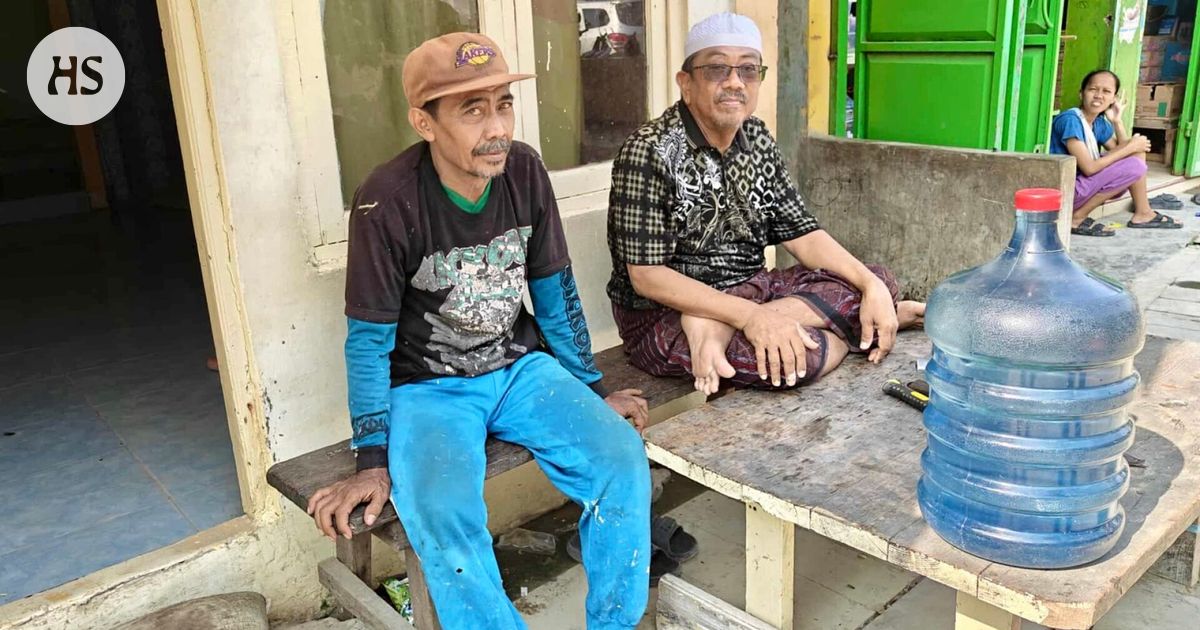
Muara Angke is the center of Jakarta’s traditional fishing. Fish have been auctioned there for centuries, and its renovated fish market is still a lively market place. Working in fishing boats and fishing harbors as a mixed laborer Suherman sits in front of his house ready to take job offers. Indeed, he only has one name, which is still a common custom in Indonesia.
Suherman has just ordered a 19-liter tank of drinking water from the local water supplier for home delivery, because tap water cannot be drunk. It is the cheapest and lowest quality on the market. If it were tested in Finland, it would be found to be undrinkable.
Higher quality watermarks cost more. For example, the country’s most popular gallon water, Aqua, already costs three times more. Suherman’s family of six uses a couple of gallons a day for drinking and cooking.
Bottled drinking water is a necessity in Jakarta – and a huge business. Indonesia is the world’s third largest bottled water market after the United States and China. However, the price of bottled water and water charges are prohibitive for many low-income families. If Suherman and his wife earned Jakarta’s minimum wage, water costs would take up about five percent of their income.
However, the income of most fishing families falls below that, so the share can rise to ten percent. While in Finland you can get clean water directly from the tap, in Jakarta it is an expensive commodity.
The Suherman family gets their water from their landlord’s borehole. However, the groundwater is polluted, and seawater mixes with it in coastal areas, so the wells have to be drilled deeper and deeper – according to Suherman, to a depth of more than 140 meters.
“The use of well water is still common in Jakarta, but it is limited and a water fee is charged for its use,” says the ESG director Arif Daranawho has previously worked as a water safety expert at the World Bank, among others.
According to Darana, deep and large-capacity boreholes require an environmental permit, but allowing shallow wells intended for domestic use is understandable until sufficient water supply is secured in other ways.
A water supply network has also been laid in Muara Angke, but it does not extend everywhere. Water is brought to some areas by tanker trucks.
Jakarta’s everyday life is built on an increasingly shaky foundation. Sunda Kelapa’s pinoc houses float on the water.
Bridge currently, the water supply network is estimated to cover about 60 percent of the city, and the goal is to reach 100 percent coverage by 2030. This requires, among other things, the construction of new water reservoirs and more efficient collection and recycling of stormwater. One of the biggest challenges is wastewater treatment and cleaning. Currently, the vast majority of wastewater ends up in waterways and groundwater, polluting precious water resources.
The subsidence of the ground surface can be seen in Muara Angke as worsening tidal floods, which occur several times a month. A peek into Suherman’s apartment tells a lot. As a downstairs resident, he has to make sure that the furniture and household appliances can be easily lifted onto tables or moved upstairs, where his landlord lives.
The worst floods occur when heavy rains and high tides coincide: the water cannot discharge into the sea and the storm drains are blocked. Then the water level can rise from a meter and a half to even three meters. The problem in urban environments is that stormwater cannot be absorbed into the soil due to the built environment and the lack of green areas, so the water is washed directly into the sea.
Efforts have been made to ease the flood situation by building protective dams and pumping stations. Elevation of the street network and the construction of barriers are also underway in Muara Angke.
In the past, fishing villages were built on wooden stilts, which protected them from the fluctuations of the tides. Now these so-called pinocchio houses have become more expensive and damaged due to land subsidence and frequent floods. The city would like to move the residents to modern apartment buildings in the nearby areas, but many fishermen are against the move. Life by the water is both a livelihood and an identity – and the rents for new apartments are simply too high for many.
As a solution, a huge sea wall has been planned to be built in Jakarta Bay, less than ten kilometers from the coast. Its purpose is to protect the city from floods and create an artificial pool inside the rampart, which could be controlled by pumping.
The fishermen of Muara Angke visit the sea at dawn and dusk, depending on the sea weather.
Hanke has also caused a lot of concern. It is feared that the massive structure will disturb marine ecosystems, weaken water turnover and endanger the fishing industry, which is the lifeblood of coastal communities. It also does not solve the water shortage, nor the subsidence of the land, if groundwater pumping is not brought under control.
Clean water is a human right and one of the UN’s development goals is to ensure water supply and sustainable use and sanitation for all by 2030. Nevertheless, more than 40 percent of the world’s population lives in areas where water resources are scarce, and more than a quarter of people suffer from a lack of clean water. Indonesia is also struggling with water stress: even though the rainfall is the highest in the world, more water is consumed than it has time to renew.
Indonesia, the world’s fourth largest country by population, has the ambitious goal of becoming one of the world’s five largest economies by 2045.
However, the World Bank has warned that without effective action, threats related to water resources could jeopardize long-term growth goals. According to its calculation, achieving the goal requires annual economic growth of at least 5.7 percent. In its worst-case scenario, not solving water security lowers the growth forecast by 7.3 percent.
On the other hand, success in increasing water resources and preventing pollution, as well as in reducing groundwater use and deforestation, already bring more than a three percent benefit to the growth of the national product.
“We have to stop taking water for granted. Water is more than just life or a natural resource – it is the basis of growth and development,” Darana emphasizes.
According to him, fixing Jakarta’s water security requires not only integrated water management, but also the political will to promote decision-making and investments in a consistent manner and guide behavior.
“Real progress happens when regulation, finance and infrastructure work together to close the loop so that water resources are managed, recycled and valued sustainably”, he sums up optimistically.
https://az-casinopinup.com/
https://pin-upcasinogiris.net/
https://pinupcasinoaz.cc/
https://pinupcasino-az.pro/
https://pinupcasinoyukle.net/
https://pinupaz-yukle.com/
https://pinupkazinoyukle.com/
https://pinup-yukle-az.com/
https://pinupcasinoyukle.org/
https://charlesnelsonreilly.com/
https://santasusana.org/
https://victoriaforcongress.com/
https://pin-up-casino.az/
https://pinup-casino.az/
https://bangsamoro.info/
https://casino-pinup.az/
https://pinupcasino.az/
https://dillontransport.com/
https://pin-up-official-casino.com/
https://pinup-casino-official-az.com/
https://pin-up-casino-az.net/
https://battroborg.com/
https://pinup.battroborg.com/
https://pin-up.battroborg.com/
https://pinup-az.battroborg.com/