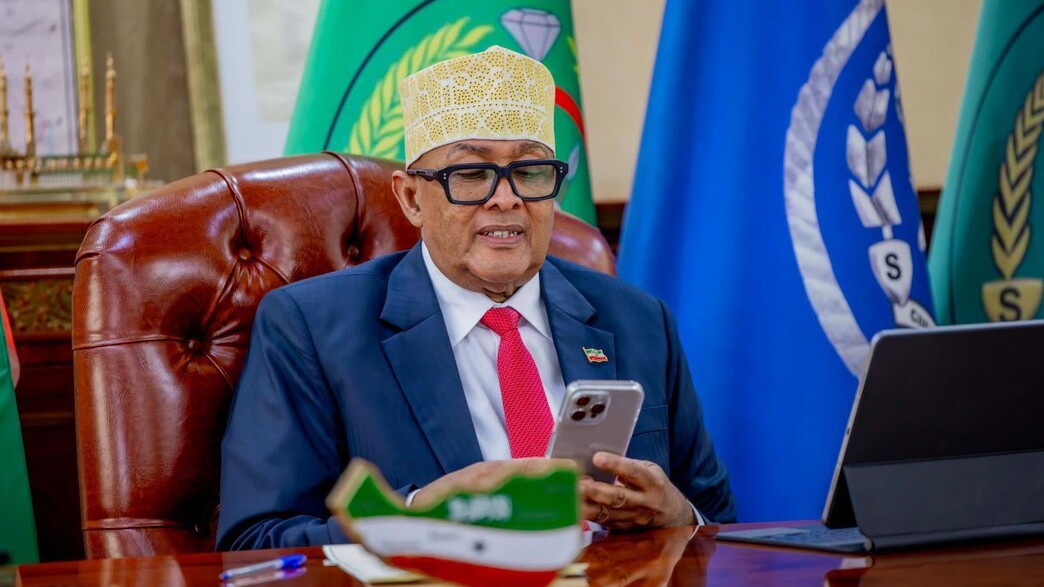
Israel announced its recognition as a sovereign country • The Prime Minister congratulated the President of Somaliland, Dr. Abdirahman Mohamed Abdilahi, and invited him to pay an official visit to Israel • In the past it was mentioned as one of the countries that will take in residents from Gaza • All the details about the new country
Prime Minister Benjamin Netanyahu announced today (Friday) the official recognition of the Republic of Somaliland as an independent and sovereign state. The Prime Minister, Foreign Minister Gideon Sa’ar and the President of Somaliland, Dr. Abdirahman Mohamed Abdilahi, signed a joint and mutual declaration.
Somaliland is a political entity that functions as a de facto independent country in the Horn of Africa. It declared independence from Somalia in the early 1990s, maintains its own governing institutions, constitution, electoral system and security forces, but in terms of international law it is still considered part of the Federal Republic of Somalia.
Who are the people of Somaliland?
- The population of Somaliland is estimated to be between 4.5 and 5.7 million people. Almost all of them belong to the Somali ethnicity and are Sunni Muslims. It is one of the most homogeneous populations in Africa: Somaliland residents share language, culture and religion with Somalis also living in Somalia, Djibouti, Eastern Ethiopia and Northern Kenya.
- The main language is Somali, but Arabic and English are also used in administration, education and commerce. The largest city and capital is Hargeisa.
- Somaliland society is largely structured around tribal affiliations. The Isaac tribal family is the most numerically and politically dominant, but there are also tribes belonging to the Deir and Drud families. Islam has a central role in both public and private life.
Ancient roots and regional identity
- Modern studies indicate that the historical homeland of the Somali people is in the area that includes present-day Somaliland.
- Archaeological and linguistic findings indicate continuous settlement in the area for thousands of years.
- The Somalis belong to the family of Afro-Asian nations, and throughout history have maintained extensive commercial and cultural ties through the routes of the Red Sea and the Gulf of Aden, with the Arabian Peninsula and Northeast Africa.
From trade networks to colonialism
- Even before modern times, the coastal areas of Somaliland were part of trade networks that linked East Africa with the Arab world and further afield. Products such as resins, rubber and animal products were exported from the area.
- Islam arrived in the region as early as the 7th century, and gradually took root, while forming the basis of local political entities, including the Adel Sultanate, whose center was in the port of Zayla.
- At the end of the 19th century, Britain signed agreements with local Somali tribes and established the British Somaliland Protectorate in the northern Somali region.
Brief independence and controversial union
- On June 26, 1960, British Somaliland gained independence and became the “State of Somaliland”. Just five days later, on July 1, 1960, it voluntarily united with former Italian Somalia, which was then a United Nations trust territory, and the two together formed the Somali Republic.
- However, many in the north soon felt that they were disadvantaged politically and economically compared to the south, which is centered in Mogadishu. The referendum on the constitution in 1961 was widely opposed or boycotted in the former Somaliland territories.
Oppression, war and the disintegration of the state
- During the reign of Siad Bara (1969-1991) the oppression and conflicts intensified. The Somali National Movement, whose center was in the north, waged an armed struggle against the regime.
- In the late 1980s, major cities in the north were destroyed on a large scale.
- After the collapse of Somalia’s central government in 1991, the leaders of the movement and tribal elders in the northern region declared the end of the 1960 union and re-established the Republic of Somaliland, within the borders of the former British protectorate.
Self-government and a complex civil reality
- Since 1991, Somaliland has developed separate governing institutions: a constitution, parliament, electoral systems, security forces and civil administration mechanisms. It has its own citizenship law, and it issues passports, maintains a population registry and actually controls immigration and naturalization.
- However, in social reality, many of the residents identify themselves as both Somalilanders and Somalis.
- Many also hold or apply for documents from the Federal Republic of Somalia or other countries to which they have immigrated, reflecting a complex and multi-layered legal status.
International status: function of a state, recognition of a region
- In terms of international law, Somaliland is a de facto state, but not a recognized state. No UN member state has given it official recognition.
- The African Union continues to see it as a region within Somalia, even if it recognizes the relative stability and institutional development achieved there.
- In Somaliland they claim that they meet the accepted criteria for a sovereign state, and that independence in 1960 and the problematic unification that followed give them the right to renew their sovereignty.
- However, the international community so far prefers to maintain the territorial integrity of Somalia.
- Therefore, Somaliland’s status remains that of an independently run entity – without official recognition, but with informal ties and collaborations with various countries and organizations.
- In March, the possibility of Gaza taking in residents was raised, however, it denied this option at the time.
- An Israeli source added new details in a conversation with N12 about Israel’s recognition of Somaliland as a sovereign state: “The talks between Israel and Somaliland have been taking place in secret for several months. Foreign Minister Sa’ar recently met with the entourage of the President of Somaliland in a third country. Since then, secret talks have taken place that included reciprocal visits by senior officials in both countries.”
- The Ministry of Foreign Affairs of Egypt said after the recognition: “We condemn, together with Somalia, Turkey and Djibouti, Israel’s recognition of Somaliland.”