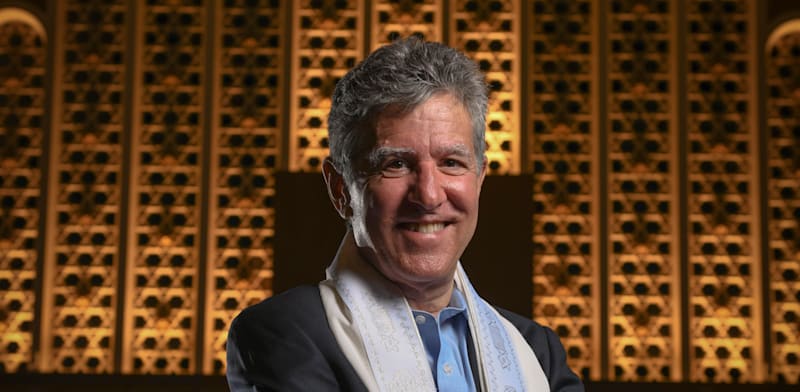
Rabbi Amiel Hirsch is one of the most influential and controversial figures in American Judaism today. As the senior rabbi of the Stephen Wise Free Synagogue, a Reform synagogue on the Upper West Side, Manhattan, one of the central communities of the Reform movement, Hirsch has been at the heart of the liberal American Jewish establishment for years. But unlike many of his colleagues, he does not hesitate to challenge the consensus of the camp from which he grew.
What distinguishes Hirsch in relation to growing parts of the leadership of Reform Judaism, is his demand for a sharp and clear moral position when it comes to Zionism, the State of Israel and the idea of the Jewish people. While major currents in American liberal Judaism have in recent years adopted an abstract universal language, and sometimes even a reservation to the idea of sovereignty, power and self-defense, Hirsch claims that a Judaism that is not connected to Jewish sovereignty and collective commitment is liable to be emptied of its content. According to him, it is impossible to maintain a living Jewish identity over time if Israel is seen as a moral burden instead of a fundamental element of Jewish identity.
Rabbi Amiel Hirsch
personal: Born in 1959, married+1
professional: A law degree with honors from the London School of Economics, studied rabbinical studies at Hebrew Union College in New York. Serves in the USA as the head of Eretz, the Zionist wing of the reform movement
one more thing: He attended high school in Israel and served in the IDF as an armor officer
This position often places Hirsch in frontal confrontation with dominant trends in the reform movement. While many liberal leaders seek to “contain” the alienation of young Jews from Israel, perhaps even showing leniency towards anti-Zionist discourse, Hirsch refuses. Criticism of Israel’s policies is legitimate, he emphasizes, but denying its right to exist, or applying moral standards that are not applied to any other democracy subject to an existential threat, are simply against Jewish identity.
“A lot has changed in the last two years, for the worse,” Hirsch opens the conversation with Globes. “Hatred of the Jews in the USA exploded, the change was dramatic and clear. But apparently he didn’t come out of nowhere, the trends happened underground. Then the events of October 7 brought out all this bile, all the lava, and caused it to erupt.”
Why did it happen at this time? Hatred of the Jews arose in New York immediately after the massacre, and even before Israel reacted.
“I have some speculations. But as a result of October 7, these currents erupted very dramatically. And it was a shock for American Jews, because unlike other places in the world, almost no American Jews were alive when Jews experienced this kind of hostility. America has never had state-sponsored anti-Semitism and official anti-Semitism. It existed, and before World War II there were quotas for Jews in institutions, but in the last 80 years or so, almost no American Jew has experienced the This hostility.”
According to him, “Liberal Jews saw liberalism as the most contributing force to what they understood to be central Jewish values, universal principles of justice, truth and peace, welfare and charity, and world reform. And American Jews assumed that liberal institutions and the adoption of a liberal philosophy were the best guarantee for its well-being in the USA. In other words, it was assumed that a liberal state and society was the best defense against anti-Jewish hostility. And from this place comes the trauma and shock.”
Among progressive American Jews, the feeling of betrayal by their natural allies – in the black community, the immigrant community, the gay community – repeatedly arises. do you identify
“Of course, and I would also add the universities to that. It’s hard to imagine many of the elite universities in as good a condition as they are without Jewish donations and support. Many of them have disappointed us badly, as have many of the elite of the Western world.”
“Those who we thought were our allies turned their backs on us”
Rabbi Hirsch demonstrates this feeling of betrayal. “I am part of an interfaith dialogue group with very senior clergy in the New York area, for many years. We all tend to be liberal, or at least we have a consensus among ourselves regarding the main issues. We are quick to publish statements when there are acts of violence against a church, a mosque or the Jewish community. When the massacre happened in the synagogue in Pittsburgh, the immorality of it was self-evident to all the clergy. On the Sabbath after the massacre on the 13 My colleagues, non-Jews, said to me, we want to come to your synagogue so that the members of your community can see solidarity. Right after October 7th, when Israel was still repelling terrorists in its territory, we assumed that the horror of these attacks would also be self-evident. We could not make a statement when 15 Jews were murdered in Pittsburgh. But a hundred times more Jews were slaughtered in their bedrooms in Israel – there was no consensus on that.”
“Almost all of these institutions, which we thought were our allies, turned their backs on us,” he lamented. “We were part of them, we cooperated with them and stood by their side. And in some cases, their betrayal of us is significant. In the end, this will have consequences in the voting patterns of the liberal Jews.”
The voices on the left who oppose Israel divide the world into victim and victimizer, oppressor and oppressed – and based on that they decide who is right. Is this a liberal thought?
“I don’t even call it the liberal world, because it’s not liberalism. It’s something else, the result of years of intellectual agitation and funding by the enemies of the Zionist idea and the reality of the State of Israel. We’ve fallen asleep at the wheel. I’ve recognized it since the end of the 2010s, but we didn’t really understand the extent of the infiltration of these ideas into places dedicated to freedom of thought and expression. Concepts of group identity, identity politics And the hierarchy of the oppressed is fundamentally illiberal, because liberalism, first of all, is a state of mind and openness to different ideas and reasonings of logic and persuasion. All of these were out of fashion in the last decade. The assumption that we judge people by their virtues, not by their religion, the color of their skin or the place of their birth, is the liberalism that many Jews of my generation were raised on We are promoting the opposite by promoting liberalism.”
Do you understand the motive for this? How do so many people think so illiberally?
“I have no expectations from young students. Young people make mistakes and think stupid things. I am disappointed with the university management and the lecturers. They should know better. There is general sympathy for the Palestinian narrative. Now, if the Palestinian narrative is that they want independence, self-determination like other nations, and are looking for coexistence, and this is fundamentally a territorial matter, fine, completely legitimate. This is something that the Israeli government itself entered into in negotiations with the Palestinians over the years. But The narrative is not that. The narrative is oppressive, oppressive, and therefore Israel has no right to exist. If that is the narrative, it is fundamentally immoral. The idea that some faculty members and even university presidents feel close to such an attitude is very troubling.”
“They said, we will judge Mamdani according to the security of the streets”
This tension was given a tangible expression in Hirsch’s meeting with New York Mayor-elect Zohran Mamdani, a prominent progressive politician associated with the radical wing of the American left and with strong anti-Israel positions. For Hirsch, the very meeting was not intended to normalize anti-Zionist attitudes, but to illustrate the deep fault line within the liberal camp: between a general human rights discourse, and a special responsibility towards the Jewish people and their state. The meeting sparked a heated debate in the Jewish community, but for Hirsch it reflected the main challenge of American Jewry today, how to conduct an open dialogue without giving up red lines.
Your mayor Mamdani does not spare criticism of Israel, and is close to radical Muslim elements. How is it that according to polls, something like 30% of the city’s Jews voted for him?
“30% sounds high to me, but even 25% or 20% is a lot. In terms of the organized Jewish community, Jewish friends associated with a Jewish institution, synagogue, school, museum, Jewish community center – I’m sure the percentages were much lower than 30%. There may even have been pro-Israeli or Zionists who agreed with his ideas about the high prices in the city. He had offers for free buses and urban supermarkets. People who felt that The main issue, they voted for him even though they disagreed with him regarding the question of Israel and Zionism. And others supported his agenda, maybe they didn’t care, because they came to the conclusion that the mayor of New York has very little influence on foreign policy, and who cares what he thinks about Israel. We will judge him by how clean and safe the streets are.
“And then there was a segment of the Jewish community, 10%-15% of them, who are very hostile to Israel and are anti-Zionists for all that is implied.”
You are very Zionist. What do you do if someone like that comes to your synagogue? Son or daughter of one of the community, who you know protests against the Jewish state?
“As I said, it is about one-tenth of the American Jewish community that considers itself to be opposed to Israel and anti-Zionist. In other words, 85-90% of American Jews in our camp. The challenge is that the older you get, the less true it is. The challenge is increasing, in terms of numbers and in terms of hostility towards Israel.
“To your question, I want to be very clear. I say this in every public forum. I do not abolish anyone. Abolition is not a liberal position. I even want to hear my opponents. But I do not give a platform to everyone in our synagogue. I am not a platform for anti-Zionists. I find no reason to debate whether the Jewish people have a collective right to self-determination. If you want to believe it, believe it. If you want to discuss it, go and discuss it, not here. I have no interest publish it, but I’m certainly ready to hear anyone who wants to talk to me.”
You met the elected mayor before the elections.
“I met him, and I will meet him again. And it’s definitely the same case with regard to young American Jews. Young American Jews who heard this from me, who didn’t even know me, contacted me and said, we’re coming to New York this weekend to visit family. You said you’d be happy to have anti-Zionists come to talk to you and we want to come. This happened several times. And each time I welcomed it, and I spent a lot of time with such people assuming that first of all, I don’t exclude anyone, especially Jews. Second, Our doors are always open. And thirdly, there’s a very small part of me that says if an anti-Zionist wants to come into my office and tell me all the reasons I’m wrong, a very small part of me says that maybe he’s open to my response as well. Anything I can do to get another idea into his mind is welcome.
Mayor of New York, Zohran Mamdani / photo: ap, Yuki Iwamura
“We don’t ask people what they believe when they join the synagogue. They have to be Jewish, of course, but we don’t ask them, you’re a Zionist, you’re not a Zionist. We may have some people who joined anti-Israel protests who are members here. If they want to be part of the synagogue, they’re more than welcome. I’ve never hidden what I believe to be central Jewish values and expressed them, especially in light of October 7th. I have an obligation to speak as decisively, loudly and clearly as possible To young people, why anti-Zionism is an abomination, and violates central Jewish values, and we have not done enough of it.”
And young people who don’t agree with you on the matter really come to be part of the community?
“Unfortunately, this does not happen often with the younger crowd, for two reasons. First, the younger generations tend not to join institutions and synagogues – it is expensive to identify with an American Jewish institution. So they tend not to do it anyway. Second, some of their criticism is against the Jewish establishment itself, and especially against rabbis, because they come with very harsh criticism. ‘You taught us humanitarian values, you taught us tikkun olam and supporting the Palestinians is tikkun The world. The Israelis are committing genocide and you are betraying the central Jewish values that you taught us. That’s why we don’t see much of them once they reach independence.”
“Jewish ignorance is the main threat”
To what extent can the fact that Israel does not allow non-Orthodox sects equality in religious services, like the whole saga of the Western Wall layout, conversion, marriage, be blamed on the distaste of progressive Jewish youth?
“The power of the religious establishment – the ultra-orthodox establishment, which is not Zionist and does not represent the main Jewish values – is that it is given all the authority and powers of the state in Israel, which it uses to coerce and suppress alternative forms of Judaism. This is not helpful. And on the political level – young American Jews, for example an 18-year-old liberal boy, all he has known throughout his life is Prime Minister Benjamin Netanyahu, and all he has known is a center-right government. And now we have what can be called an extreme right-wing government, so that’s not helpful either.
“The basic problem that causes the distance between Diaspora Judaism and Israel after October 7 is what was before, and that is the distance from Judaism. In Israel you can be a good Jew without joining a synagogue, because Jewish identity flows in the air and you simply live it. Outside of Israel, you have to identify with a Jewish community in some way. And you need some Jewish knowledge to understand what you identify with. It is impossible to develop a Jewish identity if you are ignorant of Judaism. And Jewish illiteracy is widespread Very much, and this is the main threat to the continuity of Judaism in the USA, before and after October 7th. The more distant you are from Judaism, the more likely you are to distance yourself from the Jewish state as a central value of contemporary Jewish expression.”