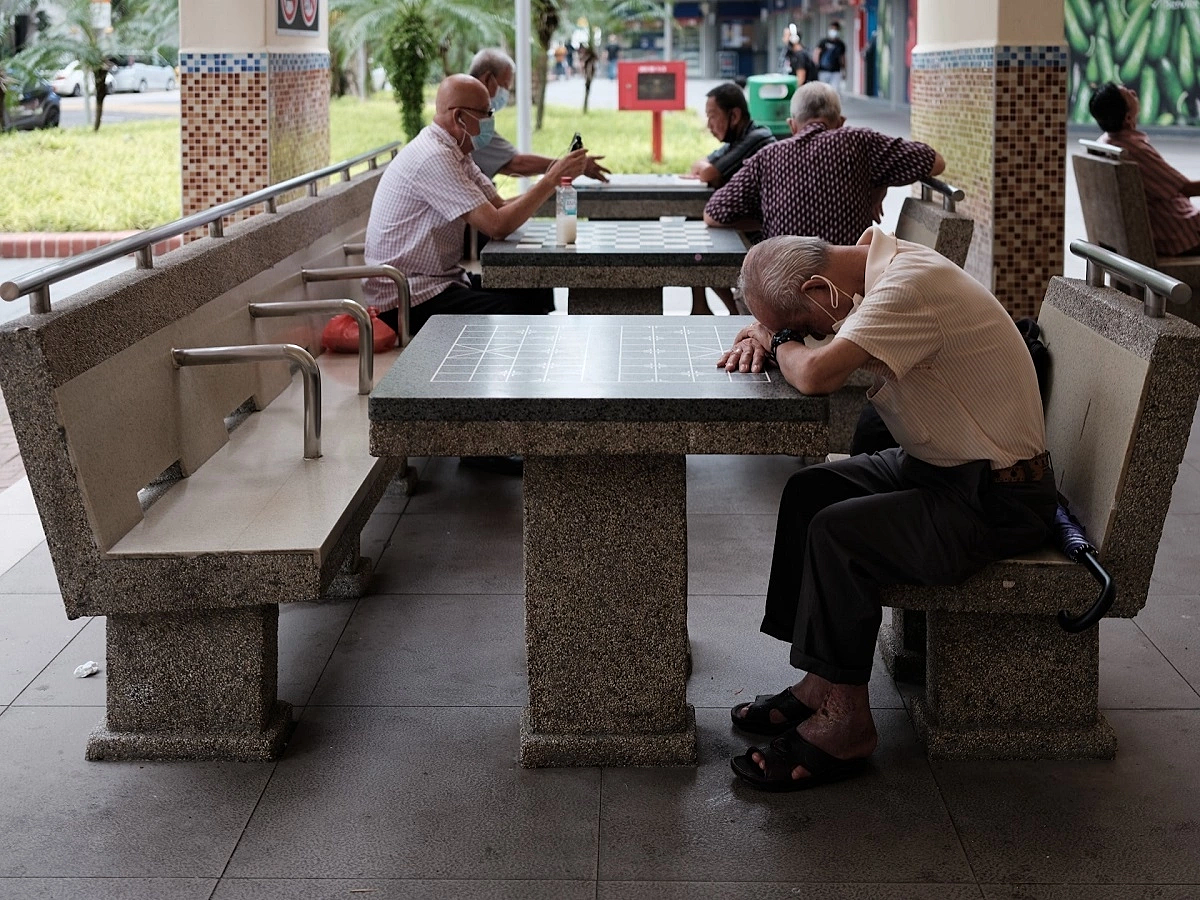
At the age of 65, instead of enjoying her old age, Ms. Dao often stays up all night with spinning headaches and a racing heartbeat.
The source of this exhaustion does not come from age pathology, but from the pressure of having to raise two children who are in their 40s but are still completely financially dependent. The eldest son, 39 years old, constantly changes jobs with the reason of “finding himself”, leaving his wife, children and economic burden to his mother, while the youngest daughter, 33 years old, works as a freelancer with an unstable income, still maintaining the habit of living dependently.
With the couple’s pension of less than 15 million VND, Mrs. Dao has to shoulder the living expenses for her large family of 9 people. To maintain a living, she sold gold, withdrew all her savings and borrowed everywhere under the guise of “taking care of her grandchildren to go to school”. Prolonged stress caused her to be diagnosed with anxiety disorder and serious depression by doctors at Mai Huong Day Psychiatric Hospital.
Mr. Hoa, 62 years old, does not live with his children but has never been at peace. Every time a stranger’s phone rang, his heart sank. On the other end of the phone: “Tell me to pay the debt, otherwise my family will have to pay.” At first a few tens of millions, then a few hundred million. His nearly 40-year-old son is often in debt, often “siphoning off” his parents’ money and forcing them to pay the debt on his behalf. Mr. Hoa did not dare answer the phone, did not dare open the door, and was startled at night by the sound of a car stopping in front of the gate. The economic deadlock caused him to lose weight quickly, become irritable, have palpitations, forgetfulness, and prolonged insomnia. Doctors warned him that depression was caused by chronic stress.
Psychologist Nguyen Thi Huong Lan, Head of the Psychology Department at BHIU Training Institute, Bac Ha International University, said that adult children are still economically dependent on their parents, which is becoming a silent crisis among the elderly. Many parents 55-70 years old seek counseling because of persistent insomnia, chronic anxiety about money, exhaustion, and mild to moderate depression.
Children who are adults but still “freeload” make their elderly parents panic. Image: Unsplash
There are no statistics on the number of adults in Vietnam living “on the sidelines” of their parents. However, according to the Department of Statistics, the third quarter of 2025 recorded 1.6 million young people aged 15-24 who were unemployed, not participating in study or training, accounting for 11.5% of the total number of young people. The number of unemployed people of working age increased by more than 222,000 compared to the previous quarter and increased by 183,000 compared to the same period last year.
Worldwide, more than a third of UK adults aged 35-44 still rely on their parents’ pension, according to Independent. Not only do young people live with their families and do not have full-time jobs, adults who are expected to be economically independent also need their parents’ support. In Korea, a 2022 Institute of Health and Society survey of 14,000 adults showed that 49.7% of people in their 30s and 48.8% of people in their 40s were still unmarried and living with their parents due to tight economic conditions.
The British use the term NEET (Not in Education, Employment, or Training) to refer to people who do not contribute labor to society, do not participate in education or training, are separated from social competition, have no income, and are completely parasitic in the family. In France, they are called “kangaroos”, and are raised by their parents even into adulthood. In China, it is a “big child” who cannot be economically independent and needs the protection of his parents.
Explaining the underlying cause, Ms. Lan believes that the deep-rooted “sacrifice” mindset of Asian culture is the key factor. Many parents equate self-worth with sacrifice, believing that they are not allowed to relax while their children are still having difficulties. This psychology, combined with the fear of being shunned by their children and the pressure of social recognition when their children are not successful, makes them voluntarily become an unconditional financial “source”. They try to compensate their children with material things with the wrong idea that letting go means pushing them into a dead end.
However, the price to pay for this protection is the parents’ own health and longevity. Medically, a constant state of anxiety stimulates the body to continuously produce cortisol, causing immune deficiency and increasing the risk of cardiovascular disease, blood pressure, and diabetes. Socially, overindulgence creates a passive, selfish generation that lacks survival skills and the ability to face difficulties. When old and weak parents pass away, these “big children” will become a double burden for the social security system.
To solve the problem, experts recommend that parents set strong financial boundaries. Instead of providing unconditional support, parents should switch to a “time-limited support” mechanism, linked to specific independence commitments of their children, absolutely not paying personal debts on their children’s behalf. A frank dialogue about health and financial limitations is a necessary step to restore family order. Geriatric depression often does not manifest through tears but through silent suffering, so early identification of signs such as insomnia and personality changes for timely medical intervention is extremely important to protect the quality of life of the elderly.