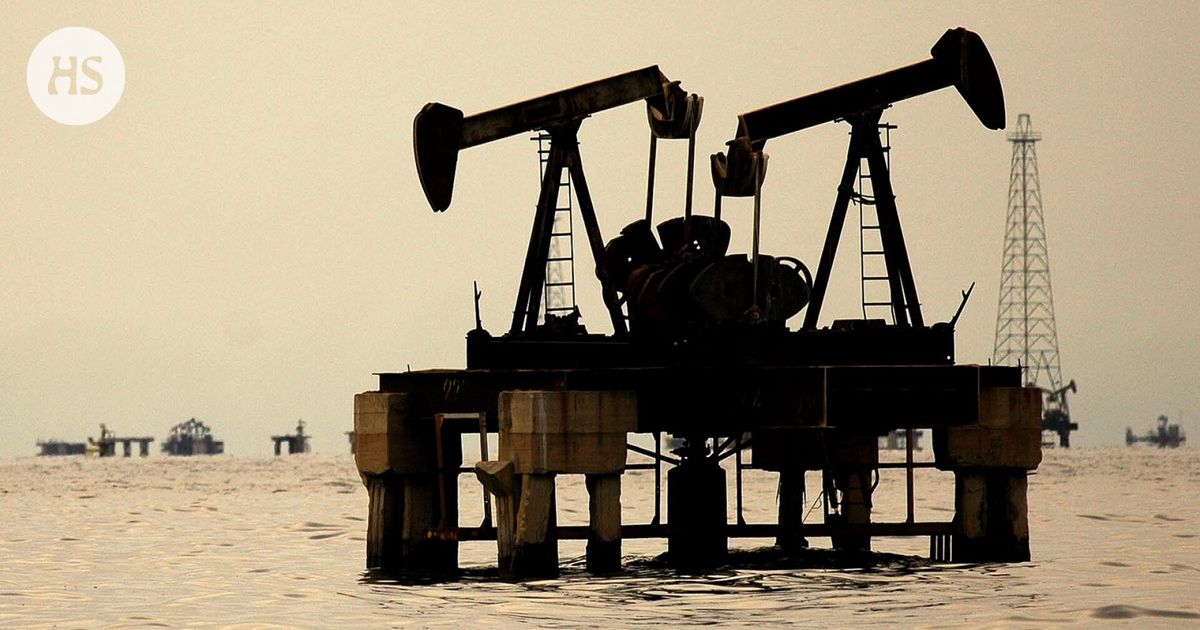
Oil|The US operation in Venezuela increases uncertainty in the world economy, and its effects on oil prices in the future are still unclear. Until now, crude oil has been cheap.
The US operation in Venezuela increases uncertainty in the oil market, but so far no dramatic changes have been seen in the price of crude oil.
President Donald Trump has said the United States wants full access to Venezuela’s oil and other natural resources.
According to Nordea’s chief analyst Jan von Gerich, it is currently unclear what will happen to Venezuela’s oil production.
The price of crude oil has halved from the peak readings four years ago, and the price of North Sea Brent quality is now around 60 dollars per barrel.
So far the oil market has seen no dramatic changes since the US made a major strike on Venezuela and captured the country’s dictator Nicolás Maduron on Saturday.
However, it is still not at all clear what will happen to Venezuela’s oil production, Nordea’s chief analyst estimates Jan von Gerich.
Until now, crude oil has been exceptionally cheap. Its price has halved from the peak readings four years ago, which were caused by Russia’s invasion of Ukraine.
In the future, the direction of the price may be downward or upward.
If US companies invest in Venezuela’s oil reserves, and more Venezuelan oil enters the market in the future, the price of oil could fall. This is generally expected in the market. However, this will not happen quickly.
On the other hand, it is also possible that the uncertainty caused by the US mission in the world economy could increase the price of oil.
Operation the effects on the price of oil will be closely monitored, as the attack is primarily thought to be the US’s desire to gain access to Venezuela’s oil reserves.
President of the United States Donald Trump said, according to the Reuters news agency, that the United States wants full access to Venezuela’s oil and other natural resources.
Venezuela’s oil reserves are the largest in the world. However, oil production in the country has recently been clearly lower than during the peak years of production in the 1970s.
Venezuela’s share of the world’s oil reserves is 17 percent, but its share of production today is just under one percent.
So far, the price of crude oil has not seen any dramatic changes in one direction or the other.
The price of North Sea Brent quality per barrel saw around 60 dollars on Monday.
Over the weekend, the OPEC+ countries, i.e. the eight oil producing countries, announced that they will refrain from raising production volumes until at least the beginning of April.
Because the oil market has now remained calm, so far no effects are expected on Finnish gas pumps either.
“Simply due to disruptions in oil production in Venezuela, Finland is unlikely to see large price fluctuations at gas pumps. It’s a different matter if the situation has larger geopolitical consequences.”
Von Gerich reminds that Venezuela’s oil production is so small that it alone does not sway the oil market.
According to von Gerich, the biggest impact of the Venezuela operation on the world economy can be seen as a general increase in geopolitical uncertainty. It brings new risks.
Concerns can now be raised about the effects of the events on superpower relations, whether it will be difficult to find peace in Ukraine, and how China views the Taiwan issue.
Last times, the price of crude oil has remained exceptionally affordable. Last year alone, the price of North Sea Brent quality fell by around 20 percent. A year ago it cost about 80 dollars, but now the price has been hovering around 60 dollars per barrel for a long time. In 2022, the price would reach 120 dollars.
According to von Gerich, the oil market was exceptionally calm last year.
“Although the geopolitical uncertainty was great last year, the price of oil did not rise dramatically.”
The background, according to von Gerich, is that there has been enough oil available and there is no great concern that there would be a shortage of oil. Demand for oil has been reduced by the slower pace of both China’s and the global economy as a whole.
It is also known in the market that if the price of oil were to rise by, say, 10–20 dollars per barrel, the United States could also increase its shale oil production quite quickly. Even now, its shale oil production is significant, but the low level of oil limits the profitability of new projects.
Yet it is not known what the US oil companies plan to do in Venezuela. It is clear that increasing the production requires considerable investments after the production plants have fallen into a bad state of decay.
“It is very possible that after a short period of uncertainty in Venezuela it will be possible to increase production volumes somewhat. It could bring additional stability to the oil market,” says von Gerich.
It is also possible that Venezuela will see a turn for the worse, and oil production will be disrupted more than currently estimated.
“At that time, we could see some kind of fluctuation in prices also upwards. However, with the current production volumes, it is difficult to see that there would be huge price fluctuations.”