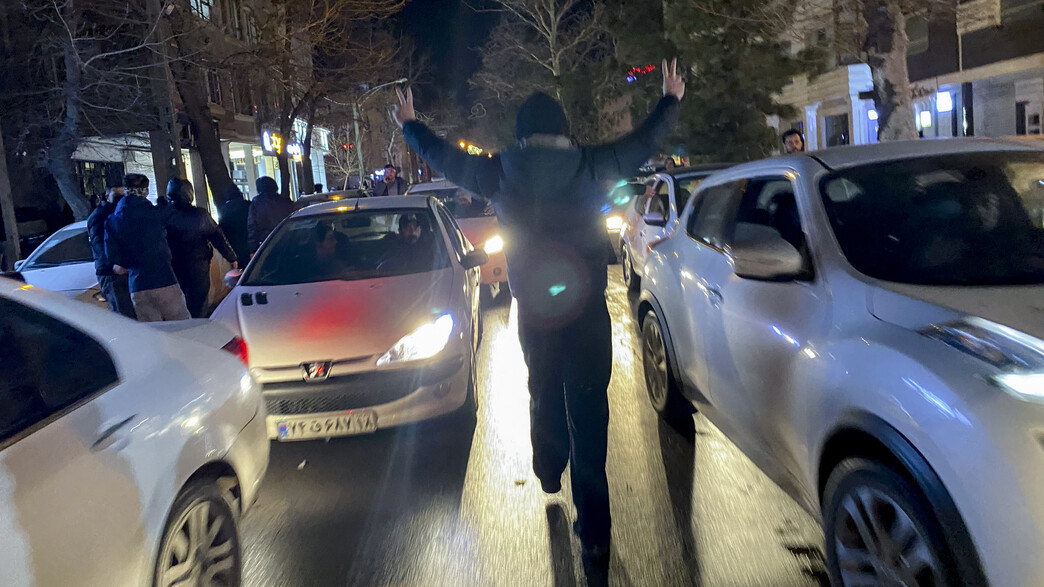
In the Iran of recent days, not only the streets are stormy – but also the social networks • Many surfers publish emotional documents and reactions that range from hope for the overthrow of the regime to despair and rage, and almost always also fear of Israel • Meanwhile the regime is doing everything in its power to stop the popular uprising, portraying the protest as “a failed project with the artificial soul of Israel” • A glimpse of what is happening on the Iranian networks
In the background of the wave of protests sweeping the streets of Iran – social networks have become another scene of protest: Citizens and activists publish documents from the demonstrations and point the finger of blame at the government, while media outlets affiliated with the regime simultaneously promote a campaign against the protesters and claim that this is not a popular protest but a “failed project with Israel’s artificial soul”.
The reactions on the Iranian networks are not limited to documenting the protests themselves, and most of them are accompanied by a deep debate about the direction of the protest, its leadership and the relations with external actors. For example, some surfers express unreserved support in the fight against the regime, while others warn against relying on foreign parties and against a split within the Iranian opposition.
“Pictures that will go down in world history”
Surfer Samnak wrote about the human cost of the demonstrations and the violence in the field: “For every one killed, a thousand are left behind.” Referring to the conduct of the regime, he added: “Someone cut off the electricity so that his head would not be connected!”. In another tweet, he described what was happening in Ilam province: “Ilam and its hospital are covered in blood. The oppressive animals have entered the hospital and are searching hall after hall, room after room, wounded protesters. The people of Ilam are barricading themselves in the streets with empty hands.”
Samnak even referred to the events in the province of Ilam, in the city of Malkshahi and wrote: “How good these people are, how understanding these people are. In the city of Malkshahi, people are divided into two groups: the first group buries the city’s Mati, under the slogan ‘Death to Khamenei’ and the second group goes to the street under the slogan ‘Death to the dictator’ against the oppressive forces.”
Amir Hossein referred to the documents from the demonstrations and emphasized their significance. “These photos will not be recorded in Iranian history, but in world history.”
In another of his tweets, Hossein compared the different protest waves: “The photo on the left: 2022 protests, on the right: 2025 protests.”
“Criminals will be thrown from their seats of oppression, freedom is near”
Another Iranian surfer, Farshid, expressed optimism regarding the continuation of the protest: “The criminal mobs will soon be overthrown from their seats of oppression. Yes, the Iranian people are winning – freedom is near.” Amir mentioned a scene from the protests at the universities, and claimed that while students were chanting “death to the dictator”, the supporters of the regime and the Basij stood in front of them and chanted “long live the dictator” – an absurdity that he said illustrates a complete blindness to oppressive rule. According to the excited surfer, this is an unprecedented phenomenon in Iranian history.
But alongside the hope for the overthrow of the regime, many surfers also express fear of external aid that will lead to the achievement of the goal. The Iranian Mana expressed a critical stance towards possible involvement in the protest – and specifically warned against Israel. “The Iranian people, and especially political activists, must understand that a foreign entity like Israel is not committed to Iranian democracy. It is committed to its security interests, but we are committed to Iranian democracy.”
Mana also claimed that in recent years the Islamic Republic has been used to promote Israel’s security and nuclear interests in the international arena and added: “For years, Israel focused on the threat from Iran and stifled criticism of the construction of settlements and violations of Palestinian rights under the title of aligning with Iran.”
According to her, a “fragmented, dubious and radical opposition, lacking social support” is a smaller threat to Israel than a democratic and cohesive national movement. Therefore, according to her, “Israel may at the same time support figures who are actually undermining the unity of the opposition.” She concluded that Israel is acting “on the one hand to invest in a fabricated opposition, and on the other hand to preserve Iran as a predictable and exploitable enemy, mired in crisis and at risk of falling apart.”
The regime’s propaganda: “Israel’s dirty dollars for artificial respiration for the suffocating chaos”
Meanwhile, the Ithullah regime is doing everything it can to stop the demonstrations, and is quick to blame the “Great Satan” and the “Little Satan” for the popular uprising that erupted against it. The Kihan newspaper, which is close to the regime, presents the protest as a foreign project pushed by Israel and the US, designed to ride on economic distress and lead the country into chaos.
Through the mobilized newspaper, the regime claims that the protest is not an expression of authentic demands, but a timed attempt to destabilize. “The movements are organized by a political service of the nuclei of chaos to capture the economic demands of the guilds, have become a failed project that now breathes only with the artificial breath of Washington and Tel Aviv.”
In Kihan, they are trying to sharpen the distinction between legitimate economic demands and what is defined, according to them, as a deliberate attempt to destabilize. According to this newspaper, behind the events is a “desperate attempt by the triangle of America, the Zionist regime and the exiled Iranian opposition – to revive a wave of unrest that has already reached a dead end in public consciousness. A current that has reached a dead end in public awareness and is now looking for ostentatious survival with the help of artificial respiration by foreign media and dirty dollars.”
Against the backdrop of the verbal escalation in front of Washington and Jerusalem, a new billboard was hung yesterday in Palestine Square in Tehran with the message: “Take care of your soldiers”. The sign was published two days after the threatening words of Ali Larijani, the secretary of Iran’s National Security Council, who warned on Friday that any American intervention in Iran’s internal affairs “will destabilize the region and harm the interests of the United States. Trump started this adventure and they should worry about the fate of their soldiers.”