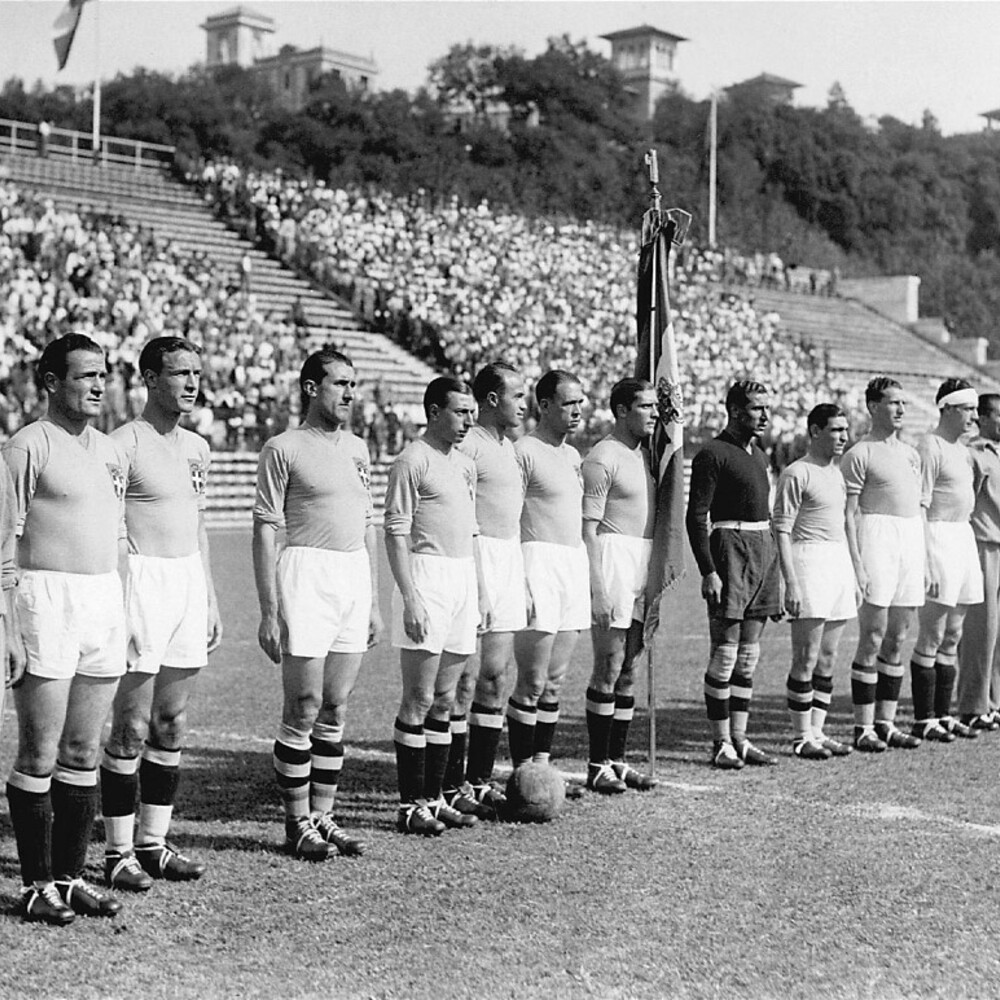
As in every story there is a hint of legend. In the stocking of the Befana of 1911, national football, and subsequently all Italian sport, found its color which has arrived today in different shades but always faithful to itself: blue. The national team “composed only of Italian players” as stated in the note from the Federation founded in Turin in 1895, had debuted on 15 May 1910 at the Civic Arena in Milan, by will of the president Luigi Bosisio and the secretary Arturo Baraldi who had founded it on 13 January. In front of him was the transalpine roosters, who lowered their crest due to the peremptory 6-2 inflicted by the team in the white jersey in front of around four thousand spectators. A neutral color had been chosen for the uniforms while waiting for a definitive and truly national one to be adopted. Even the socks could be chosen individually by the players, white or black, and so could the shorts. It ended up that everyone wore black socks but the shorts were different.
KO in Budapest with Hungary and the rematch in Milan
Italy’s second official appearance was on Thursday 26 May 1910 on the banks of the Danube, where the strong Magyars of the dual Habsburg monarchy, then allied with the Kingdom of Italy, prevailed at the Millenaris Sporttlep in Budapest packed with 12,000 spectators with a dry and searing 6-1. It was Italy’s first away match, and it was an adventurous journey, with an itinerary error, the spirit of the outing of Attilio Trerè, defender of Ausonia (but he was also a goalkeeper and midfielder) who had brought bread, cured meats and cheeses in his suitcase, and even the Milan full-back Renzo De Vecchi took to the pitch with walking shoes instead of bolted ones. There was an air of revenge which was set for the Arena Civica in Milan for January 6th. With a novelty, it seems inspired by the mosaic on the floor of the Galleria Vittorio Emanuele II, with the coat of arms of the Savoy, designed by the architect Giuseppe Mengoni. The flag of the Kingdom of Sardinia was blue and in the center was the red shield with the white cross. When Carlo Alberto adopted the tricolor in 1848, driven by the Risorgimento, the coat of arms of his dynasty was positioned on the white, retaining the blue frame. The intuition was precisely to adopt blue as the color for the Italian national football team. A sport that was rapidly catching on, but in terms of popularity it was not yet at the level of cycling and motor racing, so much so that the debut match had received significantly less coverage in the newspapers than the more followed disciplines.
Little luck at his debut but since then a long series of triumphs
The blue uniform for the match against Hungary bore the Savoy shield at heart level. It will remain on the national team’s shirts until 1946, when the Republic replaces it with the tricolor surmounted by the word Italia. During the twenty-year period, the regime managed to place the fasces sideways, on the chests of the world champion footballers in 1934 at home and in 1938 in France. In 1911 at the Arena Civica in Milan, covered in snow and with the spectators growing to over five thousand fans who also braved the rigors of the cold, the Magyars passed in the 23rd minute with a goal from Schlosser and would no longer be reached by the Italians. More than half of the team, which is not yet of the “azzurri”, plays in the Pro Vercelli team which won three championships in a row until 1909, and will also win the 1911 and 1912 editions. On the bench sits a technical commission chaired by Umberto Meazza (of US Milanese), and a group of four player selectors: Giannino Camperio (Milan), Alberto Crivelli (Ausonia), Giuseppe Gama Melcher (Inter), Agostino Recalcati (US Milanese). In some way they are all pioneers of football, animated by a passion for football, as it was written at the time, who wanted to «put together a team that can worthily represent the colors of Italy, with the hope that victory will come to the eleven valiant athletes». The blue shirt, from the day of the epiphany of 1911, will always be that of the Italian national team, while the first ever, white, will officially become the second uniform.
The historical legacy: religious, military, monarchical and republican
The first appearance of blue as a symbol of Savoy dates back to 1366, ironically by Amedeo VI who was instead known as the Green Count, who had introduced it for the officers of the Savoyard army so that they could be immediately recognizable by their scarf or belt. The color was that of the mantle of the Virgin Mary and Amedeo wanted a flag to recall her by flying next to the red-crusader banner of his family on his flagship. It was established as an obligation for officers in 1572 by Duke Emanuele Filiberto, and in 1750 King Carlo Emanuele II established its characteristics with a regulation, which were modified in 1775 by Vittorio Amedeo III. In 1814 Vittorio Emanuele I suddenly turned towards yellow, limiting the blue to rows of dots. The original color will return in 1848 for all ranks, becoming a service badge on 9 October 1850. It will also pass by immune from the epochal institutional change of 2 June 1946, with the affirmation of the republic, because no one has ever felt the need to change the national identity symbol. And this has remained both in the military and in sport. By definition, athletes of any discipline are called “blue”. And even in the flag of the President of the Republic there is the blue border, which recalls the Armed Forces of which he is constitutionally head, with this singular historical testimony of continuity and coexistence between monarchical legacy and republican present.