This company history spans from the beginnings of civil aviation to the challenges of the present: Lufthansa turns 100 today, January 6th. The airline with the crane as its symbol is closely linked to technical progress, internationalization and political turning points. Today, the Lufthansa Group, with 104,000 employees and 840 aircraft, is the largest aviation company in Europe and number four in the world. It includes: Austrian Airlines, Swiss, Discover Airlines, Lufthansa CityLine, Lufthansa City Airlines, Air Dolomiti, Eurowings, ITA Airways, Edelweiss Air and Brussels Airlines.
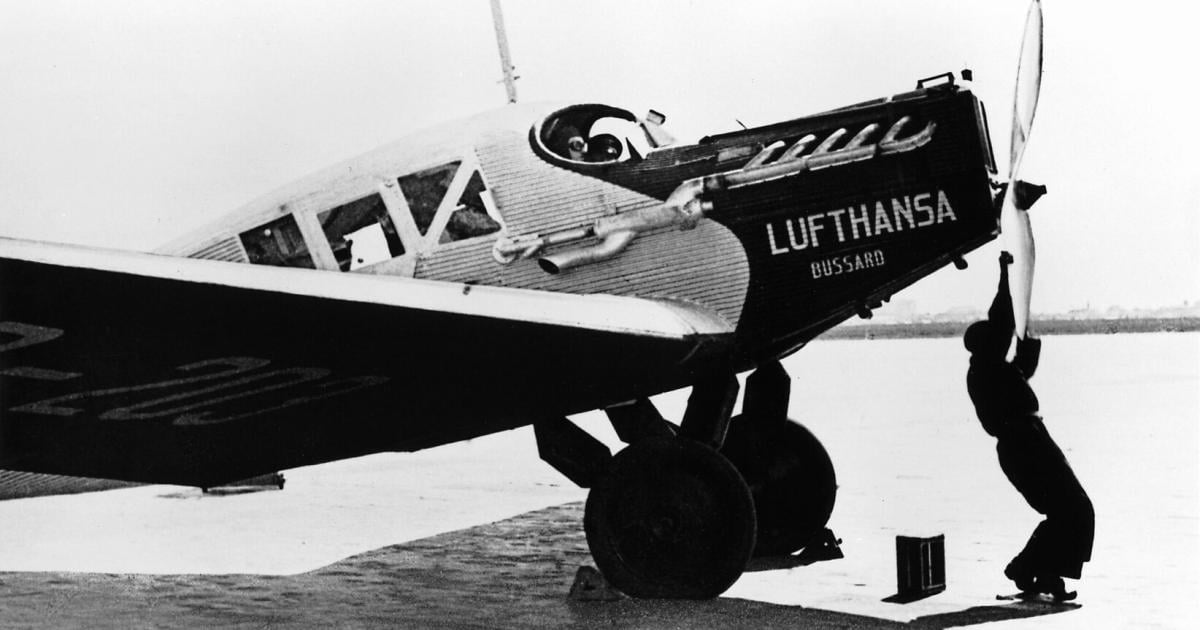
The roots go back to 1926, when the Deutsche Luft Hansa AG from a merger of competitors Aero Lloyd and Junkers air traffic emerged. The first flight took place in April 1926. In the Weimar Republic, the company was considered a symbol of modern mobility. Wooden-class aircraft such as the legendary Junkers Ju 52 corrugated iron aircraft became icons of an era in which reliability and range were more important than comfort.
The rearmament under National Socialism
Adolf Hitler used the Ju 52 for his propaganda and campaign trips in the early 1930s. According to research, the heavily subsidized Lufthansa was closely involved in the rearmament of the German Reich, which was prohibited by the Treaty of Versailles. During the Nazi era, Lufthansa benefited from the rearmament and used thousands of forced laborers, particularly in aircraft maintenance. The JU 52 was built so that it could be quickly converted for military purposes. She transported paratroopers and other soldiers, wounded and material. It was also sometimes used as an auxiliary bomber.
“A comprehensive history volume will be published in March 2026, which will contain a detailed and historically based analysis of Lufthansa’s role in the period from 1933 to 1945,” said a Lufthansa spokesman.
The restart in 1955
At the end of the Second World War, Lufthansa was dissolved and Germany lost its civil aviation. It wasn’t until April 1955 that another Lufthansa flight took off from Berlin-Tempelhof Airport.
Legally, today’s Lufthansa Group has nothing to do with its predecessor. However, from the liquidation he secured the rights to the name, the color scheme and the iconic crane symbol.
Over the next few decades, Lufthansa developed into the flagship of the German economic miracle. The shares of the state-owned Lufthansa have been listed on the Frankfurt Stock Exchange since mid-April 1966 and were thus partially privatized.
Turnstile at Frankfurt Airport
With the expansion of the hub at Frankfurt Airport, it became a central player in European air traffic. The liberalization of European air transport in the 1990s increased price pressure, and alliances and mergers changed the market. Lufthansa responded by internationalizing, co-founding the Star Alliance and taking over foreign airlines. Lufthansa has only been completely privately owned since 1997. The German investor Klaus-Michael Kühne holds 15.01 percent.
In recent years, the core airline Lufthansa has developed into an expensive problem child.
A tough restructuring program is intended to bring it back into the black. 4,000 jobs are to be eliminated in the group, and the functions of the individual airlines are to be controlled more centrally in Frankfurt. Of the three major network airlines, Lufthansa has the largest fleet and the most passengers, but the narrowest profit margin and the weakest share price. Opposite the British-Airways-Mutter IAG she is far behind, too Air France-KLM performs better with the margin.
“We have definitely lagged behind some of our competitors in financial performance, and until this summer we also lagged in operational performance,” CEO Carsten Spohr recently admitted. In 2024, the group’s return was 4.4 percent. A return of eight to ten percent is targeted for the years 2028 to 2030. Whether the goals will be achieved is anyone’s guess.
The company
From January to September 2025, Lufthansa had sales of 29.64 million euros, an increase of five percent. The EBIT margin was 4.4 percent, which is 0.5 percentage points less than in the comparable period of 2024.
The flights
In the first nine months of 2025, 776,161 flights were carried out, an increase of three percent. 103.09 million passengers were transported, an increase of two percent.