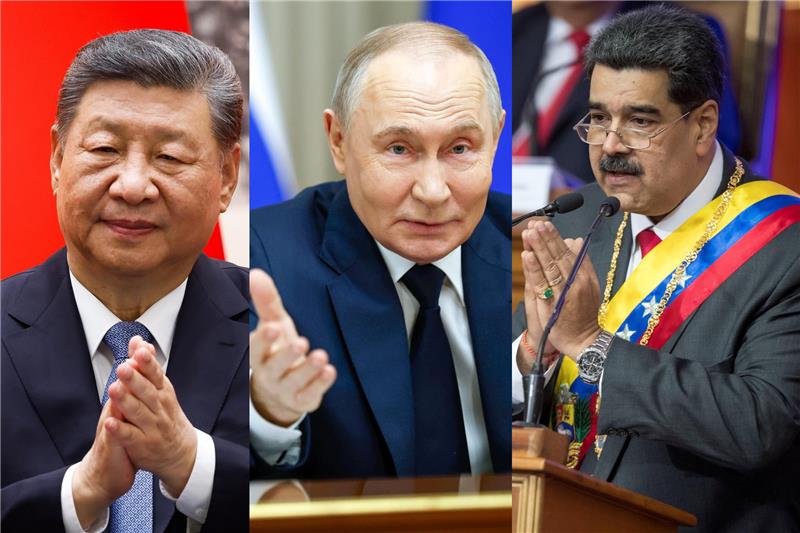
The overthrow of dictator Nicolás Maduro by the USA, in a historic operation on the 3rd, puts into question long-standing alliances made with China and Russia, dictatorships that found in Caracas a refuge for their foreign agenda in Latin America.
A Beijing envoy even met with the captured Chavista leader hours before the American surprise attack in Venezuela. Xi Jinping’s regime had been trying for months to contain President Donald Trump’s efforts to help the embattled dictator ally, who rejected any path that would result in his resignation, banking on the strength and support of his global partners. However, this did not materialize.
Maduro’s fall is a serious blow mainly to China’s influence in the region, which had its main source of oil supply in the country – around 80% of total exports of the resource went to the Asian giant, despite Caracas accounting for just 1% of global trade in the raw material.
According to data from the Oil & Gas JournalVenezuela has the largest proven oil reserves in the world, estimated at more than 300 billion barrels, in which Trump has already signaled that he is interested in investing to recover the currently scrapped energy infrastructure.
In the same sense, Russia reacted to the American attack in a condemnatory tone, as it watched yet another long-time partner being overthrown. Maduro has repeatedly threatened Washington in recent months that he would be prepared to retaliate against attacks with Russian military equipment, which was later shown to be a major fallacy by the dictator.
Influence Test
The fact is that Chinese radars, Cuban intelligence or even Russian missiles were able to prevent Maduro’s removal from his supposedly safe zone.
In addition to paving the way for a possible democratic transition in Venezuela, which is experiencing a serious humanitarian and economic crisis due to years under the rule of a bloodthirsty dictatorship, the US operation that resulted in Maduro’s ouster also represents a test for the growing influence of these regimes in Latin America.
Igor Lucena, economist and doctor in International Relations, points out that Venezuela is seen as an ally of Russia and China for several factors, including its proximity to the USA, ideological affinity, the possibility of inserting bases to train agents and for espionage.
“There was an extremely strong geopolitical component in that region. China and Russia also lose cheap oil. For Beijing, mainly, this market was very interesting due to the need for purchase and consumption. For Moscow, not so much, the relationship involved more the sale of military equipment for the defense of Venezuela, and the high point is really espionage”, assessed the political analyst.
Despite being considered Venezuela’s ideological and commercial partners, there is a clear limit to the reaction of these allied regimes in relation to US actions. Anne Dias, political commentator for People’s Gazettestates that “Putin tends to choose between openly defending Maduro or adopting strategic silence to prevent the US from increasing its pressure where Russia loses the most (the war with Ukraine). China, true to its authoritarian pragmatism, tends to follow the same path.”
Crack in the socialist axis in Latin America
For Dias, the overthrow of Maduro, even with the Chavista regime remaining in charge, mainly weakens the influence of China and Russia in the energy and political sectors of Latin America. In the same sense, a change in the regional political direction has been observed with the latest elections held in countries close to Venezuela.
“Venezuela is one country less aligned with the authoritarian axis in Latin America, at a time when the region is going through elections that have brought to power leaders openly opposed to this model, as we saw in Argentina, Chile, Bolivia and Paraguay. Maduro’s fall is not a detail, it is another concrete crack in the socialist axis that tries to sustain itself in Latin America”, stated Dias.
Game of interests
Analysts consulted by The New York Times point out that, although they played an important role in supporting Maduro and his mentor and predecessor, Hugo Chávez, China and Russia have always evaluated the cost-benefit of allying with Venezuela in times of crisis.
For decades, the Chinese supported Caracas through loans in the tens of billions of dollars that supported the Chávez and Maduro regimes, after Western creditors virtually stopped working with Venezuela.
The business community involved in the Russian oil market has also played a vital role in maintaining the flow of Venezuela’s main export since Trump imposed economic sanctions on the country in his first term in 2019.
According to the Timesover time, Venezuela’s economic decline indicated to the allied dictatorships that the strategic value of the South American country was falling drastically, as the Maduro regime began to be seen as an ally with high economic risk in the region, which accumulated many loans and had difficulty fulfilling agreements due to the loss of control of the internal crisis.
Linked to this, the two powers that compete for power zones with the USA are immersed in their own challenges – China faces a decline in its economy and trade frictions with Washington, while Russia expends enormous energy and expenses on the long invasion of Ukraine.
According to the news agency ReutersMaduro’s fall was harshly criticized by some Russian nationalists, who compared American power to Russian failure in almost four years of war in Ukraine.
On the other hand, some analysts see that Moscow could benefit from the new “Monroe Doctrine” proposed by Trump, due to the potential for creating new spheres of influence in the world. THE Reuters recalled that, since the end of the Cold War, Putin has sought to establish a Russian sphere of influence in the former Soviet republics of Central Asia, the Caucasus and Ukraine, in an initiative that is opposed by Washington.
In turn, Trump anticipated in December a new external agenda focused on increasing his influence in Latin America, informally called his “backyard”, and has already been successful in his first mission.
After the successful operation in Venezuela, the American president suggested that he could expand military actions in the region. One of the countries he targets is Colombia, whose leader, the leftist Gustavo Petro, has been involved in increasing friction with the republican and is seen as a “partner” in drug trafficking, as is former dictator Nicolás Maduro.