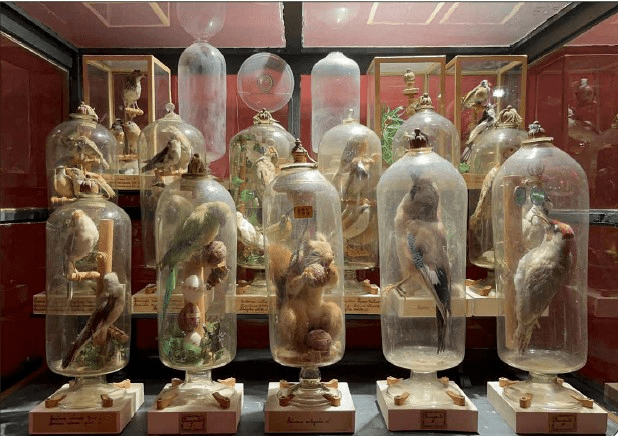
The secret of the bottled animals from the mysterious taxidermy collection of Father Jean Baptiste Fourcault, heritage of the Must – Museum of Naturalistic Historiography of the University of Parma, has finally been revealed. An article just published in “Scientific Museology” unravels a question that has persisted since the eighteenth century. The authors of the work are the scientific director of Must, Davide Persico, professor of the Department of Chemical, Life and Environmental Sustainability Sciences of the University of Parma, Maria Amarante of the University Museum System and Historical Archives Operational Unit, the professor of the Department of Medical-Veterinary Sciences Antonella Volta and the graduate student Alice Giovagnoni.
The small series of taxidermy specimens in glass ampoules, perfectly preserved after almost three centuries, is what remains of the eighteenth-century ornithological cabinet of Father Fourcault, a friar of the Order of Minims who contributed to the foundation of the Parma Museum. The glass ampoules, unique and specially made, have as their only access a small mouth sealed by Fourcault after having introduced the animals, all larger in size than the entrance hole, and the useful elements to contextualize them scenographically.
But how were animals and scenographic elements introduced into the ampoules if the only hole was too narrow to allow them to pass through? Until now it had been impossible to understand the technique used, which Father Fourcault never revealed and which, since the second half of the eighteenth century, has intrigued scholars, remaining a mystery.
Now, with modern investigation methodologies such as radiography and axial tomography, as well as with the study of some specimens preserved in non-original cases, the mystery has been revealed. The investigations shed light on the materials and methods used by Fourcault, revealing that what appeared to be the entrance hole was in reality an apparently reduced opening, created by superimposing a glass collar fixed onto the real opening using the wooden elements of the cap.
The actual opening was generally three times as wide, and thus allowed the passage of hard and non-compressible parts such as animal skulls and wooden objects which were discovered to be composed of elements then assembled inside into larger solid bodies. The bodies of the animals, however, were prepared to be compressed and introduced. The joining lines of the glass collar and the edge of the opening of the ampoule had been camouflaged by Fourcault with elegant cords wrapped all around and the joining lines of the wooden objects hidden by glued papers: therefore the “illusion” is perfect for the beholder.
“Fourcault’s bells – we read in the conclusion of the study – have a peculiar taxidermy value. They not only represent a laborious method of preserving stuffed animals over time, but there is also, on the author’s part, a clear desire to create unique artistic museum objects, with the undeniable wit of misleading the observer”. (by Paolo Martini)