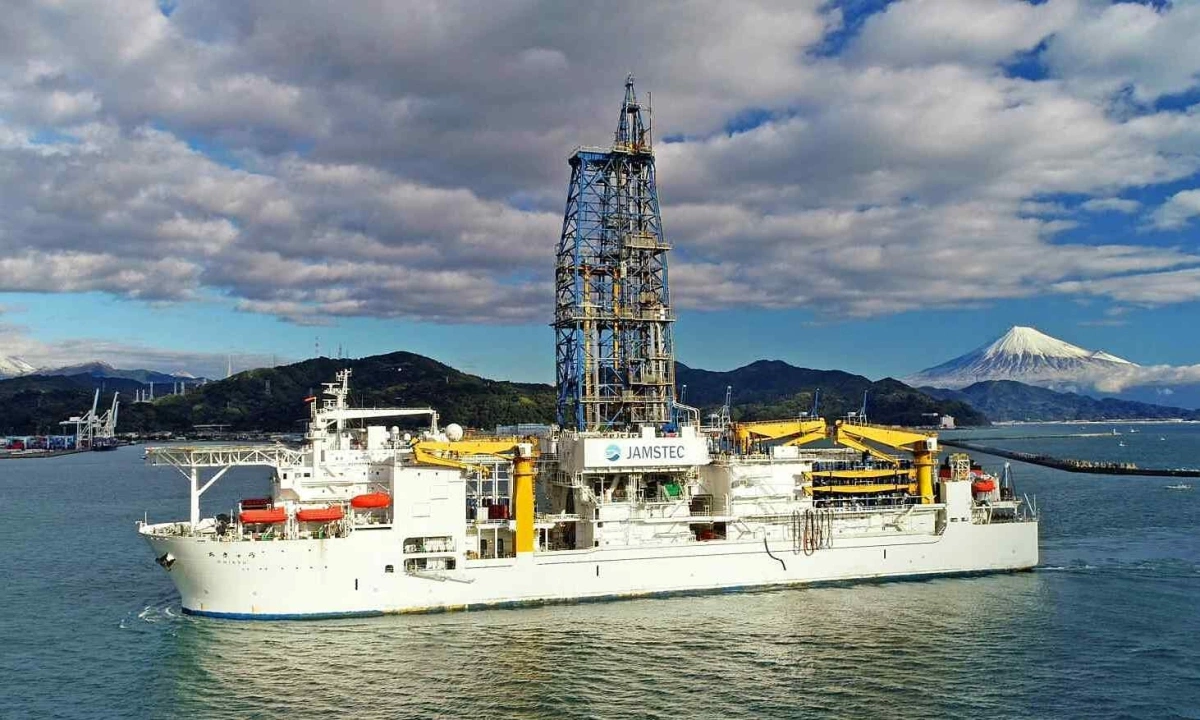
The Chikyu (Japan) departed for the remote Minamitori atoll to explore rare earth-rich mud in an effort to reduce dependence on China.
The trip started from the port city of Shizuoka on January 12, marking the world’s first attempt to continuously pump seabed mud containing rare earths from a depth of 6 km onto the ship. The ship and 130 crew members and researchers are expected to return on February 14.
“After seven years of painstaking preparation, we can finally begin confirmation tests. This is truly thrilling,” Shoichi Ishii, head of the Minamitori island project, told Reuters. “If successful, the project will have great significance in diversifying Japan’s rare earth supply,” he said, adding that mining rare earths from a depth of 6 km under the sea will be a major technological achievement.
The Chikyu ship will test deep-sea rare earth mining. Image: WARRANTY
Like many Western countries, Japan is trying to reduce dependence on China for essential minerals in the production of cars, smartphones, and military equipment. This effort is increasingly urgent in the context of serious diplomatic tensions between the two countries.
Last week, China banned the export of items to the Japanese military that have dual uses, both civilian and military, including some key minerals. According to WSJthe country also began restricting rare earth exports to Japan more broadly.
Japan is no stranger to China causing difficulties in the supply of rare earths. In 2010, China restricted exports after an incident near disputed islands in the East China Sea. Since then, Japan has reduced its dependence on China from 90% to 60% by investing in many foreign projects, promoting recycling as well as production processes that are less dependent on rare earths.
The train to Minamitori Island is the first project to mine rare earths in the country. “The fundamental solution is to produce rare earths right in Japan,” said Takahide Kiuchi, an economist at Nomura Research Institute. “If this new round of export controls includes more rare earth elements, Japanese companies will again try to shift away from China, but I don’t think it will be easy.”
According to analysts, with some heavy rare earth elements such as those used to make magnets in electric and hybrid vehicle engines, Japan is almost completely dependent on China, posing great risks to the country’s key auto industry.
The Minamitori island project has been invested by the Japanese government with 40 billion yen (250 million USD) since 2018. The project team has not announced the estimated reserves and has not given a production target. But if successful, a large-scale mining test will take place in February 2027.
Mining rare earths from seabed mud was once considered economically ineffective due to high costs. But according to Kotaro Shimizu, principal analyst at Mitsubishi UFJ Research and Consulting, if supply disruptions from China continue and buyers are willing to pay higher prices, the project could become viable in the coming years.