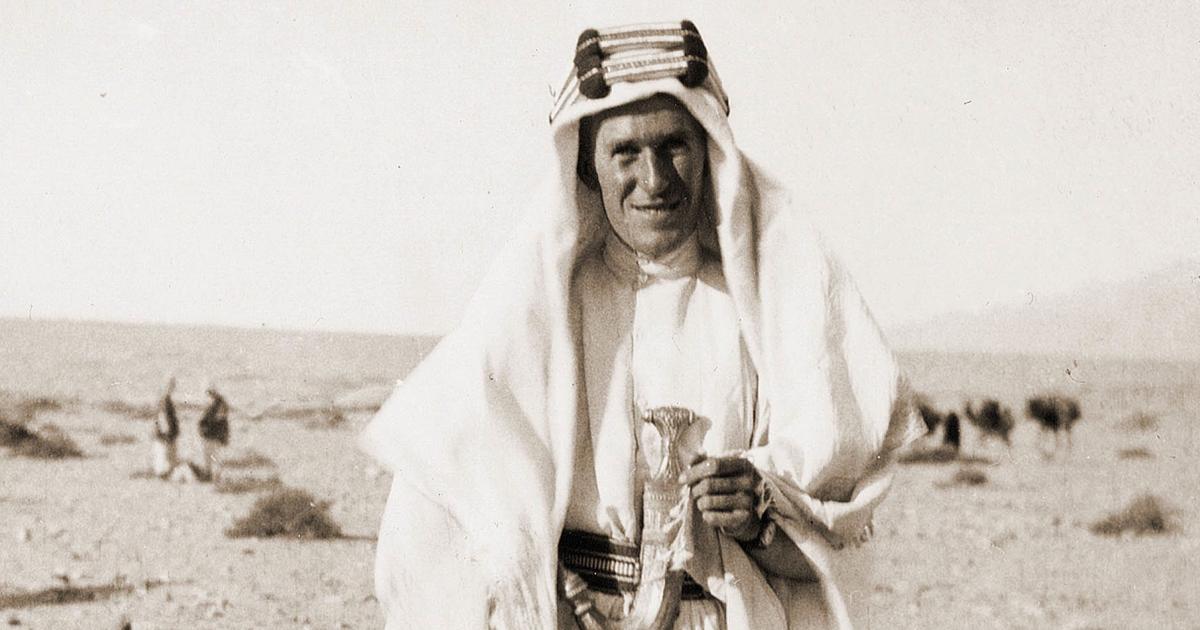
On the London museum’s website, a comment states that the appearance of the colonel, the architect of the great Arab revolt of 1916, “reflects the mentalities of his time”. A curious mark of caution.
El Aurens. The prince of Mecca. Lawrence of Arabia. His commitment earned Thomas Edward Lawrence (1888 – 1935) more or less fanciful nicknames, which reflect the singularity of his adventure. During the First World War, this British soldier was responsible for stirring up Bedouin tribes’ opposition to the Ottoman Empire. His mission was publicized in the media at the time, before being immortalized in a film in 1962.
The National Portrait Gallery, a London museum which houses portraits of historical figures, preserves several photos and drawings of this atypical soldier, who translated The Odyssey and died in a motorcycle accident at age 46. The British conservative daily The Telegraph was recently concerned that a warning accompanies some of these representations. On its website, the establishment justifies their presence.
Skip the ad
Louis XVI, Byron, Victoria
“It is a historical work of art that reflects the mentalities and points of view of the time of its creation. Although these may differ from current mentalities, this image constitutes an important historical document”notes the museum, in a discreet generic message, when the photographs show Lawrence of Arabia as a Bedouin, damascened dagger in his belt. Same thoughtfulness for a drawing representing him with a keffiyeh. Could the colonel be seen as guilty of cultural appropriation?
The warning accompanies works that are, to say the least, diverse. We see it on the table presentation page The Secret of England’s Greatness (1862-1863), where Queen Victoria offers a Bible to a deferential African ambassador. Ditto for a caricature which mocks Bonaparte’s Egyptian conquest. It depicts a scholar mistreated by natives and destined for impalement, with this subtitle: Turkish theology.
CC0
The note also accompanies a portrait of Lord Byron in traditional Albanian costume, a people whose courage the poet praised “unshakeable” against the Ottomans. Even more curious, the message appears at the foot of an engraving entitled The massacre of the unfortunate king of France (1793), in other words Louis XVI. Would the British institution be afraid of offending, in addition to the picky Albanian tourist, the royalist sympathizer? The museum obviously considered that it was necessary to put in place usual precautions.
When questioned, the establishment limits itself to explaining that it is not a question of“a warning regarding sensitive content”but simply of a ” context ” brought within the framework “research and collection development”. We will not know according to what criteria and for what purposes. The structure specifies that this policy only concerns the website, where you can “consult the entire collection, which includes around 220,000 works”. If it is discreet, this mark of caution remains no less symbolic.
A prudence of the Sioux
And surprising to say the least, concerning Lawrence of Arabia. Less heroic than it was portrayed by director David Lean, T. E. Lawrence’s mission gave rise to intense companionship. The Welsh recognized himself in these people of the desert, to the point of wanting to blend into their “ancient civilization which was able to free itself (…) from most of the constraints”. On a more personal level, he dreamed of wrapping himself in the fabric of heroes, while seeking to mask a body synonymous with psychological suffering.
Skip the ad
The outfit of Lawrence, a perfect Arabic speaker who had been roaming the Middle East since he was twenty, responded above all to pragmatism and the needs of his mission, according to the autobiographical The Seven Pillars of Wisdom (1922). It was necessary to move easily and gain the trust of the tribes. « Fayçal (the future first king of Iraq, editor’s note) asked me if I could wear Arab clothes like his at the camp. It would be more practical for me, because it was a comfortable outfit for living in Arabic, as we had to do. Plus, the tribesmen would then know how to behave around me. (…) I accepted immediately, with great pleasure; the military uniform was abominable on camelback or sitting on the ground”writes Thomas Edward Lawrence.
Also read
“Literature is not a school of virtue”: the writer Patrice Jean’s column against “sensitivity readers”
The warning from the National Portrait Gallery echoes the presence of sensitivity readers in Anglo-Saxon publishing houses. Texts by Roald Dahl, Ian Fleming and Agatha Christie have thus been rewritten in order to avoid any language potentially offensive to the modern reader. The term “oriental” has, for example, disappeared from a passage in Death on the Nile. It is showing, to use an expression that these reviewers would have banned, a Sioux prudence.
https://ondate.io/albania/berat-female-escorts
https://ondate.io/albania/durres/ts-escorts
https://ondate.io/albania/durres-female-escorts
https://ondate.io/albania/elbasan-female-escorts
https://ondate.io/albania/fier-female-escorts
https://ondate.io/albania/korce-female-escorts
https://ondate.io/albania/lezhe-female-escorts
https://ondate.io/albania/lushnje-female-escorts
https://ondate.io/albania/pogradec-female-escorts
https://ondate.io/albania/sarande-female-escorts
https://ondate.io/albania/shkoder-female-escorts
https://ondate.io/albania/tirana/ts-escorts
https://ondate.io/albania/tirana-female-escorts
https://ondate.io/albania/vlora-female-escorts
https://ondate.io/armenia/yerevan/ts-escorts
https://ondate.io/armenia/yerevan-female-escorts
https://ondate.io/austria/innsbruck-female-escorts
https://ondate.io/austria/vienna/ts-escorts
https://ondate.io/austria/vienna-female-escorts
https://ondate.io/azerbaijan/baku/ts-escorts
https://ondate.io/azerbaijan/baku-female-escorts
https://ondate.io/bahrain/juffair-female-escorts
https://ondate.io/bahrain/manama/ts-escorts
https://ondate.io/bahrain/manama-female-escorts
https://ondate.io/belarus/minsk-female-escorts