Stomach cancer does not appear suddenly but progresses silently through a series of three pre-cancerous lesions including atrophic mucosal inflammation, metaplasia and dysplasia before officially becoming malignant.
Doctor 1 Cao Thanh Vinh, Department of Gastroenterology, Hanh Phuc International General Hospital, at the conference on January 17, said stomach cancer is a common disease but completely preventable. The process of cancer formation often lasts many years, going from acute gastritis, to chronic inflammation, and then pre-cancerous lesions appear.
According to Dr. Vinh, pre-cancerous lesions of the stomach are abnormal changes in the mucosa that increase the risk of progression to cancer. The three most common forms include atrophic gastritis, intestinal metaplasia, and dysplasia.
Atrophic mucosal inflammation occurs when the stomach lining is exposed to an abnormally acidic environment for a long time, causing the protective layer to erode, thin and expose the blood vessels underneath. The next step is intestinal metaplasia, when stomach cells change into intestinal-like cells to adapt to the acidic environment. This change increases the risk of dysplasia – a lesion directly related to stomach cancer.
“Stomach cancer almost never appears from the beginning but always goes through this series of changes. If detected and intervened early, the risk of malignant progression can be significantly reduced,” the doctor said.
Who is in the high-risk group?
People with a family history of gastrointestinal cancer, especially direct relatives such as parents, siblings, are at higher risk of developing the disease than the general population. Some studies in Korea show that this risk can increase 3 times compared to normal people.
Helicobacter pylori (HP) infection is also an important risk factor. Current methods of diagnosing HP include gastroscopy, breath test and stool test. Among them, endoscopy and breath testing are commonly used in Vietnam.
In addition, people who have pre-cancerous lesions, autoimmune gastritis, smoke or are older are also at increased risk of stomach cancer.
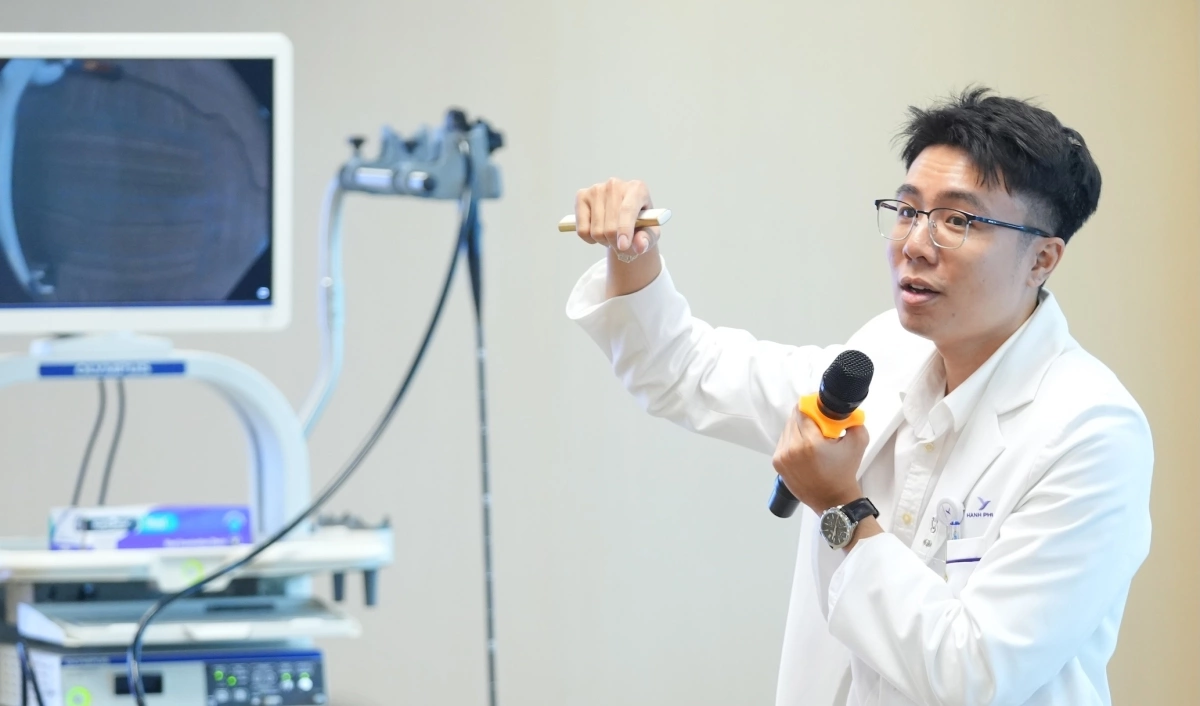
Doctor Cao Thanh Vinh next to the digestive endoscopy system. Image: Hospital provided
Screening for early detection
According to Dr. Vinh, gastric endoscopy is still the most important method and is considered the “gold standard” in diagnosing stomach cancer. A high-quality endoscopy needs to fully observe all locations in the stomach, combined with image enhancement technology such as NBI or BLI to detect small lesions that are difficult to see with conventional endoscopy.
“Many pre-cancerous lesions are only manifested by very small microvascular changes. Without the use of image-enhanced endoscopy, these lesions are easily missed and are only detected when the disease is in a late stage,” the doctor said.
The goal of gastric endoscopy is to detect damage, evaluate the stage of the disease and biopsy to determine the nature of the damage, thereby deciding on appropriate treatment methods. The general recommendation is to start screening for stomach cancer at age 40-60, and the age may be lowered in people with multiple risk factors. The schedule for another endoscopy depends on the results of the previous endoscopy.
People with precancerous lesions need to have a repeat endoscopy after about 3 years. In cases where there are both precancerous lesions and a family history of stomach cancer, the follow-up period should be shortened to 1-2 years. After intervention to treat the injury, the patient may need a repeat endoscopy after 6-12 months.
Data in Asia shows that early screening endoscopy can help reduce the risk of death from stomach cancer by about 40%. “The important thing is that people should not wait until there are clear symptoms before going to the doctor,” Dr. Vinh emphasized.
https://betfinalll.com
https://www.vauva.fi/keskustelu/1600217/ketju/sina_kotilaakari_miksi_sinusta_ei_tullut_oikeaa_la
https://keskustelu.suomi24.fi/t/13658470/paniikki-laakari-kotiin
https://musicserver.cz/pages/?leky-na-erektilni-dysfunkci-nezpusobuji-rakovinu.html
https://redfordtheatre.com/wp-content/pages/finnish-blogger-ed-drug-experiment.html
https://actuabd.com/cookies/articles/?laakari-kotiin-helsinki-espoo-vantaa-palvelut.html
https://esanok.pl/msza-online/wp-pages/?pimurto-miesten-terveyden-hoidossa.html
https://www.merituuli.fi/wp-content/pgs/suomalainen-murtaa-hiljaisuuden.html
https://iccri.net/profil-pusat-penelitian-kopi-dan-kakao-indonesia/
https://futureofsex.net/augmentation/everything-you-need-to-know-about-treating-erectile-dysfunction-with-cialis-tadalafil/
https://catlakzemin.com/viagra-ile-sorunum-mu-ne-erkeklerin-maco-performans-takintisini-besliyor/
https://www.iheart.com/podcast/269-signals-of-tomorrow-311742369/episode/who-really-offers-the-best-doctor-317710414/
https://www.iheart.com/podcast/269-signals-of-tomorrow-311742369/episode/why-p2p-trading-platforms-are-reshaping-317651959/