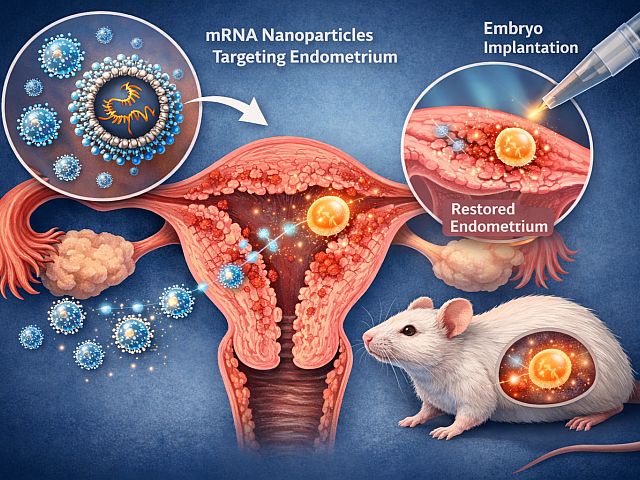
Scientists from the Institute of Ophthalmology named after. Wilmer and the Center for Nanomedicine at Johns Hopkins Medical Center have proposed a new approach to deliver therapeutic mRNA to the endometrium of mice. They used modified lipid nanoparticles (LDL)—tiny capsules of fat molecules—to deliver mRNA to the lining of the uterus.
In a report published in the journal Nature Nanotechnology, the researchers note that in a model of endometrial injury, their method improved embryo implantation. This, in their opinion, opens up the prospect of a new approach to the treatment of certain types of infertility. The team emphasizes that their experiments demonstrate the ability to specifically deliver therapeutic mRNA—the molecular instructions that cells use to synthesize proteins and control their functions—to the damaged uterine lining for a specified period of time.
Many gynecological diseases, such as endometriosis and Asherman’s syndrome, can cause infertility by reducing the likelihood of an embryo attaching to the endometrium – a critical stage for pregnancy, even with the use of assisted reproductive technologies (ART), including IVF. Patients who cannot get pregnant or carry a child to term using ART currently have no effective FDA-approved treatments, researchers say.
mRNA-based therapy works by giving cells instructions to make specific proteins without interfering with their DNA. This principle underlies current cancer treatments and mRNA vaccines against COVID-19. When developing mRNA therapies, one of the main challenges is delivering the molecules to the desired site in sufficient concentration to produce an effect while avoiding systemic toxicity. In the new experiments, the scientists said they set out to find out whether it is possible to deliver unstable mRNA directly to the endometrium using liposomal nanoparticles and what parameters can be improved with their help.
Because mRNA is rapidly degraded and cells contain enzymes that degrade naked mRNA, the scientists used liposomal nanoparticles (LDL) to protect and deliver the mRNA encoding the immune protein GM-CSF (granulocyte-macrophage colony-stimulating factor). GM-CSF is believed to help improve implantation by increasing endometrial thickness. Although recombinant GM-CSF protein can be produced in large quantities, its short duration of action and the risk of distribution to other organs limit its clinical use. In the first series of experiments, the scientists injected GM-CSF mRNA into the endometrium of mice intrauterinely, a method already used in ART to inject embryos and drugs. They found that common LDL mRNA spreads beyond the uterus and can cause toxic effects on the liver and spleen.
To reduce the risk of off-target delivery, the researchers modified LDL with the peptide RGD (arginylglycylaspartic acid). This peptide binds to integrins, cell surface proteins that are actively expressed in the endometrium during the period of implantation (WOI), when the tissue is most receptive to the embryo. This modification made it possible to direct treatment specifically to the endometrium, enhance the expected effect of GM-CSF and reduce side effects when administered during the WOI period.
After administering the specially designed LDL mRNA, the scientists noted that GM-CSF protein levels in the endometrium remained high for 24 hours. After eight hours, it was almost three times higher than in mice that received the recombinant protein. At the same time, the concentration of GM-CSF in the blood was 60 times lower than with the introduction of the recombinant protein, which indicates better safety and a lower risk of damage to other organs.
Using the same method in a mouse model of endometrial damage, which mimics the structural changes that reduce fertility in humans, the scientists found that embryo implantation was restored to levels in healthy mice. In untreated animals, the number of implantation sites was on average 67% less. At the same time, no toxic effects on the uterus and other organs were detected in the treated mice.
https://rumble.com/v74mqdi-studio-quality-headshots-without-the-studio.html
https://gettr.com/post/p3wgeyl2881
https://storymaps.arcgis.com/stories/020aed2fd2384d7986477c37be6188c1
https://diigo.com/011rr7a
https://mootin.com/story/events1/ai-headshot-generator-explained
https://myspace.com/garryhawkins/post/activity_profile_89317517_48f9c39de76c452db3589a64fee12b34/comments
https://ubookmarking.com/story/consistent-branding-for-teams
https://meadowmoss.dropmark.com/2073920/37286315
https://flipboard.com/@cristoferve1vj4/perfect-for-digital-first-careers-4r69lluiy
https://starbookmarking.com/story/custom-styles-and-professional-looks
https://graph.org/Best-AI-Headshot-Generators-for-Career-Growth-01-21
https://papaly.com/categories/share?id=c46d6c7d128c409ab4f6950b5043cae0
https://www.tumblr.com/techpulsearena/806288152774983680/simple-process-powerful-results?source=share
https://mbookmarking.com/story/ai-headshot-generators-changing-professional-photography-forever
https://ybookmarking.com/story/best-ai-headshot-generators-for-linkedin-success
https://letsdobookmark.com/story/affordable-ai-headshot-generators-with-studio-quality-results
https://justpep.com/story/tech/why-professionals-choose-ai-headshot-generators-today
https://whoosmind.com/post/359090_how-ai-headshot-generators-enhance-professional-branding-professional-branding-d.html
https://www.sbookmarking.com/story/best-ai-headshot-generators-for-business-profile-p
https://gab.com/gadgetnova/posts/115931330062879187
https://www.rvparking.com/user/504990
https://www.kildarestreet.com/user/?u=61284
https://www.fanficoverflow.com/profile/view/80147
https://www.fanficoverflow.com/profile/view/80148
https://www.fundable.com/emmittalexander-iramaldonado