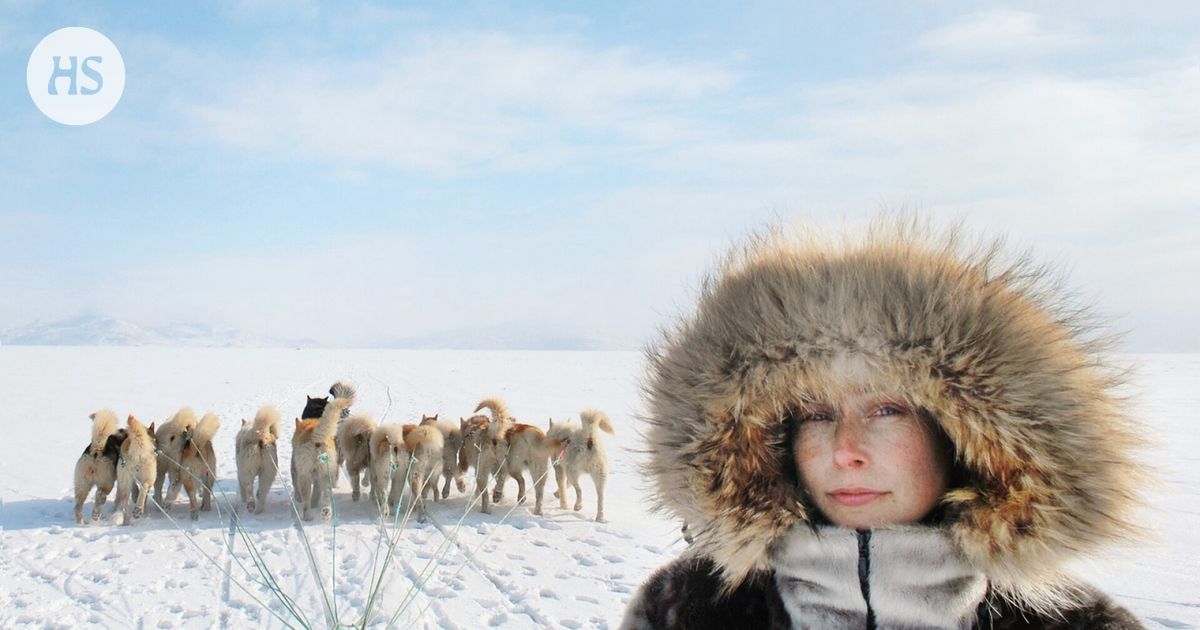
Tiina Itkonen has photographed a small hunting community in Greenland for decades. Now their traditional way of life is threatened by climate change and politicians in power.
Finnish photographer Tiina Itkonen has been photographing a small Inuit hunter-gatherer community in Northwest Greenland for almost 30 years.
The traditional way of life of the Inughuits is threatened by climate change and the political situation.
Itkonen’s photo exhibition Anori – North wind is on display at the VB photography center in Kuopio.
In the middle there is a huge seal on the floor of the room. A sight for a Finn Tiina Itkonen in the photo is peculiar, but for Greenland’s Inughuit hunter it is a way of survival.
“The catch is on the kitchen floor waiting to be cut up,” Itkonen says on the phone, now safely at home in Helsinki. “Part of the seal is put into the pot and prepared for dinner, and part goes to the dogs.”
The Inughuit living in northwest Greenland are the northernmost Inuit group, and there are about eight hundred of them left. The room in the photo belongs Gaerngaaq Nielsento the 84-year-old village elder of Savissivik.
According to Itkonen, the elderly are a bit of a cold case—but in the gentle way that a long life near nature makes understandable.
About fifty people live in Savissivik, and you don’t go there to hang out. We travel there via Denmark to Kangerlussuaq, from there by small plane to Ilulissat and another to Qaanaaq. From there by helicopter via American air base Pituffik to Savissivik, weather permitting.
If not allowed, expected.
“I once waited two weeks for a helicopter,” Itkonen says. “It’s normal there. You can’t force time.”
Now the photos taken by Itkonen in Greenland are on display at the VB photo center in Kuopio.
Kitchen, 2018. Seals, walruses and other Arctic animals are still hunted in small villages. Catch is the most important source of food for many households.
Show consists of pictures he has taken over a period of almost 30 years. The first trip was in 1995, when he was 27. Since then, he has moved on dog sleds, fishing boats, sailboats, cargo ships, oil tankers, helicopters and small planes along the west coast of Greenland.
The name of the exhibition, Anori – North windis apt. Anori means wind, and according to Itkonen, it tells everything essential about the life of small villages: the wind decides where we go and where we don’t. In Finland, the wind raises jacket collars. In Greenland, you can feel it in your soul. In some of Itkonen’s pictures, the snow is moving horizontally and the house is creaking as if trying to change its shape.
Over the course of three decades, Itkonen has spent a lot of time in the homes of Greenlanders, yes Norwegiana foreigner as he is still there. Hospitality is immediate: in small villages, doors are not locked or knocked on, but entered.
“Knowing the language is important,” Itkonen says. “I learned Greenland from the dictionary so I could talk.”
In the evenings, he played cards in homes, sometimes when the weather was raging outside. Coffee was available everywhere, often poured from a thermos. Local delicacies such as seal, walrus and polar bear were also often on display. On festive days, you could enjoy raw whale skin and stone aqia i.e. fermented snacks in a seal stomach pouch.
The essential thing in filming was to strengthen trust.
“Sometimes it took a week before the right moment for filming came,” Itkonen states.
Home 15, Savissivik, 2018. Farming is not possible in the ice-covered north.
Home 16, Kuummiut 2017. The seasons determine the rhythm of the residents’ movement.
Jonas, Savissivik 2002. Itkonen spends a lot of time to gain trust with the subjects.
Greenlandic according to the legend, a person can change to qivigtoqrun to the fells, live there and finally die there.
Itkonen’s passion for Greenland has been about as crazy. The last pictures in the exhibition are from 2019, but Itkonen has been to Greenland even after that. The other year, he took the ninth-graders of Heryk school in Helsinki on an Erasmus trip to Uummannaq, an island with a thousand inhabitants.
On the first day, the teacher took the young people to the sea ice to cast a long line. The next day they lifted it and ate raw fish, Greenland halibut, straight from the opening. Then we played futs on the ice.
“The highlight of the trip was the snowmobile trip organized by the Uummannaq orphanage along the sea ice to a nearby island. The youngsters were dressed in sealskin pants and sealskin coats for that,” Itkonen recalls.
The wind besides, Greenland is plagued by weather weakened by climate change. Hunters make their living from sea ice: seals, walruses, horned whales. Ice is a road and a pantry, a friend and an enemy.
Now the ice has become more unpredictable than before. Open water is encountered in places where there should be solid ice. Sea ice is losing ten percent per decade. The hunting culture has to find new ways to live, and you can’t catch the wind any more than you can catch the ice.
“In the 1990s, the ice was two meters thick and lasted ten months a year,” says Itkonen. “Now it’s thirty, fifty cents.”
Niels, Qaanaaq, 2019. Due to climate change, the traditional way of life may disappear completely.
Qimmit, Savissivik 2018. Northwest Greenland is one of the few places where dog sleds are still used for hunting. Thinning sea ice makes moving on the ice more dangerous than before.
Isortoq, 2017. The sun sets in October and rises again only in February.
Then a new unpredictable factor has arrived: Donald Trump. Itkonen follows the current discussions of the locals on Facebook, because there the villages discuss everything — weather, catches, births, deaths and nowadays also politics.
When Trump announced that he wanted to conquer or buy Greenland, the Inuit did not feel it as a relief. Some profile pictures changed to Greenlandic flags and national costumes.
Someone turned the letters USA inside out. Asu roughly means in the local language Stop it.
“It’s their way of saying back,” Itkonen says and reads aloud one of the most recent comments.
“Someone has posted that North Greenland would become the 51st state of the United States by name Trump. Below is a comment from another conversationalist that under no circumstances.”
“There is also a text: Greenland belongs to Greenlanders. And: Not for sale. Not for rent.”
Else and Meqo, Qeqertat, 1998. There are about 800 Inughuit. More than 600 of them live in Qaanaaq and the rest in three villages: Qeqertat, Savissivik and Siorapaluk.
Completely American soldiers are not strange. Pituffik’s American base is in the area, and the base organizes dog sled races for hunters in the surrounding areas every year. It also invites hunting families to enjoy the arrangements.
Now these acquaintances mix with Trump’s speeches, and the conversation becomes even more sensitive. In the smallest villages, opinions are divided, and the dollars promised by Trump may turn the heads of many agonizing hunting families in favor of the project.
Qaerngaaq and Therisie, 2016. The village elder in his cabin with his now deceased wife.
Olennguaq 1, Savissivik, 2018. The hunter supports the independence of Greenland, but would choose the Trump administration over Denmark.
Let’s go back so still to the cabin, on the floor of which the dead seal in the photo is purring. I asked Itko to ask the owner, village elder Gaerngaaq Nielsen, on Facebook what he thinks about the future of Greenland. Gaerngaaq did not want to comment on politics, but directed the question to his daughter-in-law Olenngaaq.
Familiar man: Itkonen has also photographed him.
And so a Trump supporter was found on the edge of Greenland. Olennguaq writes that the best option would be the independence of Greenland, but otherwise he chooses the United States instead of Denmark.
“Denmark is not doing enough for our infrastructure.”
Isn’t the hunter worried if Trump takes over the area?
“Quick. National security sounds safe to me,” Olennguaq answers briefly.
of the United States in addition to national security, Trump has justified his project with Greenland’s vast natural resources.
It may be a cold ride.
Let’s see who cheats.
Ice or human?
https://x.com/rkrahulkhorwal/status/2013586165455376524
https://x.com/rkrahulkhorwal/status/2013585094406217769
https://x.com/rkrahulkhorwal/status/2013584004973502556
https://traderstreet.uk/contractor/leicestertreeservices/
https://tradesconnect.app/-leicestertreeservices
https://www.serviceseeking.com.au/my-profile
https://www.myjobquote.co.uk/t/leicester-tree-services
https://app.qwoted.com/sources/tom-wilson-d6a669f0-b210-43db-beab-44c47652a1e3
https://www.owler.com/company/leicestertreeservices
https://www.ecitybiz.com/listing/leicester-tree-services.html
https://yourbusinessdirectory.co.uk/?post_type=listing&p=1350
https://www.zoompo.com/leicester-tree-services-delhi/
https://stackshare.io/home1225
https://webrazzi.com/profil/tomwilsonltss/
https://www.sideprojectors.com/user/profile/210959/projects
https://aetherhub.com/Tourney/ViewLeague/20808
https://shikishviliz.webflow.io
https://form.jotform.com/260224662797060
https://experiment.com/projects/wuoinozqpprhuaqzacgx/protocols/8195-shifting-vibrations-the-432-hz-audio-tracks-how-to-use-the-program
https://experiment.com/projects/mhytankmezyyughswtpc/protocols/8215-billionaire-brain-wave-7-minute-audio-dr-summers-sound-frequency
https://cineg.org/wiki/index.php/(5_star)_Wuthering_Waves_Free_100K_Pulls_Lunites_UNLOCK_all_Characters
https://neroid-sector.com/wiki/index.php?title=HOW_TO_GET_FREE_PULLS_in_Wuthering_Waves_BONUS_Lunites_Characters_CODES
https://pyra-handheld.com/wiki/index.php/(5_star_weapon)_Wuthering_Waves_Free_Pulls_Lunites_Characters_IPA_APK
https://africa-rising-wiki.net/(gift_codes)_Wuthering_Waves_Free_Pulls_Lunites_UNLOCK_all_Characters
https://ahay.org/wiki/(all_characters_free)_Wuthering_Waves_CHEATS_Free_Pulls_Lunites_ios_android