According to Deputy Minister Bui Hoang Phuong, although the policy has been open, no domestic scientist has proactively accepted the role of general engineer of large projects.
The Ministry of Science and Technology and the Ministry of Home Affairs have issued mechanisms and policies to attract general engineers and chief architects for key science and technology programs and projects, but the results are “not as expected”.
The information was stated by Deputy Minister of Science and Technology Bui Hoang Phuong at the regular press conference of the Ministry of Science and Technology, on the morning of January 29. According to him, the Ministry “very much wants to find such people but so far there has been no one”.
Deputy Minister Bui Hoang Phuong at the regular January press conference of the Ministry of Science and Technology, morning of January 29. Image: Thuy Linh
In addition to objective factors such as inadequate facilities and infrastructure for science and technology that need to be upgraded, the Deputy Minister believes that the reason is also the fear of domestic scientists.
Recently, the Ministry of Science and Technology has completed the legal corridor with many new regulations and policies, the core goal of which is “trust and empowerment” for intellectuals and scientists. Policies aim to ensure academic autonomy, allowing scientists to directly participate in exploiting, transferring, and commercializing research results, rights that have not been fully guaranteed before. However, according to the Deputy Minister, “mechanisms and policies alone are not enough”. Reality shows that, even though the new policy has been issued, many people still do not dare to do it because they are still worried and afraid.
Another reason mentioned by the Deputy Minister is the difference in policy approaches between domestic and foreign organizations and businesses. Foreign organizations and businesses often study new regulations very carefully right from the draft stage to promulgation. Meanwhile, although laws, decrees and circulars have taken effect, many domestic businesses, organizations and scientists do not clearly understand the content.
“Domestic agencies, organizations, businesses and scientists should research and update new regulations,” Deputy Minister Bui Hoang Phuong said, and advised scientists to trust and “actively go beyond the safety zone.”
According to Deputy Director of Science, Engineering and Technology Hoang Anh Tu, the “safe zone” in science and technology is understood as a space where scientific and technological risks are allowed to exist, but legal, financial and liability risks must “approach zero”. Only then will scientists feel secure in pursuing groundbreaking research.
Deputy Director of Science, Engineering and Technology Hoang Anh Tu. Image: Thuy Linh
From a management perspective, Mr. Tu believes that there are two bottlenecks in risk management in scientific research: institutions and psychological issues of scientists.
Regarding institutions, he said, the Law on Science, Technology and Innovation and guiding decrees have detailed regulations on risk management in scientific research, from the stage of proposing tasks, implementation process to evaluating results.
In case the project does not achieve the initial goal, according to Decree 265, the host organization does not have to refund the funding, because in science, all results are recorded, even when they are not as expected. The new policy also exempts the host organization from civil liability, including criminal liability, if it complies with regulations and procedures.
Regarding psychological bottlenecks, the Ministry will resolve them through transparency, continuous risk management, piloting and training, and clearly explaining laws and decrees. The Ministry has built a digital platform for managing science and technology tasks, in which the entire process from registration, implementation, evaluation to acceptance is carried out on a digital platform, ensuring publicity and transparency. Management agencies will also continuously monitor to guide and help scientists to limit risks to the lowest level.
According to Mr. Tu, in strategic technology programs and key science and technology programs, the Ministry will choose a number of tasks with high levels of risk, especially scientific risks, to serve as points, with scientists stepping out of the safe zone.
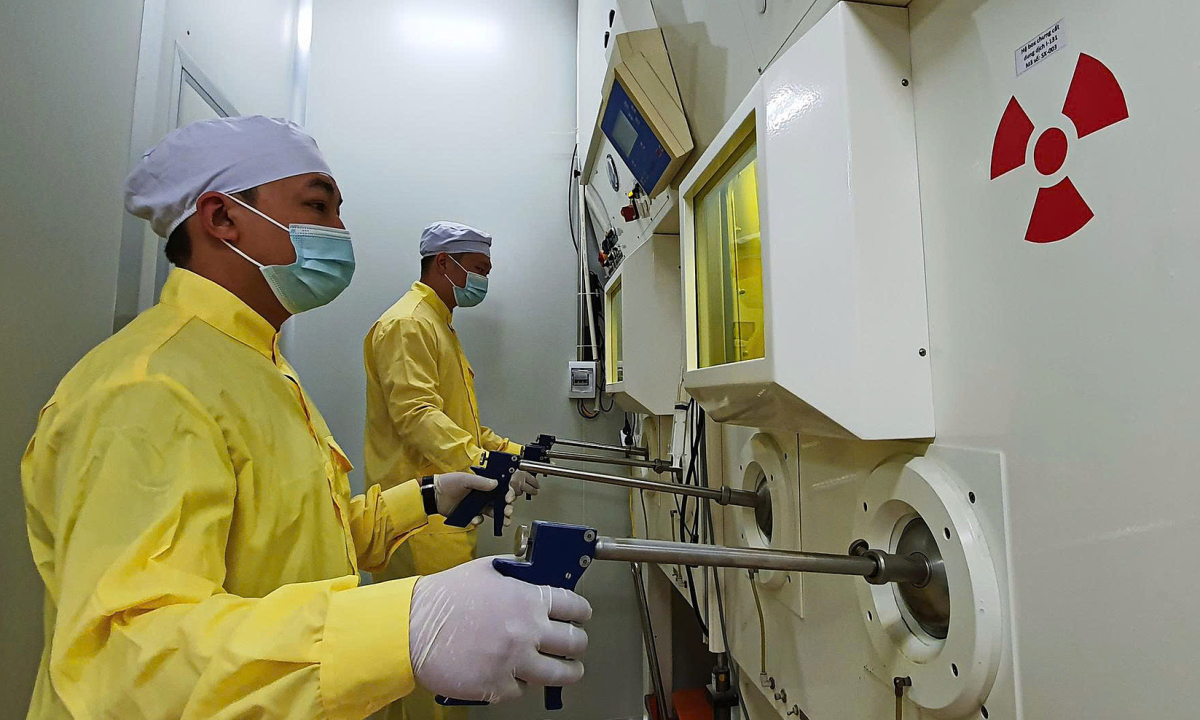
Scientist working at the Da Lat nuclear reactor. Image: Truong Ha
Faced with the fact that many scientists are still hesitant, the Ministry of Science and Technology is changing its approach, from waiting for scientists to propose to proactively searching and promoting.
Deputy Minister Bui Hoang Phuong said that the Ministry has discussed with leaders of Dien Bien province and technology businesses to pilot the sandbox model, although authority has been decentralized to localities. In another direction, the Ministry also seeks ideas from the scientific community through competitions. Ideas that have potential but are not yet completed will be supported and funded to develop into final products.
“Instead of waiting for scientists to step out of the safe zone, the Ministry will pull scientists out of the safe zone,” the Deputy Minister shared.
According to the Resolution of the National Assembly Standing Committee on developing and using high-quality human resources, Vietnam faces the risk of lacking a team of leading experts and general engineers in new technology fields such as semiconductors, AI, biotechnology…
Data from the Ministry of Science and Technology shows that Vietnam has more than 167,000 people working in the field of research and development (R&D), but the majority, accounting for 84%, is concentrated in the public sector. The number of full-time equivalent (FTE – Full Time Equivalent) researchers in Vietnam is 72,991 people. On average, there are 7.6 FTE researchers per 10,000 people, ranking fourth in the region, after Singapore (69.2 people), Malaysia (23.6 people) and Thailand (12.1 people).
https://playingwithsuperpower.com/forum/general-gaming-discussion/playing-slots-for-short-sessions-vs-long-sessions/
https://forum.nanoleaf.me/forum/feature-requests/is-it-better-to-stick-to-one-slot-or-switch-often
https://groups.diigo.com/group/TechNews/content/playing-casually-vs-being-more-deliberate-20797618
http://gendou.com/forum/thread.php?thr=58782
https://www.mrclarksdesigns.builderspot.com/board/board_topic/690695/7766082.htm
https://www.theint.co.uk/forums/topic/trying-crypto-casinos-for-the-first-time/
https://coloringart.com/forums/topic/choosing-between-online-casinos-with-similar-games-2/
https://docs.gopluslabs.io/discuss/6972801f5418716f514e01a8
https://gitlab.aicrowd.com/-/snippets/422776
https://www.trustlink.org/Ask-The-Community/Question/Business/Learning-slot-mechanics-instead-of-just-spinning-18497
https://8kun.top/test/res/87611.html
https://forums.planetdestiny.com/threads/car-interior-detailing-and-why-it-matters-more-than-you-think.52947/
https://forums.twinstuff.com/threads/paint-protection-film-%E2%80%93-is-it-worth-it-for-daily-driving.170901/
https://coldblooded.com/forums/thread/177/
https://investorshangout.com/post/view?id=6812345
https://evershinewalls.com.au/community/wall-paper/mobile-detailing-vs-studio-detailing-any-real-difference/
https://shemaleleaks.com/forum/threads/leather-care-%E2%80%93-how-do-you-avoid-cracks-over-time.886341/
https://docs.fincra.com/discuss/69732500ed0485ed9f2fc14d
https://qjure.com/community/main-forum/is-exterior-detailing-still-useful-in-winter/
https://knowmedge.com/medical_boards_forum/viewtopic.php?t=21250
https://www.edufex.com/forums/discussion/general/can-professional-detailing-increase-resale-value
https://www.molecularcloud.org/p/are-ai-companions-actually-helpful-for-loneliness
https://docs.kongregate.com/discuss/697328021c5764bcd8a19a63
https://dynamitesports.com/groups/can-ai-companions-help-with-social-anxiety/admin/edit-details/
https://kenzerco.com/forums/topic/trying-a-virtual-companion-can-it-help-with-real-life-confidence/