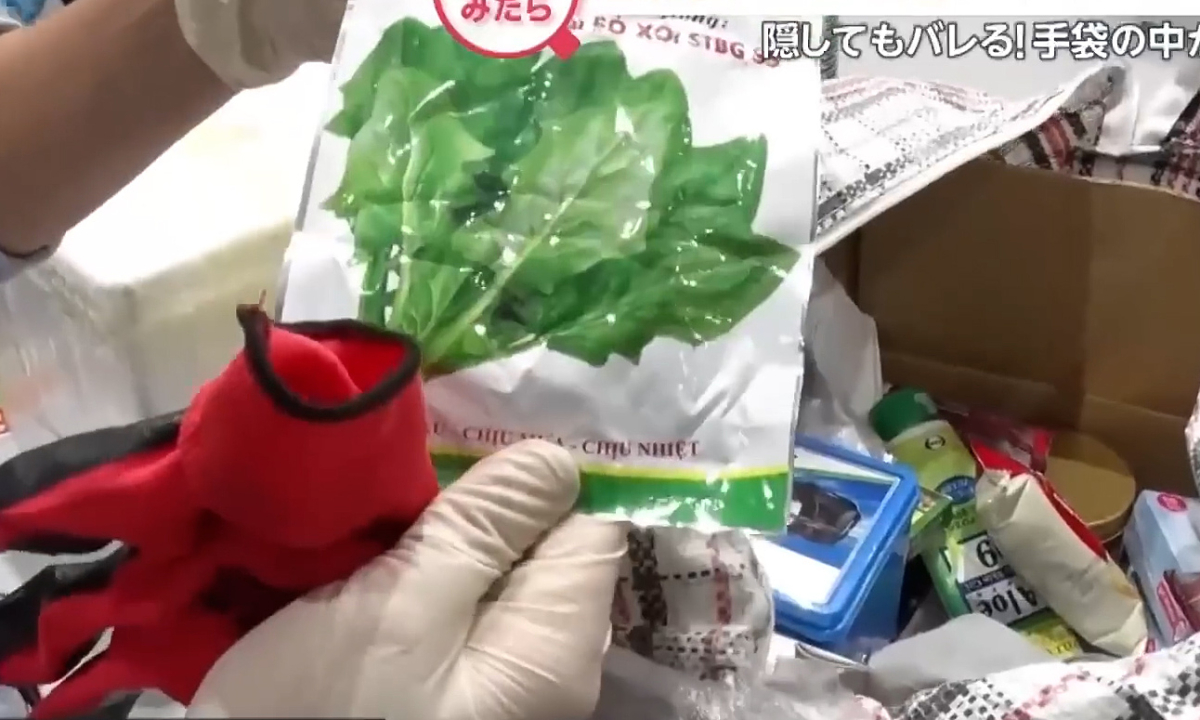
Vietnamese customers hid vegetable seeds in gloves to avoid scanners but were still discovered by authorities in Japan.
On January 22, Japan’s FNN station posted a video about animal and plant quarantine activities at Narita International Airport, Tokyo. Among the discovered cases, the sophisticated method of hiding evidence by a female passenger from Vietnam has drawn special attention from functional staff.
When screening and manually checking the Vietnamese female passenger’s bag, quarantine staff at the airport discovered a large amount of wool gloves and rubber gloves stacked on top of each other. Through inspection, they found that each glove had packets of mustard and coriander seeds stuffed inside.
This passenger even hid a large nylon bag containing seeds at the bottom of the rubber glove box and the slot of the electronic device box.
Vietnamese tourists were discovered hiding vegetable seeds when entering Japan. Video: FNN
At the same time, Japanese authorities also successfully prevented many other passengers from intentionally bringing banned food into the country. A customer from Indonesia wrapped 56 chicken sausages in many layers of black nylon. Chinese visitors also had many foods made from pork, duck neck and fresh fruits such as pears and apples confiscated.
According to the provisions of Japan’s Animal and Plant Protection Law, all types of seeds and meat products are prohibited from being brought into the domestic market without a quarantine certificate from the exporting country.
The reason comes from concerns that dangerous pathogens such as African swine fever or foreign insects lurking in seeds could cause heavy damage to agriculture and local ecosystems.
The representative of the quarantine agency at the airport emphasized that the sniffer dog team was mobilized to review and combine the enhanced multilingual translation tablet system to ensure that all passengers clearly understand the legal regulations.
According to the Japanese Ministry of Agriculture, Forestry and Fisheries (MAFF), individuals who illegally bring vegetables, plants, meat or meat products into Japan can be sentenced to imprisonment for up to three years or a maximum fine of 3 million yen (equivalent to about 505 million VND). In case of violation by an organization or business, the fine can be up to 50 million yen (about 8.4 billion VND). Cases judged to be intentional may be transferred to the police for criminal handling.
https://luckygemcasino.co
https://lyrabet.co.com/
https://lyrabet.co.com/nl/
https://lyrabet.co.com/sv/
https://magiuscasino.co.com/fi/
https://magiuscasino.co.com/pt-br/
https://maxispin.co/nl/
https://memocasino.co.com
https://mrpunter.co.com/de/
https://mrpunter.co.com/fr/
https://mrpunter.co.com/it/
https://mrpunter.co.com/nl/
https://mrpunter.co.com/pt-pt/
https://mrxbet.io
https://onlywincasino.io
https://oscarspin.co.com/
https://oscarspin.co.com/cs/
https://oscarspin.co.com/el/
https://oscarspin.co.com/es/
https://oscarspin.co.com/fr/
https://oscarspin.co.com/it/
https://oscarspin.co.com/nl/
https://oscarspin.co.com/pl/
https://oscarspin.co.com/pt-pt/
https://oscarspin.co.com/ro/