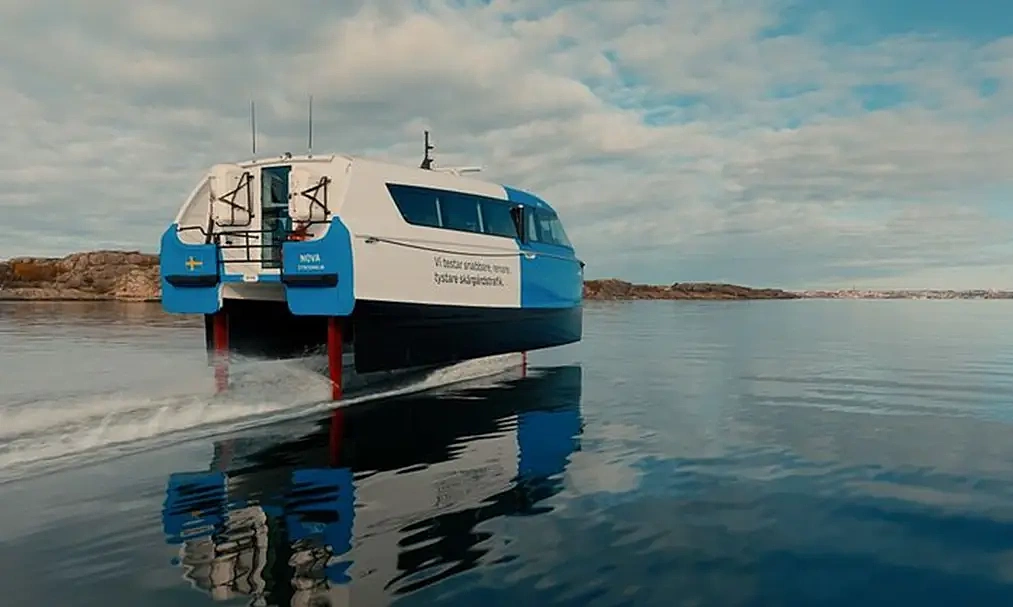
The Candela company’s electric ferry P-12 runs 296 km from Gothenburg (Sweden) to Oslo (Norway), proving that vehicles are not limited to short routes.
Candela announced on February 2 that its hydrofoil electric ferry P-12 successfully made the 296 km journey from the west coast of Sweden to the Norwegian capital in three days, with planned stops for battery charging and demonstration. The company said this was the longest electric passenger ferry trip ever recorded in the world, showing that the vehicle is not limited to short, fixed routes or requires specialized charging infrastructure.
The P-12 electric ferry has a hydrofoil design that helps lift the body out of the water. Image: Candela
P-12 is the world’s first mass-produced hydrofoil electric ferry, the body of which can be lifted out of the water thanks to computer-controlled hydrofoils. When “flying”, drag is sharply reduced, helping the ferry move quickly and consume 80% less energy than traditional boats.
The system has an operating speed of 46 km/h and once exceeded the 55 km/h mark in testing, becoming the fastest passenger electric ferry in operation. With one charge, it can travel about 74 km. This vehicle has been put into use in Stockholm’s public transport system, operating with other types of ferries. However, the journey to Oslo showed its flexibility.
Unlike traditional electric ferries, which often have large battery tanks that are replaced at fixed terminals, the P-12 can be charged using a standard DC fast charger. During the record journey, the ferry used Sweden’s existing DC fast charging network, including Aqua SuperPower charging stations. Where there are no permanent charging stations, the crew uses a 360 kW portable DC charger, connected to a mobile battery system towed by a Ford F-150 Lightning electric pickup truck.
“Charging infrastructure is a hidden cost in traditional vessel electrification,” said Gabriele De Mattia, project engineer at Candela. “In many cases, building a MW charging station can cost as much as the value of the ship. The breakthrough of the P-12 is the ability to charge quickly and be flexible in operating locations.”
In Oslo, the city’s fastest traditional electric ferry operates on a fixed route of about 19 km and needs to exchange batteries with a capacity of many MWh. That system alone has cost hundreds of millions of Norwegian krone, and has been plagued with delays and cost overruns, limiting expansion to new routes. Meanwhile, according to Candela, the total electricity cost for the P-12’s record journey was just over 200 euros (2,300 Norwegian krone).
https://henrichs.co.uk
https://johnpowneyheating.co.uk
https://bdandcomicspassion.co.uk
https://mopskimmer.co.uk
https://webuywesellmotorhomes.co.uk
https://orchardoakstreecare.co.uk
https://sensiskincbd.co.uk
https://aspirefitnessgym.co.uk
https://cybermust.co.uk
https://wassfishingtackle.co.uk
https://swatchsquad.co.uk
https://replicaluxurious.co.uk
https://whitegoodscentre.co.uk
https://sacfl.co.uk
https://dorsetarchery.co.uk
https://martinyoungstainedglass.co.uk
https://tandccars.co.uk
https://djbookbinders.co.uk
https://alanaaronson.co.uk
https://warwickjitsu.co.uk
https://sgpublishing.co.uk
https://sprotmethchurch.co.uk
https://hiltonhouse-guesthouse.co.uk
https://mpwa.co.uk
https://arcstudenttravel.co.uk