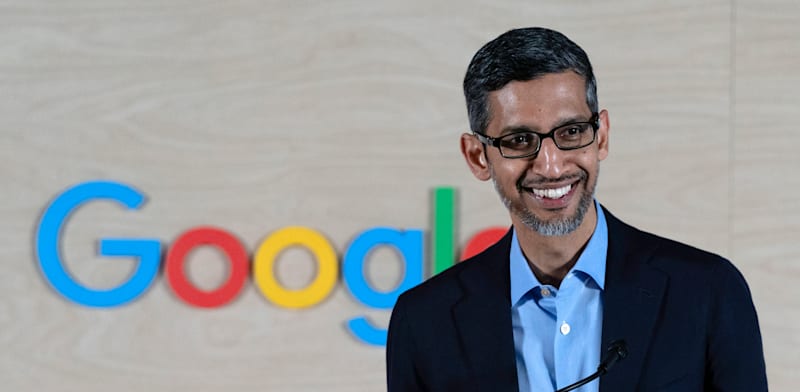
The CEO of Google, Sundar Pichai, decided to surprise investors and analysts when he revealed already during the presentation of the reports last night (Wednesday) the tidal jump that he is going to make in the capital investments during the coming year. No less than 175 billion dollars, and it is possible that the figure in general will end at 185 billion. Again, the number is only temporary and represents the forecast for the beginning of the year, and is subject to changes and updates in the future as well. Can it rise beyond For 200 billion dollars?
Pichai’s experiment shows that the answer may be positive: the company exceeded forecasts in every area, and in its cloud product, the most important growth engine – it grew by an astounding 48%. As you may remember, just a week ago Microsoft missed out on the cloud business, when its quarterly growth in the field dropped from 40% to 39% and it was punished by a 15% reduction in the share price since then. stock Google Received after the publication of the reports in the evening “only” 2% of its share price. In early trading today (Thursday) it has already recorded a 3% drop and is on its way, apparently, to drop again below the 4 billion dollar mark.
The huge investment in capital equipment means a massive expansion of building server farms, graphics processors and maybe even buying or operating power plants. Google, or any company, has never spent such a large amount on building infrastructure in one year. By comparison, the International Space Station was built with a lower budget of $150 billion, and that too by a consortium of governments such as the US, Russia, Canada, Japan and the European Union. The entire Apollo program over its generations cost $178 billion, and it amounted to landing 12 astronauts on the moon.
The surprising announcement as mentioned did not do Google stock any good, but for the group of shares associated with it – companies from which it buys services and products such as Broadcom and Nvidia – it did nothing but good. stock Nvidia Now up 1.5% in early trading, AMD increases by 1.4%, and Broadcom increases by almost 5%. Broadcom is Google’s main engineering supplier in its GPU project, TPU, and a partner in the development of communication chips.
Why surprise now?
Why did the CEO of Google decide to surprise the investors and in the midst of such good reports to “slip” the figure that on other days would have been difficult to swallow? Here are three possible scenarios.
1Nvidia competition: Google is a client of Nvidia in some of its server farms, but also its fierce competitor. Its TPU7 processors compete with Nvidia’s Blackwell processors, and its ICI chips compete with Nvidia’s processors developed in Israel, such as the Bluefield and Spectrum X.
Google proved in the last quarter of the year – the one in which it jumped 48% in cloud revenues – that it is able to sell its chips to external customers after using them mainly internally in recent years. Senior officials in the industry even admit that the bulk of its growth in Israel, for example, is done in jobs in the field of chip development, and not in other activities related to software or the cloud – which means internally that Google also prioritizes the chip project over other businesses. After it became known that it serves huge clients such as Meta, Anthropic and Midgerni, and several companies for renting AI clouds (“neo-cloud” companies), Google proved that it can provide large organizations with server farms that mainly house its chips and operate on the basis of its technology.
It is very possible that part of the construction of the giant’s facilities will allow it to compete with Nvidia in the provision of cloud and AI services that will come with cheaper chips and better suited for heating, alongside ready-made servers. In this case, Google will prove not only that it is Nvidia’s main competitor, but also that it can be the winner of the AI era. For a dream like this, it pays for Pichai to pay even 200 billion dollars a year.
2space venture: The comparison to the International Space Station is not without context. Like SpaceX and Elon Musk, Google is also exploring the idea of establishing a server farm in space. It sounds a little sketchy, but there is logic behind it: the main bottleneck in building server farms for AI processing is electrical infrastructure – and in a situation where a satellite is cruising in space, it can enjoy free solar energy, all day long. Satellite communication networks can be more efficient and faster than international fiber networks – but they have one major drawback, which is the emission of a lot of heat and the difficulty of cooling the satellite, which is solved on the ground using sophisticated cooling systems. Google sees the satellite project as an interesting long-term plan, but does not expect it to become a reality before 2031.
3Invest more because there is no choice: The CEO of Google still remembers the punchline he said a year ago: It is impossible not to invest in AI infrastructure – it is better to invest too much than too little. This philosophy apparently paid off for Google – which this year crossed the quarterly revenue threshold of $100 billion for the first time (annual revenue rate of $400 billion or more).
However, there is a chance that Google is investing in capital equipment only to continue growing at the current rate and not to lose momentum. Microsoft’s miss from a week ago indicates the negative sentiment that investors can attribute to a company whose cloud activity does not continue to grow at an accelerated rate. The fact that Google does not reveal how much of the new revenue is attributed to AI and what profitability it provides, only adds to the suspicion of investors who do not know how to swallow the economic model behind replica investments.
For your attention: The Globes system strives for a diverse, relevant and respectful discourse in accordance with the code of ethics that appears in the trust report according to which we operate. Expressions of violence, racism, incitement or any other inappropriate discourse are filtered out automatically and will not be published on the site.
https://pin-up-141-casino.com/
https://www.instagram.com/p/DUVa-ZzkyNP/
https://pinterest.com/pin/1115696507707367370
https://pin.it/5vIcYcayR
https://topmate.io/subsmart
https://anyleads.com/how-to-build-an-seo-strategy-that-survives-every-google-update
https://anyleads.com/how-social-media-signals-impact-seo-rankings
https://anyleads.com/how-small-business-founders-can-leverage-seo-marketing-even-with-small-budgets
https://note.com/ozv/n/n4cadf0552532
https://asim.uj.ac.za/wp-content/uploads/formidable/2/citrusburn_review_2026_r_miller.pdf
https://cupolaboraltrans.chubut.gov.ar/wp-content/uploads/formidable/3/citrusburn_review_for_2026.pdf
https://lnat.ac.uk/wp-content/uploads/formidable/12/cbreview2026.pdf
https://www.dut.ac.za/wp-content/uploads/formidable/193/citrusburn_review_rmiller.pdf
https://www.smu.ac.za/wp-content/uploads/formidable/19/citrusburn_review_470.pdf
https://pitchengine.com/view/ideawins-set-to-announce-major-wsk4eexc
https://pcloud-valentine2026.manus.space/
https://pcloud-valentine2026.manus.space/what-is-pcloud
https://pcloud-valentine2026.manus.space/comparison
https://pcloud-valentine2026.manus.space/sale-guide
https://github.com/shabbirraju19-hue/cardioton-heart-health-toolkit/blob/master/README.md
https://github.com/shabbirraju19-hue/cardioton-heart-health-toolkit/
https://pcloud.manus.space/
https://pcloud.manus.space/pcloud-lifetime-timing
https://pcloud.manus.space/compare
https://pcloud.manus.space/compare/dropbox