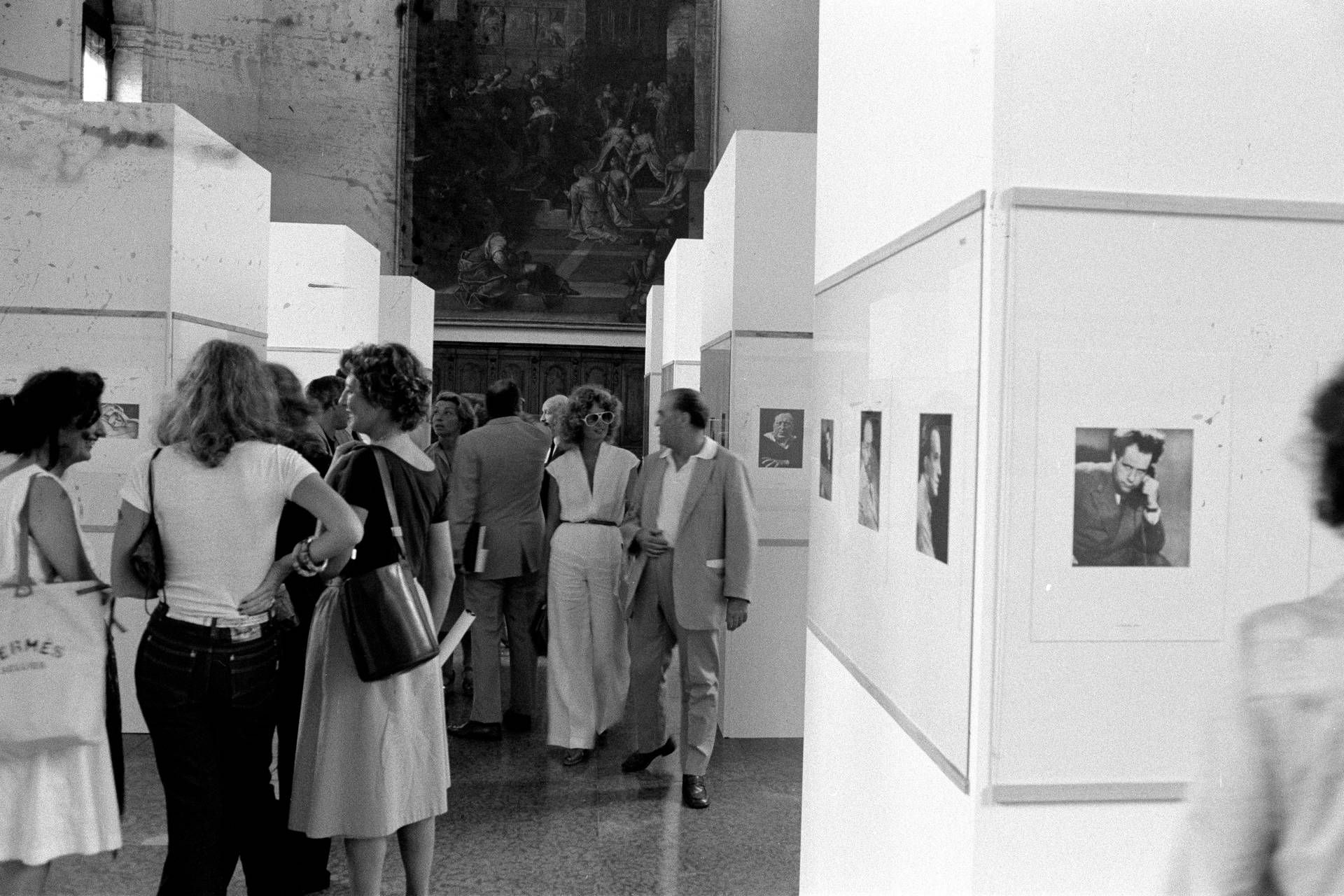
Fifty years after the historic Art Biennale of 1976, the Venice Biennale inaugurated today, Friday 6 February, the exhibition “Man Ray, the rediscovered image”, set up at the Portego of Ca’ Giustinian, home of the Biennale itself. The exhibition presents in its entirety the photographic corpus of the “Man Ray. Testimonianza” exhibition, held at the time on the island of San Giorgio Maggiore by Janus, as part of the “Environment, Participation, Cultural Structures” section, directed by Vittorio Gregotti. The inauguration saw speeches by Pietrangelo Buttafuoco, president of the Biennale, and Debora Rossi, head of the Historical Archives.
The exhibition constitutes a tribute to one of the protagonists of Dadaism and Surrealism, through the re-proposal of 160 photographic works donated by the artist to the Historical Archive, together with a selection of preserved materials including documents, photographs and work materials. The initiative thus restores the context and meaning of an exhibition project that Man Ray himself donated to the Biennale and which over time has become one of the most requested funds of the Archive.
“We are in the beating heart of the Biennale, which is not only expressed through exhibitions and festivals, but has its own daily life – declared Pietrangelo Buttafuoco during the inauguration -. Soon we will announce and prepare a physical place in the city that represents this daily dimension of our work. Here, in this transit, we can encounter the results of the work of this ‘continuous factory’ that is the Archive”.
President Buttafuoco underlined the central role of photography in art and cultural memory: “Today we find ourselves faced with a master who applies the precise sense of aesthetics using a technology imbued with thought: photography. The photograph is read, the newspaper article is looked at – as an eccentric character from our memory once wrote to the printer’s daughter – and in it the artist’s eye goes straight to the point, even among superfetations and inventions”.
Debora Rossi, head of the Historical Archive, then presented the exhibition itinerary in detail: “Today we propose again, after 50 years, this exhibition which is part of the heritage of the Historical Archive collections. The 160 works on display cover Man Ray’s entire career from 1917 to 1973 and guide the public through his dreams and suggestions, reconstructed together with Janus and the artist himself. At the time, Man Ray was already ill and forced to Paris, but followed the construction of the project with attention and participation, then donating it to the Archive of the Biennale”.
The works presented include prints from negatives and plates, unique photographs, reproductions from catalogs and publications, selected not only for their documentary value, but also as components of a conceptual work that reflects the expressive potential of photography. “The sense of re-proposing this collection – explained Rossi – is twofold: to show it for the quality and beauty of the works, and to make it accessible to students, researchers and enthusiasts who were not able to see it at the time. The exhibition thus becomes a study tool and an opportunity for reflection, with a contemporary perspective on Man Ray’s contribution to the history of photography”.
In parallel to the exhibition, a workshop is planned which will see the presentation of the anastatic reproduction of the historical catalog of the 1976 Biennale, enriched by new texts, iconographic apparatus and critical interventions. The project strengthens the mission of the Historical Archive – International Center for Research on Contemporary Arts of Venice, a lively and open place dedicated to the protection, valorisation and research of artistic legacies, and to their accessibility for scholars, students and researchers.
The exhibition also represents a bridge to the future: the new headquarters of the Archive at the Arsenale, currently nearing completion, will be inaugurated in June 2026 and will offer additional spaces for exhibitions and research activities.
The exhibition itinerary allows us to retrace Man Ray’s career through photography, from his beginnings with Dadaist experimentation to his latest works, and to understand his innovative approach to reproduction, image manipulation and the construction of the work as a global concept. Janus, curator of the exhibition and art historian, personally followed the project since 1969, organizing exhibitions in Italy and abroad, and maintaining a constant dialogue with the artist even when Man Ray was unable to travel.
The Ca’ Giustinian exhibition thus represents a unique opportunity to rediscover the legacy of Man Ray and his role as an absolute experimenter of photography, capable of combining technique, aesthetics and conceptuality in works that continue to influence generations of artists and photographers. The exhibition will remain open for the next few months, welcoming visitors, students and scholars, and preparing for a moment of in-depth analysis scheduled for the autumn, which will see further critical reflection on the artist’s photographic heritage.
With “Man Ray, the rediscovered image”, the Venice Biennale reaffirms not only the historical value of its Archive, but also the ability to return to the public a living and significant artistic heritage, capable of communicating with the present and projecting itself towards the stars, just like in the master’s last exhibited work, “The Milky Way”. (by Paolo Martini)
https://bdmbetaustria.com/mobile
https://bdmbetaustria.com/payments
https://bdmbetaustria.com/problems
https://bdmbetaustria.com/review
https://bdmbetaustria.com/slots
https://bdmbetaustria.com/support
https://bdmbetaustria.com/withdraw
https://bdmbet-belgica.com
https://bdmbet-belgica.com/apk
https://bdmbet-belgica.com/app
https://bdmbet-belgica.com/bonus
https://bdmbet-belgica.com/bonuscode
https://bdmbet-belgica.com/casino
https://bdmbet-belgica.com/deposit
https://bdmbet-belgica.com/download
https://bdmbet-belgica.com/faq
https://bdmbet-belgica.com/legal
https://bdmbet-belgica.com/login
https://bdmbet-belgica.com/mirror
https://bdmbet-belgica.com/mobile
https://bdmbet-belgica.com/payments
https://bdmbet-belgica.com/problems
https://bdmbet-belgica.com/review
https://bdmbet-belgica.com/slots
https://bdmbet-belgica.com/support