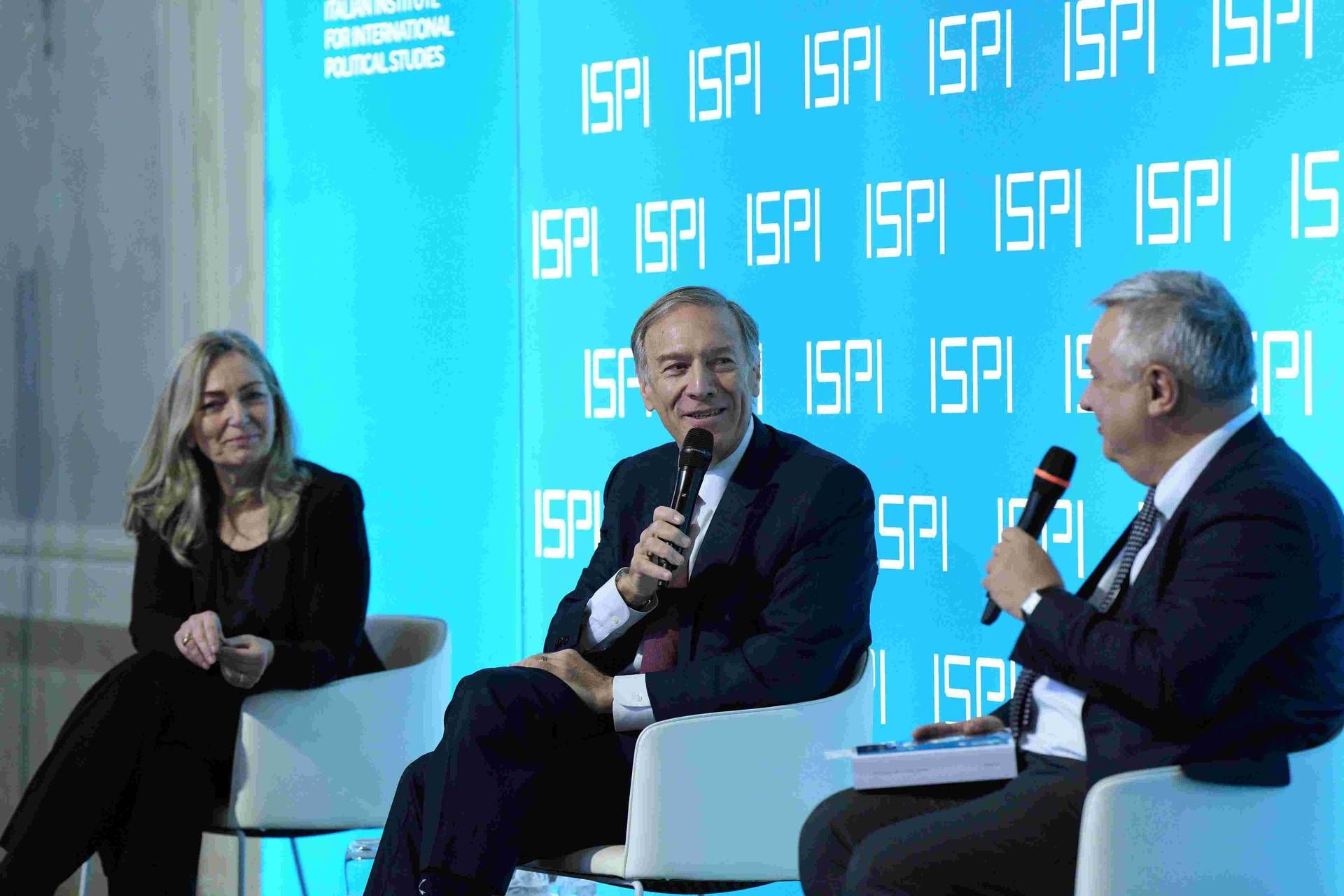
The West faces an existential challenge. Not economic, not only military, but profoundly political, moral and civil. This is the underlying theme of the speech Mike Pompeo at ISPI, where the former Secretary of State and Director of the CIA presented the Italian edition of his book “Never a step back. Fighting for the America I love” (Liberlibri), in a meeting moderated by Maurizio Molinariwho wrote the introductory essay for the Italian edition of the book, and opened by the president of ISPI Mariangela Zappia. One of the most interesting elements is that Pompeo, the only one who managed to “survive” four years during Trump’s first term, without resigning or being kicked out, and is still one of the president’s most listened to men, does not hold back from criticizing the “negotiating” attitude of the current administration with Iran, Russia and China.
In this regard, on the sidelines of the meeting, Adnkronos was able to ask a question to the former Secretary of State, on the topic he spoke about most during the meeting: the Chinese danger. In this phase of transatlantic turbulence, many in Europe are pushing for rapprochement with Beijing. What should Italy do in this context? According to Pompeo, “neither in Europe nor in the United States are we fully aware of this threat, but we must be. And when the risk is fully understood, the market and investors will react in a rational and coherent way. Because in the end these are commercial investments. It is businesses, banks, private funds and industrial capital that decide where to grow and innovate. The Italian government must create the conditions so that investing is convenient and attractive: a stable regulatory environment, a financial system that supports innovation, a qualified workforce and institutions capable of training advanced skills. We are facing a civilizational, generational change, the sooner we realize it the better.”
An “aged” international order
In his opening speech, Pompeo immediately questions the architecture built after the Second World War. Multilateral institutions such as the United Nations have worked for decades to benefit the West, but today they are “no longer relevant to the times”. The problem is not only institutional, but political and cultural: the world has changed, the populations have changed and above all the global weight of the Chinese Communist Party has changed.
According to Pompeo, the values that have ensured prosperity and stability – human dignity, property rights, national sovereignty – have not disappeared, but are under attack from alternative models that openly reject them. “Western civilization will prevail in the end,” he says, “but that is by no means a given.” Beijing actively works, even within Western societies, to delegitimize the historical role of the West and convince it that it no longer deserves global leadership.
“Good guys” and “bad guys”: the geopolitical map
To Mariangela Zappia’s question about the role of Europe, Pompeo responds with a formula that summarizes the entire structure of his speech: “I’m from Kansas, I think in simple terms: there are the good guys and the bad guys.”
In the “good guys” camp he places the United States and Europe, together with Japan, Australia, South Korea, India, South-East Asia and the Gulf countries (provided they contain Islamist radicalism). On the other side, the “bad guys”: Russia, China, Iran, North Korea and Venezuela.
The United States, he insists, cannot handle this confrontation alone. This is why Europe is called to “do its part”, strengthening defence, security and strategic autonomy. But the most important cooperation is neither military nor economic: it is psychological and cultural. “We must believe in ourselves. If we lose faith, if we accept the idea that we are destined to become Beijing’s vassals, then everything else becomes irrelevant.”
China: a civil challenge before a military one
It is on China that Pompeo builds his most radical reasoning. The West, he says, has made itself dangerously dependent on Beijing, from rare earths to drugs, for economic convenience and political laziness. Not because there is a lack of resources or technologies, but because we chose to outsource what was expensive or environmentally inconvenient.
The real issue, however, is human and cultural. “Brains matter more than the Navy and the Army.” For decades, he argues, China has absorbed Western human capital through universities and research, strengthening a system that today has no intention of cooperating. “There is no real Chinese private company: when you talk to a company, you talk to the Party.”
Pompeo rejects the idea of a possible neutrality: it is not a question of choosing between the United States and China, but between “decency and brutality”. Beijing’s management of the pandemic is cited as clear proof: the escape of the virus from the Wuhan laboratory (which the former Secretary of State takes for granted) could also have been accidental, but the choice not to contain it and allow its global spread was deliberate, with tens of millions of deaths and devastating consequences for entire generations. “Xi Jinping hasn’t lost an hour of sleep over all this. This gives you a measure of how ready his regime is to cooperate.”
North Korean soldiers in Europe
Even more clear was when he spoke of North Korea’s direct involvement in the conflict in Ukraine. Thousands of Kim Jong-Un’s soldiers fighting in Europe, “unthinkable until a few years ago”. But the central point, for Pompeo, is not Pyongyang: Kim would not act as an autonomous leader, but rather “under the full control of Beijing”. Every meeting between American and North Korean envoys, he said, was preceded and followed by trips by the “dear leader” to China, first to receive instructions and then to give an account. The sending of troops would therefore not be a sovereign decision nor the result of the defense agreement with Russia, but the result of a Chinese strategic choice. “North Korea is not an independent country in the full sense of the term,” Pompeo said, “it is a tool in the hands of the Chinese Communist Party.” An element that reinforces, in his reading, the idea that the war in Ukraine is not a regional conflict, but an advanced front of a global challenge in which Russia and China operate in a coordinated way against the West.
Putin doesn’t “suffer” enough
What does it take to end the war in Ukraine? The problem, according to Pompeo, is that Vladimir Putin is not yet paying a high enough price. Indeed, it is better for him to continue fighting. Europe must understand that the Kremlin’s objective is not just Kyiv, but a strategic project that includes the Baltics, Moldova and Georgia. Pompeo spoke with Putin for about ten hours (“no one will give them back to me”, he jokes), and he understood one thing: he considers those territories, and will always consider them, an integral part of Russia.
Western deterrence has so far worked only partially. To change the Kremlin’s calculation, Pompeo argues, it is necessary to hit Russian military, energy and industrial (non-civilian) infrastructures more decisively, increasing the cost of the war. “I don’t believe that if we hit the regime’s key infrastructure there will be a nuclear retaliation. Of course, now that I’m not in government they could accuse me of ‘making it easy’. But I believe the opposite: that today we are already paying a very high cost and we cannot afford not to act.”
Iran: “The regime is weaker than ever”
On the Iranian chapter, requested by Maurizio Molinari, Pompeo describes the protests of recent months as radically different from the past: not only in geographical extension, but in social composition and economic depth. Shopkeepers, students, elderly people: a transversal rebellion fueled by the collapse of living conditions.
The regime’s response was, according to Pompeo, of unprecedented brutality: tens of thousands of deaths in a few dozen hours, including wounded killed in hospitals. “When the world doesn’t react with the same strength shown in other tragedies, I worry,” he says. In his opinion, Tehran and its regional proxies – Hezbollah, Hamas, militias in Iraq and Yemen – today find themselves at their moment of greatest weakness since the end of the Cold War.
“Nothing will go back to the way it was before October 7,” he claims. The final result in Tehran will not be a democracy on the Western model, but there is a real possibility of overthrowing a regime that since 1979 has represented, in his words, “the largest state sponsor of terrorism”.
Hence the rejection of the negotiations with Tehran: “Thinking of making an agreement with this regime is simply naive. They lie. They will never voluntarily give up ballistic missiles or the nuclear program as long as they remain in power. An agreement is only possible after a change of regime, which can happen tomorrow or in a year, but it will happen.”
Abraham Accords and Saudi Arabia
Pompeo claims the historical significance of the Abraham Accords: the first recognition, after decades, of Israel’s right to exist by Arab countries. However, Saudi Arabia’s absence remains the big missing piece.
According to the former Secretary of State, Riyadh needs two conditions to take the step: the certainty of American support in the event of internal tensions and a decisive weakening of Iran. As long as Tehran continues to threaten the region with missiles and nuclear ambitions, it will be difficult for the Saudis to expose themselves. Meanwhile, he notes, operational relations between Israel and the Gulf countries are already much deeper than they formally appear.
Born, the global South and trust
On the future of NATO, he reassures: the Alliance is not in danger, but must evolve. Born to contain the USSR, today it faces hybrid threats, cyber and systemic Chinese influence. Russia and China, he repeats, are not separate dossiers.
There is also ample space for the global South, from Latin America to Africa, where Beijing has taken advantage of years of Western distraction to build infrastructures, ports and levers of political conditioning. A model based, he says without half measures, on corruption, dumping and dependence.
The final point is trust. It is not measured in political declarations, but in real behavior: where do young people want to go to live? In which currency is wealth stored? “Not in renminbi,” he observes, “but in dollars, euros and gold.” This, for Pompeo, is the sign of a civil superiority that the West risks losing only if it stops believing in it. Faced with a protest from a lady in the audience, who accused him of offering empty rhetoric and asked him on what basis of values we can define ourselves as ‘the good guys’ today, Pompeo replied: ‘in China he couldn’t have asked this question.’
“If we think we are no different”, he concludes, “we are destined to become like them. I remain “long” on Western civilization, I bet we will make it. But whoever doesn’t think so can convert all his assets into renminbi. And good luck”. (by Giorgio Rutelli)
https://nv-casino.se/en/spins-free/
https://nv-casino.se/en/en-login/
https://nv-casino.se/en/en-bonus/
https://nv-casino.se/en/
https://nv-casino.se/aterbetalningspolicy/
https://nv-casino.se/sekretesspolicy/
https://nv-casino.se/en/terms-and-conditions/
https://nv-casino.se/allmanna-villkor/
https://nv-casino.se/en/privacy-policy/
https://nv-casino.se/en/refund-policy/
https://nv-casino.se/en/bonus-terms-and-conditions/
https://nv-casino.se/bonusvillkor/
https://nv-casino.se/en/customer-complaints-policy/
https://nv-casino.se/policy-for-kundklagomal/
https://nv-casino.se/en/customer-policy/
https://nv-casino.se/kund-policy/
https://agenturachata.cz/
https://mk-fenix.sk/
https://24h-brive.fr/
https://allertryk.dk/
https://allsvenskan-tabell.se/
https://byskebatklubb.se/
https://byskebatklubb.se/ai-paverkan-online-casino/
https://byskebatklubb.se/juridiska-aspekter-och-reglering-av-online-casinon/
https://byskebatklubb.se/populara-online-casinospel-poker-roulette-blackjack/