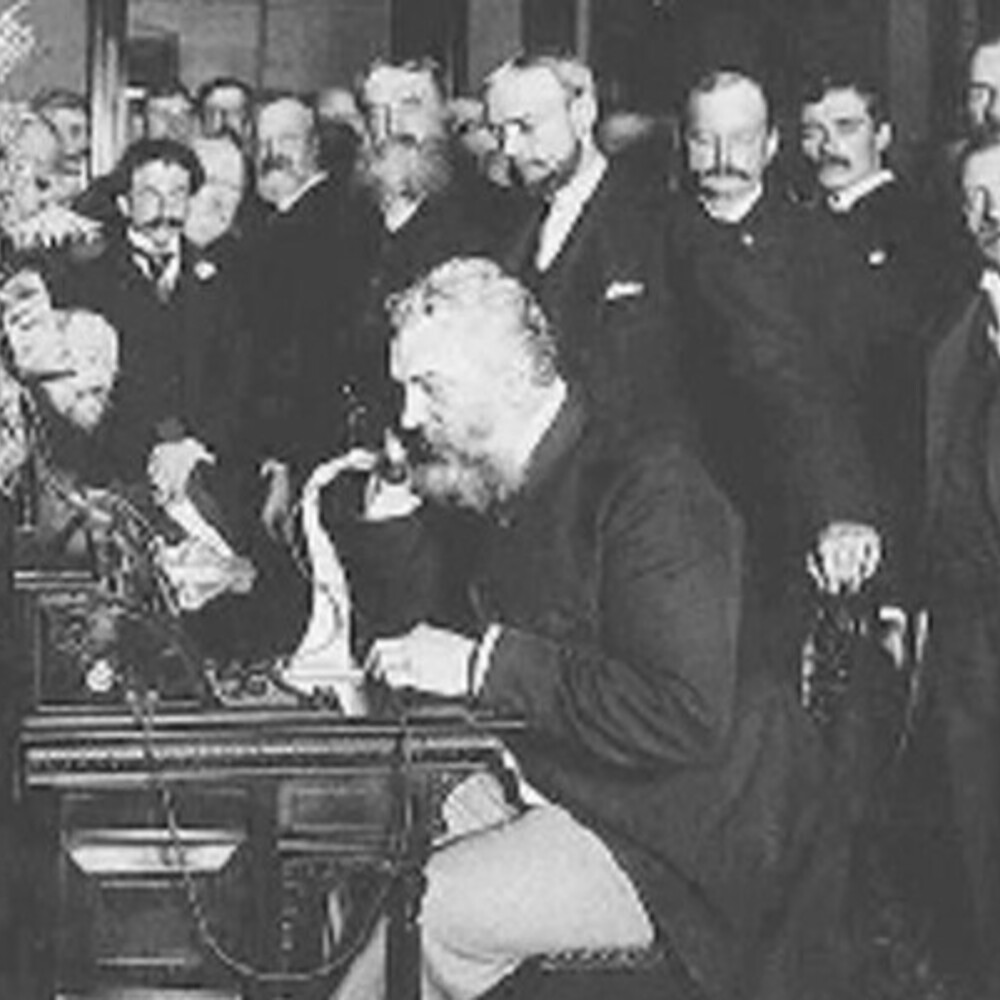
The telephone patent application was presented on 14 February 1876 by Graham Bell’s lawyer, and the filing was made on 7 March with the attribution of paternity of the invention with number 174,465. The era of voice communications was dawning for humanity. But great inventions don’t always proceed in a linear manner.
On 28 December 1871 the Italian Antonio Meucci (1808-1889) had deposited a caveat, or a pre-patent, renewed only for a few years by paying the fee of 10 dollars, which was worth the birthright of the device for transmitting sounds through electrical undulations to which he had given the name of telephone. The dispute over the paternity of the invention continued until 2002, and perhaps it is still not over, after a century and a half
In Cuba the first experiments on sound transmission
The Florentine Meucci had left Italy together with the staff of the opera house hired by the Teatro Principal of Havana, Cuba. He had studied art, he was passionate about science, he had had several problems with the law for reasons that would make you smile today, he was looking for the opportunity of his life away from the Grand Duchy of Tuscany after some unhappy experiences during the Carbonari uprisings of 1830-’31 which led him to have to embark while escaping police checks.
In Cuba, where he remained for about fifteen years, his reputation as an inventor was consolidated around him, and he was responsible for the introduction of electroplating in the Americas. Here, having come into contact with the theories of the Austrian doctor Franz Anton Mesmer (1734-1815) through some friends, he began to conduct electrotherapy studies in the period 1849-1850 to bring relief to patients suffering from rheumatism. Chance had intervened when one of these had emitted a cry of pain due to the electrical impulse of the equipment that the Florentine had prepared, a sound that Meucci had distinctly heard through the instrument he was using in another room.
The 1871 caveat application renewed for two years only
In 1850, when the contract with the Havana theater expired, he did not follow the company to the USA because his six-year-old daughter had died, but on May 1st he reached New York where friends had suggested to him that there were more possibilities of making a fortune, and took up residence in Clifton, in the New York county of Staten Island, where he opened a candle factory in which Giuseppe Garibaldi, who had been welcomed and hosted by him, also worked. Strangely, business didn’t go well, and the conversion to a brewery won’t go well either.
Since 1854 his wife Maria Matilde Esterre Mochi, married in 1834, was bedridden due to rheumatoid arthritis, from which he would never recover, and Meucci remembered the experiments in Cuba to create a direct vocal connection between his external office-laboratory and the sick room, perfecting what he called a tool and even creating a network of electrophores.
But business was so bad that the house was put up for auction in 1861 and only the generous willingness of the new buyer allowed the couple to remain living there. In 1871 he decided to file the patent, but his precarious economic conditions prevented him from paying the necessary 250 dollars, and so he limited himself to the caveat that it only cost 10, but had to be renewed annually. Thus in 1871 he obtained application 3335, which was also confirmed in 1872 and 1873. Two weeks earlier, with three other Italians, he had also founded the Telettronicafono Co.
The contact with the American District Telegraph and the “lost” projects
But it happened that, while waiting to have the money necessary to obtain the patent, in 1872 he turned to the American District Telegraph Co., bringing with him the prototype and the drawings, so that they would grant him the use of the telegraph lines for experimentation. He had spoken about this with one of the company’s two consultants, the Scotsman Alexander Graham Bell (1847-1922), trusting in the financial help that had been promised to him several times, but never arrived.
Furthermore, later, when he insistently demanded the return of the drawings, he was eventually told that the Western Union affiliated laboratory had lost them. As soon as he learned that Bell had registered the telephone patent in 1876, which had remained undiscovered since the end of 1874, Meucci flew into a rage and took every possible legal route to be right, and many in the public opinion recognized this.
The same American newspapers fought for his rights, which were those of Globe Telephone which had acquired them on 28 September 1885 by requesting the intervention of the US Attorney General. The Bell Telephone Co. not even two months later sued Globe and Meucci himself, triggering a long judicial tug-of-war with three trials with enormous costs and conflicting provisions, also because Meucci could not produce the documentation that was claimed to have been lost. The Italian’s death contributed to the “United States vs. Bell” trial, which cost American taxpayers a lot, being finally closed in 1897.
“Extraordinary and tragic career” according to the US House resolution
Bell’s economic fortunes entered history at the same time as Meucci’s misfortune. In resolution 269 of 11 June 2002 of the United States House of Representatives, it was asked to recognize (with a controversial formula it is written as “contribution” to the invention) the role of Meucci: “a great Italian inventor, he had a career that was both extraordinary and tragic”, recalling that for a period he had to survive thanks to public assistance as he was unable to renew the caveat in 1874.
“In March 1876 Alexander Graham Bell, who conducted experiments in the same laboratory where Meucci’s materials had been stored, was issued a patent and was subsequently credited with inventing the telephone,” then annulled on January 13, 1887 for “fraud and misrepresentation, a case which the Supreme Court found valid and remanded for trial. (…) If Meucci had been able to pay the $275 fee and maintain the caveat after 1874 no patent would have could be released.”
https://topforless.com/store/debenhams-uk
https://topforless.com/store/decathlon-it
https://topforless.com/store/decathlon-us
https://topforless.com/store/decjuba
https://topforless.com/store/desigual
https://topforless.com/store/dhgate
https://topforless.com/store/dicks
https://topforless.com/store/diesel
https://topforless.com/store/disney
https://topforless.com/store/dji
https://topforless.com/store/dog-friendly-co
https://topforless.com/store/doordash
https://topforless.com/store/dorothy-perkins
https://topforless.com/store/douglas-it
https://topforless.com/store/douglas-pt
https://topforless.com/store/dyson
https://topforless.com/store/dyson-canada
https://topforless.com/store/dyson-fi
https://topforless.com/store/dyson-it
https://topforless.com/store/easyjet-holidays
https://topforless.com/store/ecko-unltd
https://topforless.com/store/edx
https://topforless.com/store/electrolux-it
https://topforless.com/store/elegoo
https://topforless.com/store/elemis-es
https://topforless.com/store/elemis-fr
https://topforless.com/store/elemis-it
https://topforless.com/store/emp-es
https://topforless.com/store/endgame-gear-de
https://topforless.com/store/endgame-gear-uk