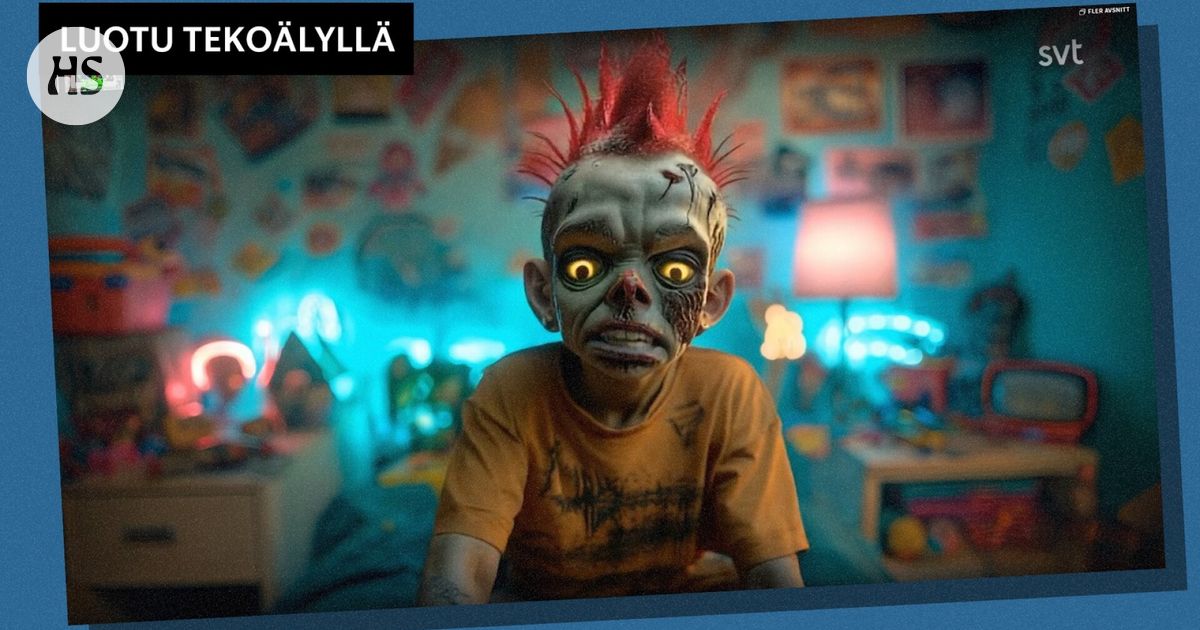
Artificial intelligence|According to the professional association of illustrators, programs created with artificial intelligence use material protected by copyright without permission. The use of artificial intelligence has not pleased the viewers either.
The Swedish professional association of illustrators, Svenska tecknare, accuses the broadcasting company SVT of using copyrighted material without permission in its artificial intelligence-produced children’s programs.
The president of the organization, Josefine Engström, says that Illustrators will lose their jobs and their material will be used to develop artificial intelligence services.
SVT’s program director Petter Bragée admits that the company cannot fully guarantee the copyright backgrounds of all artificial intelligence material.
Swedish viewers have considered artificial intelligence-produced children’s programs a waste of tax money, and some have been worried about their effect on children.
Swedish the association of illustrators and graphic designers Svenska tecknare criticizes the country’s public broadcasting company SVT for offering children’s programs produced with artificial intelligence in the streaming service SVT Play.
According to the organization, programs created with artificial intelligence use material protected by copyright without permission. In addition, SVT’s streaming service is harming the profession of illustrators.
In the past year, SVT has released several children’s programs produced entirely with artificial intelligence on SVT Play, such as Draw the adventure, Confessions of a zombie and Mountain of the Gods. The programs have already received crushing judgment from both the cultural field and the users of the streaming service.
They talk about it, among other things SVT Culture and news agency TT.
According to SVT Kultur, viewers have viewed the children’s programs produced with artificial intelligence, which can be seen on the company’s streaming service, as a waste of tax money on “artificial intelligence garbage”. Some viewers have been worried about how content made with artificial intelligence affects children.
Screenshot from the Gudarnas Berg program in the SVT Play service.
Swedish chairman of the tecknare organization Josefine Engström said that Kuvittajas suffer doubly from SVT’s operation when the creative work done by humans is outsourced to artificial intelligence.
“First of all, they will lose their jobs, secondly, the illustrators’ material will be used to develop these artificial intelligence services,” said Engström in an interview with SVT.
According to Engström, in the use of artificial intelligence, material protected by copyright is almost always used without permission.
The Svenska tecknare organization considers the position of the tax-funded SVT to be particularly responsible in terms of protecting their work.
The SVT children’s program production SVT Barn’s program director Petter Bragéen according to SVT, in principle, SVT does not use material protected by copyright in its programs. However, Bragée admitted that SVT cannot fully guarantee the copyright backgrounds of all AI material.
According to Bragée, content produced with artificial intelligence only makes up a very small part of SVT’s program content. He says that artificial intelligence is only used in the creation of new ways of storytelling and in the experimentation of new technology, and the contents produced by artificial intelligence have not replaced draftsmen or animators.
Bragée pointed out that large, commercial players like Disney, for example, are significantly further along in utilizing artificial intelligence. According to him, it is in any case important for media companies to keep up with the development of artificial intelligence.
Swedish Dagbladet columnist Björn Warner wrote previously, that using artificial intelligence to create children’s program content is a sign that SVT’s time as an “oasis of children’s culture” is over in Sweden. According to Warner, the children’s programs presented by SVT, made with artificial intelligence, are “sheer brain rot”.
Bragée responded to Warner’s criticism pointing out that, according to him, it makes sense to test the use of artificial intelligence technology, but only in certain carefully selected projects.
in Finland Grafia and the illustrators’ organization Kuvittajat act as umbrella organizations for visual communication.
Chairman of Graphics True Veziko considers the ongoing debate in Sweden necessary. According to Veziko, what is particularly worrying in the case of Sweden is that the operator has been the publicly funded SVT.
“A publicly funded media house should be a trend setter in the ethical use of creative work, not an early adopter of tools operating in a gray area,” he says.
If in the construction of artificial intelligence systems the work of the authors has been used without their permission, the content produced with public funds can practically rely on unauthorized cultural capital. It is especially problematic when the same technology directly affects employment in the creative industries.
Yle currently has no plans to make entire children’s programs with artificial intelligence.
in graphics members work as graphic designers, art directors, illustrators and animators, among other things.
The organization also actively follows the discussion related to the use of artificial intelligence. Since the use of artificial intelligence tools is still relatively new, there are no answers to almost all the questions that come up.
“Certainly, the use of artificial intelligence will progress in many situations in the same way as it has happened in Sweden, that is, that someone tries it and it is knocked out,” says Veziko.
Mightily head of responsible artificial intelligence Minna Mustakallio tells HS by e-mail that the possibilities of artificial intelligence are being increasingly tested at Yelle as well.
“The goal of using generative artificial intelligence is diverse and interesting content that increases the audience’s understanding. We can use generative artificial intelligence if it brings added value to the audience,” Mustakallio writes.
According to Mustakallio, Yle currently has no plans to make entire children’s programs with artificial intelligence.
At Yelle, artificial intelligence has been used mainly as a spice for visual narration, and the use of artificial intelligence in connection with the content is openly discussed, says Mustakallio.
https://vigorecords.us/court-records
https://vigorecords.us/inmate-search
https://vigorecords.us/arrest-records
https://vigorecords.us/warrant-search
https://vigorecords.us/property-records
https://vigorecords.us/divorce-records
https://walworthrecords.us/
https://walworthrecords.us/criminal-records
https://walworthrecords.us/court-records
https://walworthrecords.us/inmate-search
https://walworthrecords.us/arrest-records
https://walworthrecords.us/warrant-search
https://walworthrecords.us/property-records
https://walworthrecords.us/divorce-records
https://tompkinsrecords.us/
https://tompkinsrecords.us/criminal-records
https://tompkinsrecords.us/court-records
https://tompkinsrecords.us/inmate-search
https://tompkinsrecords.us/arrest-records
https://tompkinsrecords.us/warrant-search
https://tompkinsrecords.us/property-records
https://tompkinsrecords.us/divorce-records
https://whitfieldrecords.us/
https://whitfieldrecords.us/criminal-records
https://whitfieldrecords.us/court-records
https://whitfieldrecords.us/inmate-search
https://whitfieldrecords.us/arrest-records
https://whitfieldrecords.us/warrant-search
https://whitfieldrecords.us/property-records
https://whitfieldrecords.us/divorce-records