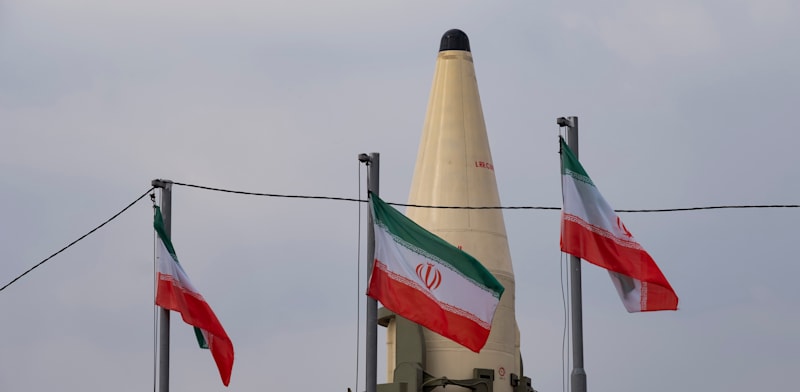
The Middle East of 2026 operates according to the Trump Doctrine: unprecedented military might, designed to push the adversary to the negotiating table.
The President of the United States, Donald Trump, admittedly stated last weekend that the fall of the Ayatollah regime in Iran is “the best thing that could happen”, but on the ground he is sticking to the diplomatic channel: this week Washington will – once again – send a delegation to Geneva for the nuclear talks. The US Secretary of State, Marco Rubio, even revealed in the newspaper “Bloomberg” that Trump is ready for a direct meeting with the supreme leader of Iran, Ali Khamenei.
● 8.8 trillion dollars in danger? Mohammed bin Salman’s flagship project ran into financing difficulties
● Encouraged by the White House: the wealthy Canadian province that demands to secede from the country and gain independence
The reality shows that although the country’s nuclear facilities were attacked in the “Midnight Hammer” operation, it was carried out in the face of a fait accompli: at the time of the attack, Iran already possessed about 450 kg of uranium enriched to 60% – an amount that puts it within touching distance of actual military capability.
Iran, for its part, comes to the table in a serious economic situation, part of which is caused by the economic sanctions of the West. Kepler company data shows that the loading of crude oil at Iranian terminals decreased in January to approximately 1.39 million barrels per day, a 26% decrease on the annual level. The trend is influenced by what is happening in the main customer of the Ayatollah regime, China, where Iranian oil discharges amounted to approximately 1.13 million barrels per day, after 1.4 million barrels per day in 2025.
Another issue that erodes the profitability of Iranian oil is the increase in storage in tanks at sea to the extent of about 170 million barrels – three times within a year due to the lack of customers. So according to Kepler monitoring. which is estimated at about 100 thousand dollars per tank, which erodes the income even more.
The Russian-Iranian axis is not deterred by Trump
Despite the nuclear and economic blows it suffered, the Islamic Republic remains a significant strategic asset: the close alliance with Moscow. The state-owned Russian nuclear corporation, “Rosatom”, which built the reactor in Bushehr, signed a huge $25 billion contract last September. As part of it, four new production units will be established in the Hormuzgan district, designed to provide about 20 gigawatts of electricity by 2040.
Relations between the countries went up a notch following the invasion of Ukraine, which made it clear to Putin that Tehran is an essential partner. The cooperation culminated in the widespread operation of Iranian roving munitions of the “Shahad” series, after Russia established independent production lines for them on its territory. Beyond the financial income, the Iranian regime derived valuable operational lessons from the Ukrainian battlefield, which helped it significantly upgrade its weapons.
Moscow does not hide the depth of the partnership: last week, at a particularly sensitive time, the delegations of Russia, Iran and China met in Vienna to coordinate positions on the nuclear issue. The three countries agreed on tightening cooperation – only a few days before the opening of the decisive round in Geneva.
Ten bombs and a question mark
Yikki Dayan, former consul of Israel in Los Angeles, points out that Trump is perhaps the only person in the world who believes that an agreement can be reached with Iran – which pushes him to exhaust the negotiations. “In the shadow of moving the aircraft carrier Gerald Ford, the president believes that the Iranians will break and there will be an agreement,” says Dayan.
“This week will reach the ‘all-out’ stage. Right now it is clear that the Iranian maximum is far from Trump’s minimum, and the question is what will they come to the table with: will they agree to zero enrichment or to the removal of the enriched uranium to 60%? Trump has a month to gather forces and wait for the weather to improve, while hoping for contacts to be exhausted.”
Nuclear experts emphasize that the transition from 60% enrichment to 90% is not a complex scientific hurdle. Considering that the production of a bomb requires about 42 kg of highly enriched uranium, the stockpile that Iran has accumulated – if the enrichment process is completed – could be sufficient for the production of about ten nuclear bombs.
The American attack last June did damage the nuclear ambitions of the Islamic Republic, but did not completely cut it off from its capabilities. For Tehran, the nuclear is a significant economic engine, despite the large investment it requires. According to data presented by Mohammad Eslami, the head of the Iranian Atomic Energy Agency, the power plant in Bushehr – whose construction cost about 1.8 billion dollars – supplied over a decade about 70 billion kilowatt hours. According to him, energy production on a similar scale using fossil fuels would have cost the country about 8 billion dollars – four times the cost of building the reactor.
The crossroads of Iran
The billion-dollar question remains: is Tehran striving for a real agreement, or is it a strategic “wasting time” as Israel claims? On the one hand, the Iranians have a tremendous economic incentive: after the 2017 agreement, trade with the European Union jumped 180% to $20.6 billion – a growth that was cut off once Trump withdrew from the agreement in 2018. On the other hand, the latest rounds of negotiations have proven that the regime is ready to suffer a fatal economic blow for the pursuit of nuclear status at any cost.
Washington may put on the table a proposal to limit uranium enrichment in Iran to a level of 3.67% at most, or alternatively – a complete freeze of the program for several years. If the Americans persist in their refusal to continue enrichment on Iranian soil, the solution that may please both sides is the Emirati “golden model”. In this model, the country completely gives up the ability to enrich uranium independently on its territory. Today, four nuclear reactors in the United Arab Emirates are already connected to the electricity grid, operating on the basis of enriched uranium imported from Australia.
For your attention: The Globes system strives for a diverse, relevant and respectful discourse in accordance with the code of ethics that appears in the trust report according to which we operate. Expressions of violence, racism, incitement or any other inappropriate discourse are filtered out automatically and will not be published on the site.
https://pinco-canada.net/mma/
https://md.infs.ch/s/yVtj6yx7e
https://trueluck-global.com/live-casino/
https://www.pdc.edu/?URL=https://www.raylyst.eu/de/
https://tahiti-annonces.com/author/chemajos/
https://pad.ura.design/s/TG7jAhEd-
http://megapari-egypt.org/basketball/
https://writexo.com/share/9e02f95e31c8
https://travelersqa.com/user/rubberzephyr1
https://mmcon.sakura.ne.jp:443/mmwiki/index.php?tradenail80
https://hedgedoc.stusta.de/s/LwaHmvWx_r
https://md.chaosdorf.de/s/zSEaoUcnV6
https://www.sulekha.com/uro-onco-connect-gomti-nagar-lucknow-contact-address
https://mmcon.sakura.ne.jp:443/mmwiki/index.php?organsale76
https://jbcasinobe.com/esports/dota2/
https://www.modhub.us/user/SonnydgTucker/
https://www.demilked.com/author/harborlock95/
https://sportpoisktv.ru/author/valleyrange83/
https://www.linkedin.com/posts/alfonso-wolfe-2016411b4_raylyst-solar-sro-t%C3%BCrkova-2319-149-activity-7426470218400677888-tria/
https://paripesa-peru.org/bonuses/
https://paripesa-chile.com/codigo-promocional/
https://googlino.com/members/greasegarlic0/activity/650614/
https://jbcasinobe.com/nl-be/registratie/
https://1xbet-costarika.com/retiro/
https://www.pdc.edu/?URL=https://www.raylyst.eu/it/