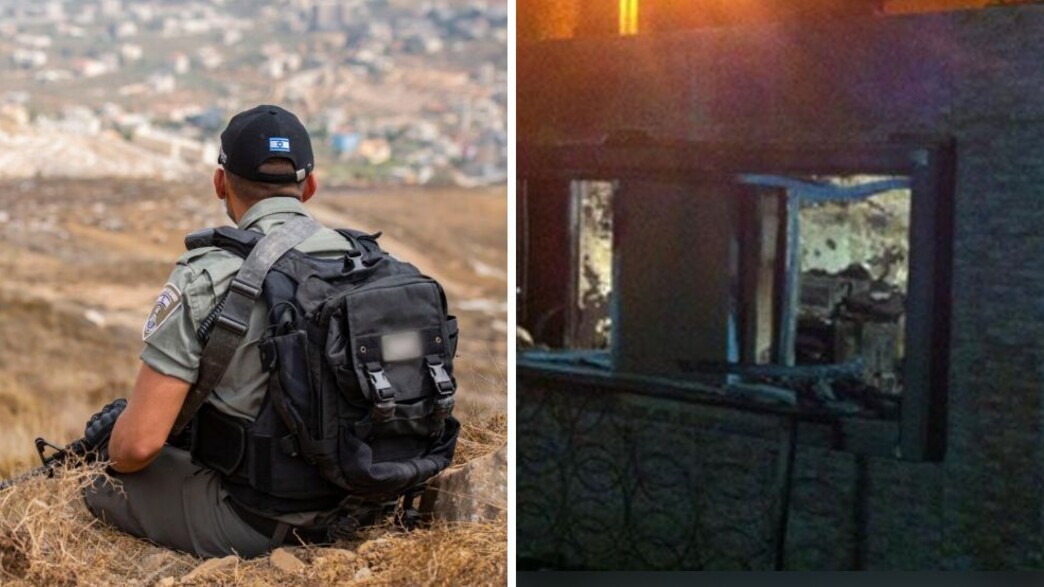
In October 2019, a team of Border Guard fighters was called to a fire that broke out in a residential building in the Sharon area. Amidst the chaos, the smoke and the flames, Yoni (pseudonym), one of the fighters, then in his 30s, entered the burning building and rescued a child who was trapped in the apartment. After that, according to the lawsuit submitted to the rewards officer at the Ministry of Defense, he went back into the building to make sure there were no more trapped.
At the end of the activity, he was taken to the emergency room at Ichilov Hospital after inhaling a massive amount of smoke. What seemed to be a one-off event at the time, soon became a health turning point.
Shortly after the fire incident, the fighter began to suffer from breathing difficulties, a bothersome cough and ‘wheezing’. Later, according to the claim, he was diagnosed as suffering from asthma which requires regular treatment with inhalers and medication. In view of his condition, he submitted a claim to the compensation officer at the Ministry of Defense demanding that he be recognized as disabled by the IDF due to “a service illness”. However, his request was rejected, and according to the Ministry of Defense, it was a decrease in lung function and breathing difficulties that are not included in the scope of responsibility, after the amendment of the Law on the Disabled in 2017 (the Goren Amendment), which limited the possibility of recognizing certain illnesses as service illnesses.
The legal battle: “A fundamentally wrong decision“
Four years after the incident, Attorney Yanon Koren of the law firm Markman Tomshin & Co. submitted a request for a reconsideration of the decision. The request claims that the asthma was caused as a direct result of exposure to toxic gases in a one-time event during operational activity, and therefore, according to him, it accurately meets the definition of “service disease” according to the Minister of Defense’s decree.
The compensation officer re-examined the request, and it was decided to recognize the smoke inhalation damage and the decrease in lung function as an injury caused during the service.
In order to establish the causal relationship, an expert in pulmonary medicine, Dr. Yevgeni Gershman, was appointed. In his opinion, he stated that the fighter did not suffer from respiratory diseases before the incident, and that there was a clear closeness of time between the fire and the appearance of the symptoms. His conclusion was that it was unbalanced asthma caused by exposure to smoke.
In the end, the compensation officer announced that after reviewing the medical opinion, it was decided to recognize that the respiratory injury occurred due to the service in the military.
https://tuttle-lauritzen-5.federatedjournals.com/genau-wie-man-den-idealen-photovoltaik-gerate-handler-in-europa-bestimmt
https://cineblog01.rest/user/clubcut1/
https://dadesobertes.molletvalles.cat/es/user/auraestudios?
https://doc.isotronic.de/s/pClb0jvvw
https://pinco-canada.net/fr-ca/inscription/
https://edit.leiden.digital/s/RfSajN5T1
https://pad.eisfunke.com/s/C9C8shbeAu
https://pad.darmstadt.social/s/rPsLsYUCE0
https://jbcasinobe.com/fr-be/politique-de-confidentialite/
https://elclasificadomx.com/author/chequepink97/
https://pinco-canada.net/fr-ca/pinco-lucky-streak-3/
https://www.repecho.com/author/authoranime7/
https://opendata.liberec.cz/es/user/por-que-elegir-estudios-de-grabacion-en-barcelona-para-tu-podcast
https://docs.erraticbits.ca/s/SzotbIzlPX
https://jbcasinobe.com/nl-be/ondersteuning/
https://pad.janniklorenz.de/s/8rA6VKj1E
https://pinco-ca.net/fr-ca/s-inscrire/
https://md.warpzone.ms/s/VfAOjk5EYf
https://md.openbikesensor.org/s/nHiX70rKjc
https://trueluck-global.com/es-es/ios/
https://md.freiheitswolke.org/s/QpTplcS7q
https://codimd.caa-ins.org/s/HkRyZdIvWg
https://pad.stuve.de/s/MrsxeobK8
https://six6xbd.com/mma/
https://doc.computhings.be/s/RWAUUVSZ-M