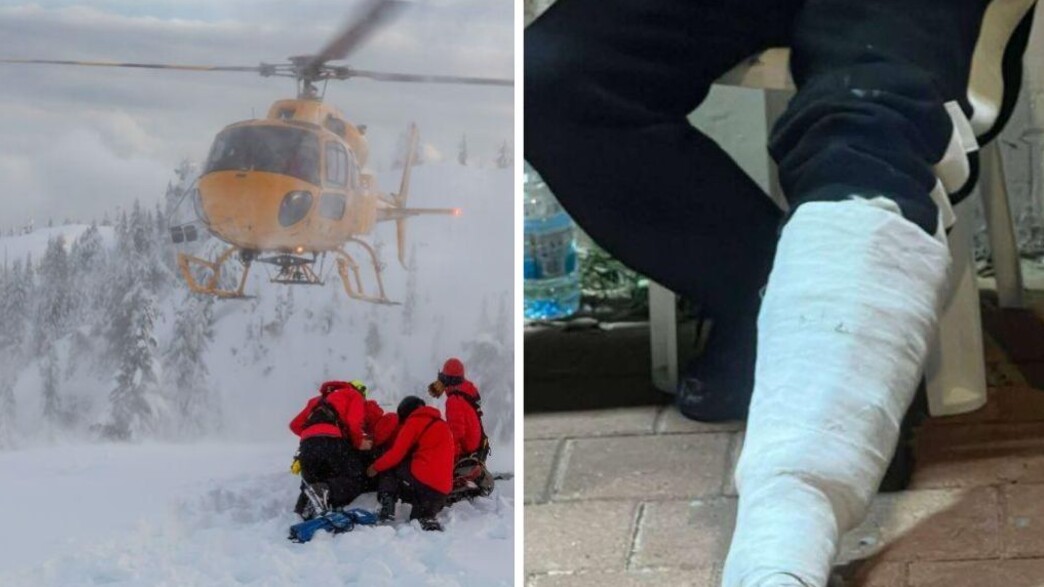
Ski vacations become a nightmare: The season is in full swing and dozens of Israelis are returning from winter vacations with injuries, mainly knees, lower back, pelvis and buttocks. Some of the injuries occur on the surfing course and some even before the surfers had time to surf. Falling on snow and ice can end in prolonged pain and sometimes even surgery.
“It was my first time on a snowboard,” says Eyal, 30 years old from Herzliya to Mako Health, who flew for a skiing vacation with his friends in Georgia. “We took a guide, went up to the track – and the visibility was simply horrible – heavy snow and fog, we couldn’t see fifty meters ahead. At one point I gained speed, the front part of the snowboard dug into the snow and I just flew forward. The leg stayed connected to the board (surface) and the knee just stretched.”
According to him, he was forced to descend the mountain on foot, barely able to step on his feet. “Everyone surfed quickly and I was injured, I was afraid they would hurt me. In the evening the pain was crazy. I was looking for medical treatment – the nearest hospital is three hours away, and we were warned not to enter the local clinic because the treatment there is horrible.”
“The number of Israelis injured there is crazy”
Only the next day, Eyal was taken by ambulance to the on-site clinic. “I had a culture shock. The equipment there looked so old, a very basic x-ray without minimal protection. They said there was no fracture, but they couldn’t really tell what was going on inside the knee.” Eyal chose to end his vacation and returned to Israel. “The orthopedist said there is a suspicion of injury to the meniscus, and I may need surgery.” “The number of Israelis who were injured there is crazy. The ambulance kept going and coming back,” he says.
Erez, a resident of Bat Yam, was also injured, but in a different way. “It was my first time at a ski resort in Austria. I got out of the car at the entrance to the resort – and immediately slipped off the ice. I fell hard on my butt.” According to him, the pain appeared almost immediately. “I thought it would pass so I tried to surf, but every movement hurt. At some point I realized there was no point in continuing to force myself.” During the entire vacation he suffered from significant back pain, and when he returned to Israel he went for tests. “I’m still under medical clearance, we don’t know exactly what’s wrong yet. But it’s clear to me that this fall ruined my whole trip.”
The Israelis fill the clinics
According to Dr. Niv Marom, deputy head of the department in the orthopedic department at the Meir Medical Center of the Klalit Group, this time of year is also well felt in the clinics. “During the winter months, we see dozens of patients returning from ski vacations with typical injuries. Even people without athletic abilities suddenly find themselves making significant efforts – sometimes without any guidance. Just yesterday I saw a patient who had never played sports, she was in Georgia, fell down a slope, flipped over and was dragged down. It is understood that the skis did not detach from her legs, and she suffered from lameness, swelling and a lot of pain.”
According to him, over a third of skiing injuries are caused in the knee area. “The most common injuries are to the front cruciate ligament and the inner lateral ligament. It is usually a fall with a rotational movement of the body when the boot is not released from the slide.” The signs include a tearing sensation during the fall, collapse of the leg, difficulty stepping and swelling that appears quickly,” he says. And clarifies: “In such situations it is not recommended to continue surfing.”
According to him, while in snowboarding the common injuries are in the upper body, in skiing we see more injuries to the ligaments in the knee. “We see shoulder dislocations, fractures of the clavicle and injuries to the wrist, which are caused by falling on the hand outstretched to the front, usually with the aim of stopping the fall. There is also what is known as ‘surfers’ thumb’ – an injury to the ligament at the base of the thumb. Fractures are also not rare, especially in snowboarding – in the clavicle, wrist, ankle and foot. Any suspicion of a fracture requires a medical evaluation that includes an examination and imaging, and sometimes fixation or surgical intervention depending on the severity of the injury,” explains Dr. Marom.
Injuries to the spine and pelvis are also known to the medical teams, especially those caused after strong jumps or falls. “In snowboarding, the injury is usually in the lumbar spine, and in skiing – in the cervical or dorsal spine.”
Dr. Marom points out that early physical preparation, professional equipment adjustment, use of protective equipment and adherence to correct technique – reduce the chance of getting injured. “If there is a feeling of fatigue or injury during surfing – you should stop, because if you don’t stop it may lead to more injuries.”
https://trueluck-global.com/de-de/support/
https://hedgedoc.thuanbui.me/s/mAuJZHhPq
https://1win-lucky-jet.in.net/payment-methods/
https://hedgedoc.nixc.us/s/U-VkwV9UF
http://theconsultingagency.com/members/tenorlatex77/activity/79132/
https://hedgedoc.inet.tu-berlin.de/s/_pca2tKeU
https://mapleprimes.com/users/rubberstate6
https://doc.anagora.org/s/LI1oWuYu4
https://www.pinterest.com/pin/1133992381200172860
https://www.decidimmataro.cat/profiles/farmaciaenmalagacen/groups
https://dentepic.toothaidschool.com/members/brakebelief50/activity/77464/
https://atesoglusogutma.com/user/foamarea89/
https://vortexgame-argentina.com/megapari/
https://es.pinterest.com/pin/1133992381200173487
https://data.gov.kg/en/user/clinicboost
https://travelersqa.com/user/dilltuna48
https://browne-wu-6.thoughtlanes.net/the-narust-fotovoltaickeho-ci-pv-nastroju-poskytovatele-na-trhu-eu
https://trueluck-global.com/de-de/ueber-uns/
https://trueluck-global.com/en-ie/slots/
https://avtovoprosi.ru/user/harbormenu66
https://ed.coop/forums/users/chillzone36/
https://fravito.fr/user/profile/2175811
https://hd.wedler.me/s/IIePmKJtT
https://six6xbd.com/promo-code/
https://vortexgame-argentina.com/1xbet/