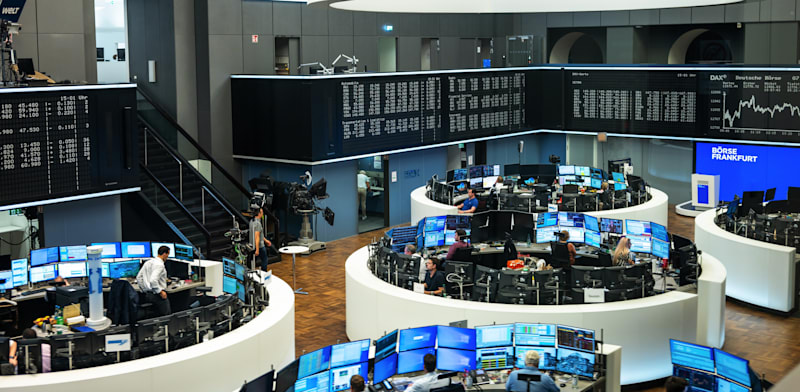
Trade overview: current reports, trends, indices, stock prices, bonds, foreign exchange and commodities and analyst recommendations
15:53
The surprising data from the American labor market, published today, adds fuel to the fire of uncertainty on Wall Street. The number of initial claims for unemployment benefits fell by 23,000 to 206,000 – the sharpest drop since last November and significantly lower than analysts’ forecasts of 225,000 claims.
While a strong labor market is usually a positive sign for the economy, for investors it is a worrying sign that reduces the chances of an interest rate cut soon.
From the minutes of the Federal Reserve (Fed) meeting published last night, it appears that the central bank is not only distancing itself from the decision to lower interest rates in March, but the possibility of additional interest rate increases has also been raised if inflation does not cool down as expected. The low unemployment figures strengthen the position of the hawks at the Fed, as they indicate a hot economy that may continue to generate inflationary pressures. On the other hand, the number of ongoing claims registered a slight increase to 1.87 million, which suggests that for those who have already lost their jobs, the road back to the employment circle is a little longer.
15:00
The third trend in Europe continues. The DAX is down about 0.9%, the KAK about 0.8% and the FTSE about 0.6%.
On Wall Street, stocks Walmart Down about 3% in early trading, after the company’s annual profit forecast did not meet expectations. Sales in the last quarter of the year did increase by almost 6%, and its quarterly profits and revenues exceeded Wall Street expectations. But for the current fiscal year as a whole, Walmart announced that it expects a 3.5% to 4.5% increase in net sales, and adjusted earnings per share will range between $2.75 and $2.85. This earnings forecast did not meet Wall Street’s expectations of $2.96 per share.
The dollar is falling slightly at this time, and after already reaching NIS 3.14 today, it now stands at NIS 3.13. At the same time, the DXY index – which examines the dollar against 6 foreign currencies – rises by about 0.15%.
14:15
Wall Street futures show slight declines at this time. The Nasdaq and the Dow Jones are down about 0.3%, the S&P500 is down about 0.2%.
Meanwhile, a share Lemonade the digital insurance company in the USA – property, building, auto insurance – jumps 12% in pre-trade on Wall Street. This, after the Israeli company of Daniel Schreiber (CEO) and Shai Weininger (President) reported strong results for it with revenues of $228.1 million, a jump of 53% compared to the corresponding quarter last year and above analysts’ expectations for revenues of $218.1 million.
13:15
The negative trend continues in Europe. The DAX, KAK and POTSI indices lose their value by about 0.8%.
On Wall Street, futures now show declines of 0.3%-0.4% in the leading indexes. stock nice Jumps in early trading by about 8%, after beating forecasts for the fourth quarter of 2025. The company reported adjusted earnings of 3.24 per share on revenues of 786.5, after analysts expected a profit of 3.21 dollars per share on revenues of 780 million dollars. For the entire year, the company reports an adjusted profit of $12.3 per share on revenues of $2.95 billion. Even in this case the results are slightly above market expectations.
In the foreign exchange sector, the dollar is strengthening and today crosses the NIS 3.14 mark. “The main reason is the great nervousness in the markets over fears of an attack in Iran as well as the fear of a regional flare-up in the Middle East,” explains Idit Moskovitz, director of the International Bank’s trading rooms.
Compared to the main currencies in the world, explains Moskovitz, the dollar trades stably. “It is estimated that in the coming days the volatility will continue due to the security uncertainty, which will support the continued strengthening of the dollar in Israel”
12:20
The declines in Europe are getting stronger – the DAX plunges by about 1%, the CAC loses its value by about 0.9% and the FTSE drops by about 0.7%.
At the same time, the futures contracts on Wall Street also move to decreases of about 0.3% in the leading indexes. It should be noted that regardless of what happens today, the opening of the year on Wall Street is particularly bad. In fact, since 1995, this is the worst start to the year for US stocks against the global market, according to Goldman Sachs data. While the S&P500 is down 1% since the start of the year, the index that tracks market returns across the rest of the global economy (ACWX) has gained 8%.
In the foreign exchange sector – against the background of the geopolitical tensions between the US and Iran, the dollar continues to strengthen against the shekel and its value is around NIS 3.14. Contrary to this, the DXY dollar index – which examines the dollar against 6 currencies – is actually today in slight declines of about 0.1%. In fact, it can be understood from this that in general the dollar is weakening in the world today, but against the shekel it is actually strengthening.
11:20
The negative trend in Europe continues. The Dax, Kac and Potsi indices lose their value by about 0.5% each.
stock Renault Down on the French stock market by about 3.5%. This, after it published its reports for 2025. Although the car manufacturer’s revenues increased by 3% to 57.9 billion euros ($68 billion), the net profit dropped significantly to a loss of 10.9 billion euros.
Nestlé rising in the Swiss market by about 2.7%, after it also published reports. Nestlé’s sales in 2025 totaled 89.49 billion Swiss francs, down 2% from 91.35 billion Swiss francs the previous year. Net profit fell by 17% to 9 billion Swiss francs. The company’s organic growth was 3.5% for this year.
And despite the declines, it seems that the increases in the stock come following the announcement made by the food giant, that it is in advanced negotiations to sell its ice cream business to the owner of the Hagen-Daz company, Pruneri.
10:20
The trading day in Europe started with a negative trend. In Germany and the UK, the Dax and the Potsi lose about 0.4% of their value. In France, the CAC is down by about 0.3%.
The aircraft manufacturer Airbus Beki announced that it expects to deliver 870 commercial aircraft in 2026, slightly less than analysts expected – about 880 analysts. As a result, the company’s stock is now falling in the European markets by about 4%. This comes amid mounting pressure on the European plane maker, with its American rival Boeing showing signs of recovery after years of crisis.
08:30
Asia
After the Lunar New Year holiday, trading in South Korea returned with a storm this morning: the Kospi index jumped by about 3% to a new record. company Samsung led the increases, with its share adding about 4.1% to its value. “Having nearly doubled in 2025, Korea is once again the leading market in Asia Pacific,” Goldman Sachs wrote in a recent note.
Japan also recorded increases this morning, but slightly more solidly: the Nikkei index rose by about 0.7%. In China and Hong Kong there was no trading even today due to the Rosh Hashanah holiday.
Wall Street
On Wall Street, futures are showing slight gains this morning, with all major indices rising by about 0.1%.
Yesterday, trading on Wall Street closed higher, which was reduced to the closing following the publication of the Fed protocol. The Dow Jones gained 0.2%, the S&P 500 gained 0.5%, and the Nasdaq climbed 0.7%. At least for now, geopolitical tensions between the US and Iran do not seem to have permeated the market.
The market is supported by increases in key technology stocks, stock Nvidia rose 1% after Meta announced it would use millions of Nvidia chips to build its data centers.
also Amazon It rose after regulatory filings showed Bill Ackman increased his holdings in the e-commerce giant by 65% during the fourth quarter — making Amazon the third-largest holding in Schackman’s Pershing Square fund. The move came after the stock snapped a nine-day losing streak.
Micron rose after super investor David Tepper increased his holdings in the chip maker, and the stock closed up more than 4%.
stock Wendy’s Soared about 15% after veteran investor Nelson Platz said he might push for changes at the struggling burger chain.
Europe
In Europe, trade is expected to open with a mixed trend. The FTSE index in Great Britain is expected to increase by 0.15%, the Dax in Germany will decrease by approximately 0.25%, and the CAC in France will also decrease by approximately 0.15%.
Commodities and currencies
Against the background of the tensions between the US and Iran, the dollar strengthened this morning by about 0.1% against the shekel and traded at more than 3.12 shekels. This, after yesterday its value increased by about 0.5%. Also against the basket of currencies, and especially against the euro and the Israeli shekel, the dollar strengthened by about 0.5% yesterday.
Taking a broad view of the dollar – the largest investment managers in the world have adopted the most negative position towards the US dollar since 2012, according to the survey of fund managers by Bank of America published in mid-February 2026 (published in the Financial Times).
The decline in popularity of the currency comes after the dollar lost about 9% of its value during the year 2025 and dropped by an additional 1.3% from the beginning of this year against the basket of major currencies. The fund managers point to the growing uncertainty in US foreign policy and the economy, along with political pressure on the Federal Reserve, as factors undermining confidence in the dollar as the traditional “safe haven” of the world market.
The negative sentiment is largely driven by the fear that the aggressive policies of the administration in Washington, including the imposition of large-scale tariffs, will produce unexpected shocks in supply chains and lead to stagflation.
At the same time, expectations for continued interest rate cuts by the Federal Reserve during 2026 are eroding the yield advantage the dollar had over other currencies. Institutional investors, among them pension funds and asset management giants such as Vanguard and J.P. Morgan, have begun to significantly increase their hedging levels against the continued weakening of the currency, a move that is a major engine for its continued decline in value.
As for oil, prices rose about 4% yesterday as traders weighed whether talks between the United States and Iran would be enough to avert a conflict, after a report that US military intervention could come sooner than expected. The talks between Ukraine and Russia have also reached an impasse, according to reports. This morning, the increases continued and oil added about 0.2% to its value. Brent oil is now more than $70 a barrel.
In the crypto market, Bitcoin continues to lose ground and is already trading for only 66.8 thousand dollars per currency, a fall of more than 40% in six months. Since its peak last October, Bitcoin has completed a nearly 50% drop, bringing it back to price levels at which it traded in early 2024 and earlier in 2021.
The strategists of Wells Fargo Bank published an interesting forecast. According to the bank, the expected injection of liquidity from US tax refunds, estimated at around $150 billion by the end of March 2026, is meeting a crypto market that is at a strategic boiling point.
For the retail investor, the tax refund is not seen as part of the current salary intended for living expenses, but as “found money” or a bonus from the homeless. This psychological perception rekindles the YOLO (You Only Live Once) phenomenon, where investors tend to bet the entire pot on assets with the potential for a quick and sharp jump, with the feeling that this is “free money” that can be taken with higher risks.
Bitcoin is seen as the ideal asset for channeling this liquidity. Analysts at Wells Fargo point out that Bitcoin currently functions as the most accurate “barometer” for the amount of cash in the market, when domestic liquidity in the US decreased by $105 billion last month, the currency reacted with a sharp drop, therefore the massive injection of cash from tax refunds is seen as fuel that can catapult it back towards new highs.
According to them, the psychology of the “bargain hunters” (Buy the Dip), combined with the excess cash in their pockets, creates a momentum where investors run to apps like Robinhood to convert their tax refunds into digital assets before the price rises.
On the other hand, gold manages to stabilize, and this morning traded at a price of more than $5,000 per ounce. Unlike cryptocurrencies, gold still manages to maintain its status as a safe haven against inflationary concerns.
Macro
USA: The Fed’s minutes from the last interest rate meeting were published yesterday. It turns out that Fed members were divided about the continuation of interest rate policy, when they voted that the cessation of interest rate cuts would remain in effect for the time being, but they may continue later this year if inflation behaves in accordance with expectations.
According to the minutes of the January 27-28 meeting, the decision to keep the interest rate at the current level was mostly accepted positively, but the way forward seemed less clear, with differences of opinion between the need to fight inflation and support the labor market.
“In examining the monetary policy forecast, a number of participants indicated that further downward adjustments to the interest rate range may be appropriate if inflation declines in line with their expectations,” the minutes read.
However, participants disagreed on the direction of policy, debating whether to focus more on fighting inflation or supporting the labor market.
“Some of the participants stated that it would probably be correct to keep the interest rate unchanged for a while while the committee carefully evaluates the incoming data, and some even estimated that further easing of policy is not required until it is clear that the decline in inflation is back on track,” it added.
Some participants even considered that interest rate hikes could be on the table and wanted the statement after the meeting to reflect in a more balanced way the future decisions of the committee. “Such a description would reflect the possibility that upward adjustments in the interest rate range may be appropriate if inflation remains above level.” noted in the protocol.
https://www.bitspower.com/support/user/teamcut36
https://hedgedoc.obermui.de/s/OUbi9vBWQU
https://jbcasinobe.com/nl-be/app/
https://www.screenskills.com/community/f7a490af-f782-4292-8a31-1bd40c42b3ad/
https://pad.grossweber.com/s/ssUeM82Ka7
https://partycypuj.ohpraga.pl/profiles/control_de_plagas_ma/activity
https://trueluck-global.com/en-ie/cricket/
https://pad.libreon.fr/s/VfFVgXZQeS
https://ssnote.skku.edu/s/V3fJo_PUu
http://amur.1gb.ua/user/sonmonth9/
https://pinco-ca.net/hockey/
https://six6xbd.com/withdrawal/
https://hackmd.iscpif.fr/s/rkDof7HvWe
https://canvas.instructure.com/eportfolios/4231234/entries/14773044
https://pinco-canada.net/licence/
https://opentreebase.datacity.org.il/user/como-prepararse-antes-de-comenzar-cursos-intensivosen-valencia
https://pad.wolkenbar.de/s/vOkl3kRLY6
https://askmotopros.com/user/jumpjump15
https://md.eris.cc/s/U-JBQaHYWO
https://jobs.westerncity.com/profiles/7844761-creme-anasthesiante
https://buyandsellhair.com/author/johnsalary9/
https://xn--41-4lcpj.xn--j1amh/user/baitlaura26/
https://vortexgame-argentina.com/deposito/
https://trueluck-global.com/en-ie/payments/
https://pinco-ca.net/fr-ca/pinco-aviator/