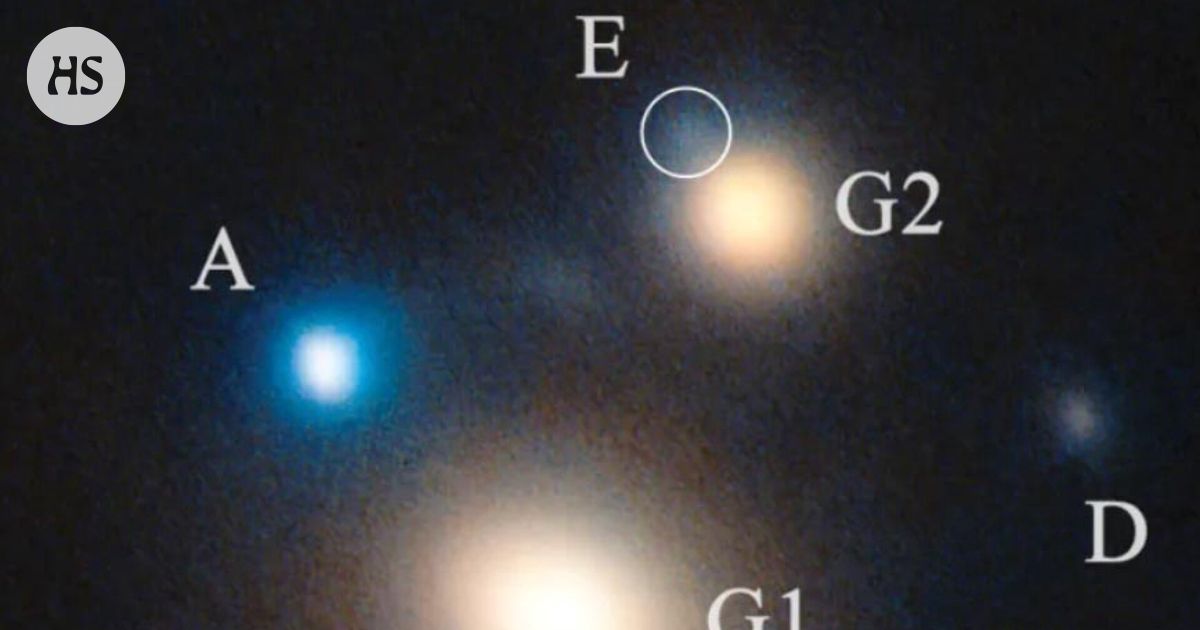
Astronomy|The University of Helsinki is now studying the image created by the explosion of the supernova Winny. It can provide information about the rate at which the universe is expanding.
A rare gravitational lens of space shows the exploded supernova Winny in five separate images.
The supernova is more than ten billion light-years away from Earth.
Stefan Schuldt, PhD, who discovered the lens, believes that the observation can help in the dispute about how fast the universe is expanding.
Gravitational lensing is a phenomenon in space where a massive object bends and amplifies the light traveling by with its gravity.
It works in a way like an optical lens, thanks to which it is possible to observe distant objects here on Earth.
Gravitational lensing observed last year showed an image of a distant exploded star ie from a supernova. Astronomers named the supernova Winny.
The light it emits is bent on its way past two galaxies so that Winny appears in five versions.
Helsinki a research doctor working at the university Stefan Schuldt noticed that Winny’s light has traveled towards Earth through gravitational lensing. Tells about the discovery Bulletin of the University of Helsinki.
Schuldt is a researcher in the Finnish Eso centerwhose members are the University of Helsinki, the University of Oulu, Aalto University (Helsinki) and the University of Turku.
The center operates mainly in Turku, but Schuldt’s office is at the University of Helsinki, which has more cosmology.
The supernova was observed by an international network of astronomers Holismokes. One of its observatories is located in California, The Zwicky Transient Facility.
Observations began to be refined Nordic Optical with a telescope. It is maintained by Finland and the other Nordic countries.
Observations revealed that the object is a rare supernova. It is located more than ten billion light-years away from Earth.
Such a distance is very large for such a supernova as has been observed.
Astronomers can measure great distances based on how much the wavelength of light is stretched during its journey.
The wavelength of light reaching the earth has shifted towards the red end of the spectrum during the long journey, because the universe has expanded during the journey. This so-called redshift can be measured.
About Winny according to the observation, the outgoing light encountered two galaxies on its way to Earth. Both galaxies act as gravitational lenses.
The second galaxy has a larger mass, so its effect was greater. According to Schuldt, both galaxies were still important. Without the effect of the smaller galaxy’s gravity, only four images of the supernova would have been visible instead of five.
The observation is very rare. Before Winny, astronomers knew of only two cases of individual galaxies causing gravitational lensing. Neither of these lenses was suitable for cosmological studies.
Because the light has taken different paths through the gravitational lens, this offers researchers a benefit.
“The gravitational lens refracted the light produced by Winny’s explosion onto the Earth in five different paths. Each path is slightly different in size,” explains Schuldt.
“Thanks to the time differences of the routes, we can measure the rate of expansion of the universe.”
The rate of expansion of the universe is described by the so-called with the Hubble constant. There are conflicting estimates of its exact value. The dispute over the speed of expansion has continued for decades.
Schuldt believes that the five gravitational lensing images of Winny will shed more light on the controversy. The goal is to make a new, independent measurement of the Hubble constant. It can be done as early as 2026.
The study about Supernova Winny has been approved Astronomy & Astrophysics – science journal.
https://issuu.com/pinup_hn
https://mastodon.social/@Mateo_Vargas
https://www.heroesfire.com/profile/velsit5667/bio
https://ezlocal.com/ky/col%c3%b3n/casino/0919487687
https://www.bandlab.com/user9039774870769905
https://forum.spacehey.com/topic?id=237930
https://www.livinlite.com/forum/index.php?topic=7610.0
https://www.gametracker.com/clan/Dynamickillercs/forum.php?thread=205669
https://forums.planetdestiny.com/threads/el-valor-estrat%C3%A9gico-del-bono-de-bienvenida-en-la-captaci%C3%B3n-de-usuarios-de-1xbet.40263/
https://megagrass.com/community/question-and-answer/forums/4133-general-questions/topics/3022228-como-decides-cuando-dejar-de-jugar-en-el-casino-online
https://civitai.com/user/knobloch219525
https://anyflip.com/homepage/wlzcy/preview
https://alma-ata.city/forums/iskusstvo/literatura/25443/
https://realestateinvesting.com/company/pinco-uzbekistan/
https://brandfetch.com/pinco-casino-online-uz.com
https://form.jotform.com/260264136633049
https://pavlodar.city/forums/zhenskij-forum/materinstvo/3143/
https://www.igromania.ru/news/109652/Novoe_ograblenie_kazino-avtory_Payday_2_rasskazali_o_gryaduschih_obnovleniyah.html
https://geometria.ru/reportage/488525-vinnoe-kazino/