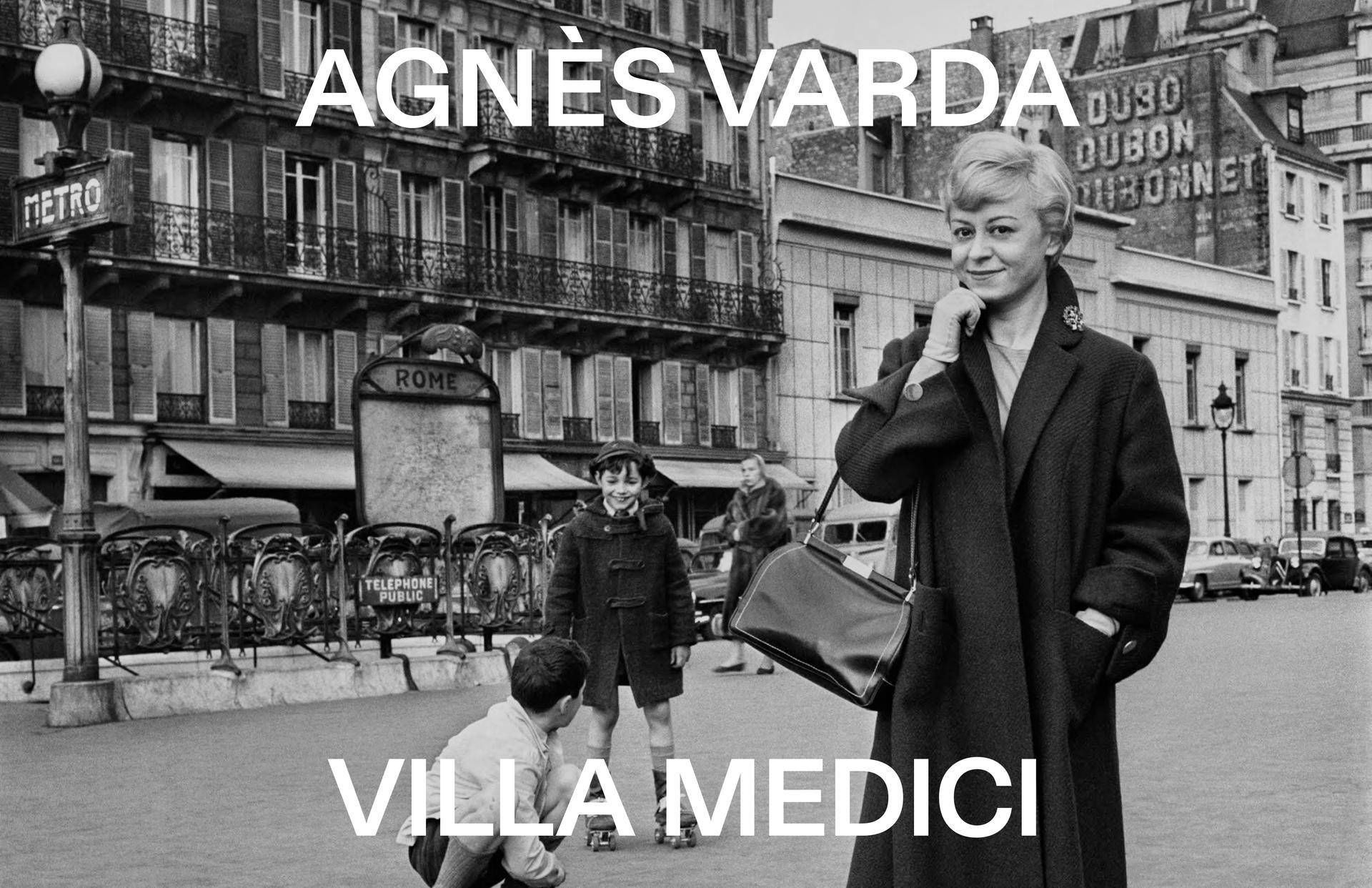
The French Academy of Villa Medici celebrates, in the capital, the photographic work of Agnès Varda (1928-2019) with ‘Agnès Varda. De-ci De-là. Paris-Rome’ the first major retrospective dedicated by Italy to the famous director on the occasion of the seventieth anniversary of the twinning between Paris and Rome. Opening of the exhibition, curated by Anne de Mondenard (musée Carnavalet – Histoire de Paris), on 25 February (scheduled until 25 May). The exhibition invites you to immerse yourself in post-war Paris and, in particular, in the courtyard-atelier of rue Daguerre, the place of life, creation and experimentation of Agnès Varda for almost seven decades, inseparable from her work. The photographs taken by the artist during his travels in Italy, from Venice to Rome, in Renaissance villas and gardens or on film sets echo the Parisian years. Through the places and figures that inspired her, the exhibition traces the path of a prolific and singular artist. His work will also be the protagonist of ‘Viva Varda’ (6 March 2026 – 7 February 2027), an exhibition at the Galleria Modernissimo of the Cineteca di Bologna created in collaboration with the Cinémathèque française.
The exhibition will retrace the entire work of the first filmmaker to have received the honorary Oscar for the entire span of her career. The Villa Medici exhibition therefore brings the photographer’s work into dialogue with that of the filmmaker through a set of 130 original prints, film extracts, publications, documents, posters, still photographs and objects belonging to the artist. Conceived by the musée Carnavalet – Histoire de Paris and curated by Anne de Mondenard and Paris Musées, it was presented in Paris from 9 April to 24 August 2025. The exhibition is the result of research lasting over two years and is based on Agnès Varda’s photographic collection, as well as on the archives of Ciné-Tamaris, the production company she founded, now directed by her children Rosalie Varda and Mathieu Demy.
The itinerary traces Agnès Varda’s beginnings as a photographer and her settlement in the early 1950s in the courtyard-atelier of rue Daguerre, transformed into a studio, photography laboratory and home to her first exhibition in 1954. That courtyard, later shared with her partner, the director Jacques Demy, became the heart of her universe. Photographs and film excerpts highlight the unconventional gaze, tinged with humor and singularity, that the artist directs at the streets of the capital and its inhabitants. Through works such as ‘Cléo de 5 à 7’ (1962) or ‘Daguerréotypes’ (1975), the exhibition particularly highlights his constant attention to women and marginal lives. The exhibition brings together the works of several artists presented in dialogue with the photographs and films of Agnès Varda, including, Giancarlo Botti, Michaële Buisson, Alexander Calder, Martine Franck, Dominique Genty, JR, Liliane de Kermadec, Michèle Laurent, Claude Nori, Laurent Sully-Jaulmes, Robert Picard, Valentine Schlegel, Collier Schorr.
In continuity with the exhibition, Agnès Varda’s Italy illuminates the deep ties that united the artist to Italy through a selection of unpublished photographs taken during two stays, in 1959 and 1963. At the time Agnès Varda was known as a theater photographer and worked on numerous reportage commissions for the press in France and Europe. In 1959 he explored Venice and its region in search of filming locations for ‘La Mélangite’ (ou ‘Les Amours de Valentin’), a film that would never see the light of day. His photographs testify to his discovery of Italy and his taste for the picturesque. The views of Venice and its inhabitants fully reflect its spirit. The spontaneous practice of photography is accompanied by an attraction for graphic scenes that play with shadows and contrasts. At the Villa della Torre, near Verona, and in the Gardens of Bomarzo in Latio, the materials and singularity of the sculptures fascinate her.
In May 1963, the French magazine Réalités commissioned her to paint a portrait of Luchino Visconti, who had just won the Palme d’Or for ‘The Leopard’. He leaves for Rome with three cameras. Contact sheets and color photographs document the session with what the press defined as the ‘taciturn prince of Italian cinema’. In the same period Jean-Luc Godard shot ‘Contempt’ at the Titanus studios. Varda goes to the set and photographs her friend while he directs Brigitte Bardot, Jack Palance and Michel Piccoli. About fifty original prints from Rosalie Varda’s collection, as well as documents from her archives and from the collection deposited at the Institut pour la photographyie des Hauts-de-France tell the story of Agnès Varda’s relationship with Italy for the first time.
Arriving in Paris in 1943, Agnès Varda attended the École du Louvre and chose to dedicate herself to photography, a practice that allowed her to combine manual dimension and intellectual reflection. During her apprenticeship years she shared an apartment near Pigalle with three other young women. Her roommates become the first subjects of her portraits, while the banks of the Seine stand out as her first Parisian landscapes. In this initial phase, his style – characterized by a subtle enigmatic quality of surrealist origin – and his artistic identity were already establishing themselves. In 1951 Agnès Varda moved to number 86 rue Daguerre, a space with a singular character. It converts two former shops, separated by a courtyard-alley, into atelier, studio and laboratory. This place of work and creation also becomes a space of shared life with the sculptor Valentine Schlegel and a family of Spanish refugees. In the courtyard he organized his first exhibition in 1954 and made his first films there.
In the 1950s Agnès Varda held the role of official photographer of Jean Vilar’s Théâtre national populaire and of the Avignon Festival. This experience opened the doors to the Parisian artistic world for her. He created numerous portraits and photographic services, immortalizing figures such as Calder, Brassaï, Suzanne Flon, Giulietta Masina and Fellini. Combining irony and a subtle enigmatic quality, to the point of sometimes touching a darker dimension, he progressively established himself as a singular voice of the post-war intellectual scene. Agnès Varda excels in reportage, while at the same time affirming, in some subjects, an aesthetic and a method marked by cinematographic language. As a director would do, he stages his shots and directs his models: a little girl dressed up as an angel or young actors miming various love behaviors. In 1961, with ‘Cléo de 5 à 7’, Agnès Varda created both a female portrait and a documentary on Paris, in which the city becomes a mirror of the protagonist’s states of mind, troubled by the fear of cancer.
In 1967 he returned to film Paris in resonance with the emotions going through a young mother, distressed by the war in Vietnam. Close to the filmmakers of the Nouvelle Vague, Agnès Varda inscribes her gaze on the city in a continuous dialogue between the intimate sphere and the political dimension. In her photographs and, later, in her films, Agnès Varda questions the way women are looked at and represented, particularly in ‘L’une chante, l’autre pas’, where she takes a stand in favor of women’s rights and contraception. Her feminism is part of a broader attention paid to the human. Already in the 1950s he brought to light the impoverished population that animated the market on rue Mouffetard (‘L’Opéra-Mouffe’, 1958). Later, in ‘Daguerréotypes’ (1975), she focuses on the traders of rue Daguerre, whom she defines as the ‘silent majority'”. She records their gestures, faces and narratives of daily life with a poetic sincerity, poised between social documentary and surrealist homage.
In 1959, during a reconnaissance in Venice and its surroundings, Agnès Varda captured scenes of daily life and recurring motifs such as laundry on the windows and shadowy passages. On the occasion of this trip he created one of his famous self-portraits in front of a canvas by Gentile Bellini, playing with humor on his now iconic hairstyle. Sent to Rome in 1963 to photograph Luchino Visconti, she visited Jean-Luc Godard on the set of ‘Contempt’ and portrayed Brigitte Bardot, Jack Palance and Michel Piccoli. Until the mid-1960s, Agnès Varda created portraits of young actresses and actors in her court, including Delphine Seyrig and Gérard Depardieu. After having made the neighborhood traders famous in ‘Daguerréotypes’ (1975), he identified more and more with his path, to the point of calling himself a ‘daguerréotype’. Over the years, the courtyard-atelier transforms into a courtyard-garden, which sometimes extends as far as rue Daguerre, as in the ‘self-documentary’ ‘Les Plages d’Agnès’ (2008). It is also the place where Agnès Varda talks about herself, puts herself on stage and from which her work spreads and takes shape. In Paris, Agnès Varda does not allow herself to be seduced by the more picturesque aspects of the capital. Instead, she turns her gaze to what goes unnoticed and to the places that are most familiar to her: her neighborhood and the banks of the Seine. The excerpts presented in the exhibition reveal the way in which his camera traverses urban space. They draw on all genres — fiction, documentary, advertising — and a plurality of formats, from feature films to short films and fragments of evidence.
https://www.pearltrees.com/tatianacowan/item776709665
https://supplyautonomy.com/brunoautomotive11.ca
https://www.callupcontact.com/b/businessprofile/Bruno_Automotive_Inc/9949565
https://myspace.com/autodrivehub/post/activity_profile_32463737_367517a4ddbf495e9fcab76b9fcdd72f/comments
https://telegra.ph/Quality-Auto-Repairs-That-Keep-Cars-Running-01-22
https://penzu.com/p/63d65a603167b2e6
https://gamesgumball.blogspot.com/2026/01/switzerlands-shift-towards-sustainable.html
https://thewheellifeofry.weebly.com/home/glittering-trends-the-rise-of-face-painting-cosmetic-glitters-in-switzerland
https://penzu.com/p/08394b4832cc3259
https://jewelryfashionblog.mystrikingly.com/blog/switzerland-embraces-eco-friendly-beauty-with-bioabbaubarer-glitzer-cosmetic
https://blogfreely.net/bestfashionlooks/h1-glitter-revolution-schminken-glitzer-cosmetic-glitters-shine-bright-in
https://jewelryfashionblog.wixsite.com/luxury-jewelry-hub/post/shimmering-trends-the-rise-of-glitzer-gesicht-cosmetic-glitters-in-switzerland
https://johncornershop.hatenablog.com/entry/Shimmering_Trends%3A_The_Rise_of_Paillettes_Visage_Cosmetic_Glitters_in_Switzerland
https://telegra.ph/Shimmering-Trends-The-Rise-of-Face-Glitters-Cosmetic-Glitters-in-Switzerland-01-21
https://postheaven.net/warrenwoods/shimmering-trends-the-rise-of-cosmetic-glitters-in-switzerland
https://supplyautonomy.com/%C3%A9clair%C3%A9eu.ch
https://www.provenexpert.com/eclairee/
https://myspace.com/beautique10/post/activity_profile_81467159_38974ae4744f4083b78aae3a885c4302/comments
https://flipboard.com/@fashionelle/paillettes-cosm-tiques-bioglitzer-switzerland-festival-ready-hvg5ac14y
https://rune-college-a24.notion.site/Plastic-Free-Glitters-Cosmetic-Glitters-Switzerland-Fun-2f56fd05e51880b69d18c955480508ba
https://to-portal.com/post/416794_swiss-schminken-glitzer-and-face-glitters-provide-eco-friendly-sparkle-for-face.html
https://www.startus.cc/company/kenka
https://gab.com/JuneGilbert/posts/115936824861178833
https://postheaven.net/warrenwoods/keeping-your-vehicle-in-top-shape-with-timely-oil-changes-in-north-vancouver
https://blogfreely.net/elvisthomas/ensuring-smooth-rides-the-importance-of-transmission-service-in-north-vancouver
https://flipboard.com/@carcarecorner/north-vancouver-s-experts-in-honest-auto-repair-t5rtmt4my
https://to-portal.com/post/416766_at-bruno-automotive-we-provide-honest-expert-car-repairs-in-north-vancouver-from.html
https://gettr.com/post/p3wnwpp7ec3
https://penzu.com/p/72915f54653bbb1e