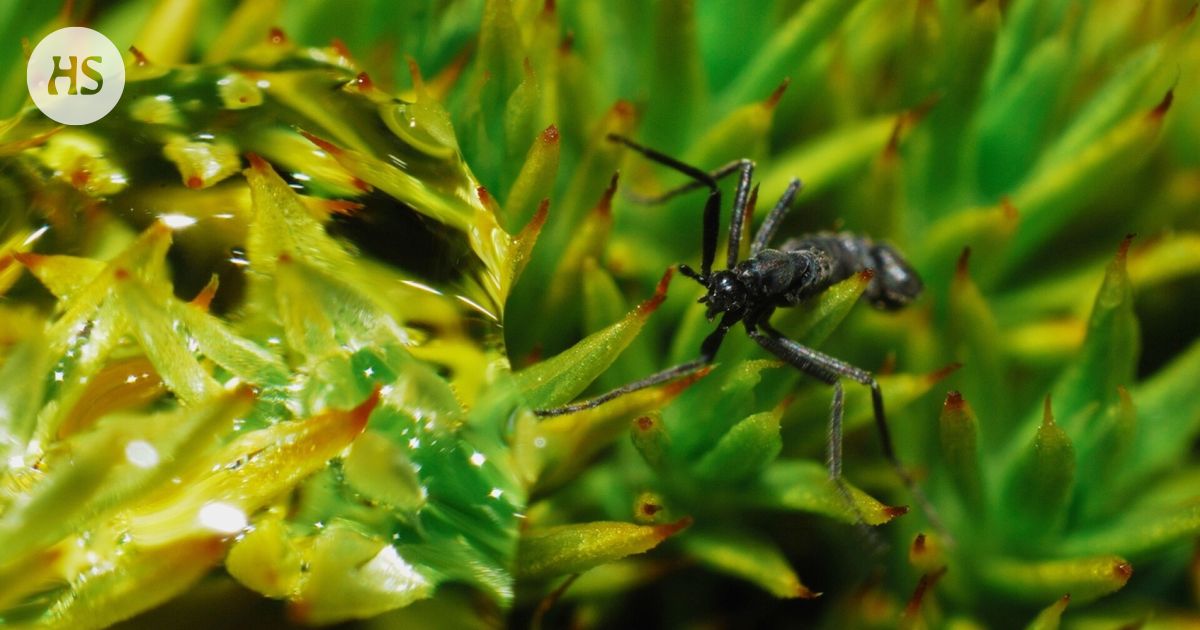
Avan beyond the sea, far to the south, lives a bug. A tiny, wingless goshawk.
It is dying on the cruel shores of Antarctica, where almost nothing else can live.
Wingless, it cannot fly, but is a prisoner of the cold earth. The osprey, which grows to only half a centimeter, is the only insect species in the whole of Antarctica.
It lives in such isolation that you would think it should be left alone.
But man’s grasp reaches far. Even in this perhaps the most remote insect in the world, pieces of microplastic have now been found. That’s what it says A new study from the University of Kentucky.
Humanity uses so much plastic that it is ground up and transported as microscopic particles around the world.
Investigator Jack Devlin wondered if plastic could even be found in Antarctic organisms. Found, unfortunately.
The researchers collected barn owl larvae from Hermit Island (“Hermit Island”) off the coast of Antarctica and opened them in the laboratory.
Using precise equipment, it was possible to separate plastic particles only thousandths of a millimeter in size from the insides of the larvae.
Not many of them were found – a total of two plastic particles out of 40 larvae, but they were found nonetheless.
Barn swallows live on the Antarctic Peninsula, in the horn that reaches towards South America. Sea currents also carry plastic particles there.
The study did not find out whether microplastics are harmful to the bug, at least in the small concentrations that the creature absorbs from nature.
Still, plastic is certainly not useful for it.
The hawk hawk official name is Antarctic Belgium. It was discovered and named during an expedition led by Belgians at the end of the 19th century.
The monster is indeed the only insect in Antarctica. It spends most of its life as a larva under the snow, eating microbes, algae and penguin droppings. In summer, it can be found on the moss growing on the coast, as in the picture in the story.
As an adult, it only lives for a week, mates, and dies. As her last act, the female lays a kind of anti-icing agent on the eggs.
http://pattern-wiki.win/index.php?title=geislerho3613
https://skitterphoto.com/photographers/2219239/gustavsen-bondesen
https://apunto.it/user/profile/599857
https://platform.joinus4health.eu/forums/users/dibblefamily2/
http://hikvisiondb.webcam/index.php?title=hodgeshove8188
https://www.blurb.com/user/dibblecornet
http://kriminal-ohlyad.com.ua/user/crossrocket1/
https://actualites.cava.tn/user/flarejury7/
https://tvoyaskala.com/user/squaredonkey4/
http://dudoser.com/user/silkbow6/
http://www.qazaqpen-club.kz/en/user/francerifle5/
https://itkvariat.com/user/antbow1/
https://invastu.kz/user/antnickel8/
https://panoptikon.org/user/thomastown6/
https://www.udrpsearch.com/user/asiameat9
https://mehmetnuriarslan.com/user/antcancer7/
http://csmouse.com/user/flarerate4/
http://bioimagingcore.be/q2a/user/asiarate3
http://dubizzle.ca/index.php?page=user&action=pub_profile&id=138430
https://www.24propertyinspain.com/user/profile/1370209
https://shenasname.ir/ask/user/squarestorm9
http://qa.holoo.co.ir/user/dibblemeat2
https://stackoverflow.qastan.be/?qa=user/francejury1
https://www.fionapremium.com/author/francegoat3/
https://adsintro.com/index.php?page=user&action=pub_profile&id=784900