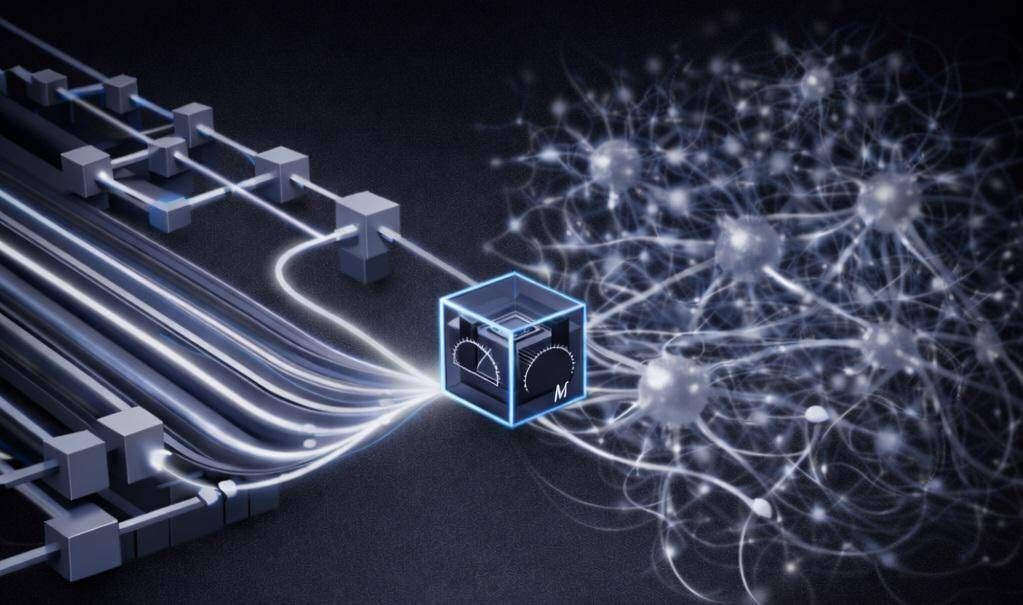
The boundary between particle physics and artificial intelligence has been broken down by Italian-led international research, published in Physical Review Letters. The studywhich saw the collaboration between Cnr-Nanotec, the Italian Institute of Technology (IIT) and Sapienza University of Rome, reveals that photons propagating in optical circuits are not only data carriers, but behave spontaneously like a Hopfield Networkone of the most sophisticated models to describe the associative memory of the human brain. Instead of relying on classic electronic chips, researchers have exploited quantum interference to encode information directly into light particles. “Instead of using traditional electronic chips, we exploited quantum interference, the phenomenon that occurs in photonic chips when light particles overlap and interact with each other to encode and retrieve information“, explains Marco Leonetti, coordinator and corresponding author of the study, first researcher of the Cnr-Nanotec and affiliated to the Center for Life Nano- and Neuro-Science of the Italian Institute of Technology (IIT). “In this system, photons are not simple data carriers, but themselves become the ‘neurons’ of an associative memory“.
This discovery paves the way for a new generation of hardware capable of guaranteeing very high performance with an energy impact drastically lower than that of current data centers. However, the research identified a natural limitation: just like in biological systems, there is a saturation threshold.
“When the number of stored information is limited, the system manages to recover it correctly thanks to quantum coherence“, clarifies the researcher Gennaro Zanfardino, adding however that when this threshold is exceeded, a problem occurs “memory blackout” in which the system enters a state of disorder known as “spin glass.”
This link with complex systems links the discovery to the studies of Giorgio Parisi, Nobel Prize winner 2021. As pointed out by Fabrizio Illuminati, director of Cnr-Nanotec“the light thus becomes a real miniature laboratory“capable of exploring the most complex phenomena of nature, laying the foundation for an artificial intelligence that imitates human thought not only in software, but in its very physical substance.
https://library.zortrax.com/members/damian-15/
https://championsleage.review/wiki/User:DianaMattes
https://freepaste.link/d29jr1thro
https://thewion.com/post/417175_kind-seed-co-039-s-product-range-typically-includes-several-main-categories-of-s.html
http://centercep.ru/phpbb/profile.php?mode=viewprofile&u=58831
https://toot.community/@KiraAnter
https://www.codewars.com/users/BernhardHooler
https://md.darmstadt.ccc.de/s/IYXAyrbfIm
https://estar.jp/users/1993353464
https://www.growkudos.com/profile/boris_bekker
https://skitterphoto.com/photographers/2251132/casparroels
https://www.logic-sunrise.com/forums/user/188447-melkanters/
https://blender.community/corneliasemplet/
http://www.webclap.com/php/jump.php?url=https://kindseed.com/what-are-deps-weed/
https://myliveroom.com/BirgittaTaller
https://md.coredump.ch/s/vrG_3TqGJ
https://www.tsxvresearch.com/forum/viewtopic.php?t=295093
https://www.theseobacklink.com/detail/kindseed221039
https://mez.ink/kindseed
https://www.easyhits4u.com/profile.cgi?login=milanilsen&view_as=1
https://www.cadviet.com/forum/index.php?app=core&module=members&controller=profile&id=224170
https://bioqoo.com/kindseed
https://www.pickupforum.de/profile/244185-baxterpass/
https://www.notariosyregistradores.com/web/forums/usuario/leonnorman/
https://caramellaapp.com/densetter/2TSQabOEJ/kind-seed-co