Once the driving force behind Germany’s exports, China is now seen as a direct trade competitor with the European leader.
From February 25, German Prime Minister Friedrich Merz began his first official visit to China. He led a delegation of about 30 business leaders to Beijing and Hangzhou – a major center for humanoid robots.
To prepare for this trip, Mr. Merz invited leading experts with knowledge about Germany to the meeting on February 17. Mr. Jörg Wuttke, representative of BASF chemical group in China from 1997 to 2024, currently President of the European Chamber of Commerce in Beijing, was present that evening.
“The Prime Minister wants to know how to build relationships with Chinese officials. He prepared for this trip very carefully,” he said.
Theo The World, German public opinion is divided over how to respond to the historic change in economic relations between the two largest economies in Eurasia. Over the past two decades, bilateral trade has been complementary, with strong Chinese demand for German chemicals, vehicles and equipment.
This brought benefits to both sides, where industry in China advanced rapidly and brought significant prosperity to Germany in the 2010s. However, that relationship has ended. “We are witnessing a brutal retreat,” Mr. Wuttke said.
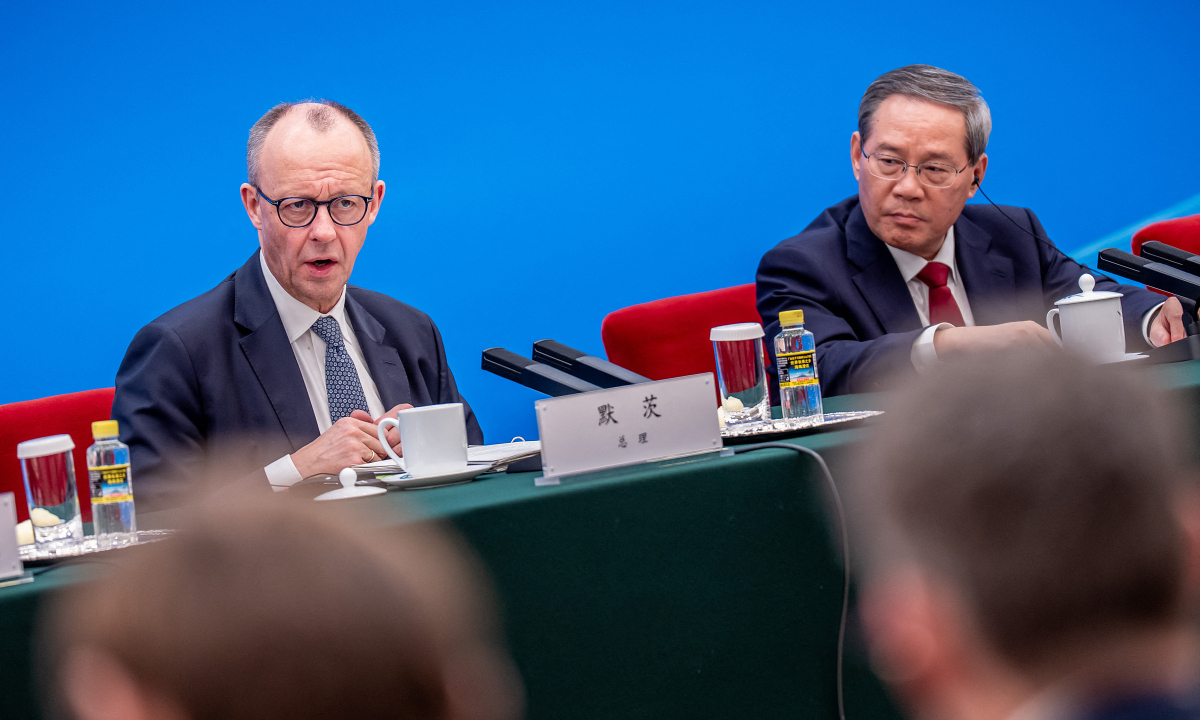
German Chancellor Friedrich Merz and Chinese Prime Minister Li Qiang at a meeting in Beijing on February 25. Image: AFP
China is now a net global exporter of machine tools and vehicles, sectors where traditional German industry once dominated. Due to excess production capacity, China creates fierce competition not only domestically but also in the international market, where exports benefit from the undervalued RMB.
On the contrary, German industry gradually lost market share, many manufacturing enterprises struggled and cut jobs. According to data released in mid-February by auditing company EY, 266,000 industrial jobs have disappeared since 2019. The sharpest decline is in automobiles, with 111,000 positions cut during this period.
Mr. Wuttke experienced this firsthand. BASF China had not received a single euro from Germany for 25 years. All major projects are funded by Chinese partners or huge local profits. Every year, they also send 1-2 billion euros back home. “But that resource is now exhausted,” he admitted.
The same thing happens with the auto industry. Volkswagen’s profits in China for a long time flowed to its headquarters in Wolfsburg, until the company was forced to restructure in 2025. Recently, Volkswagen, along with BMW and Mercedes-Benz, warned of low sales. Data from the European Statistics Agency (Eurostat) shows that German car exports to China will decrease by two-thirds from 2022.
Competition spread to other industries. Last year, goods exports to China decreased by 9.3%, to 81.8 billion euros ($97 billion), the lowest level in a decade, while imports from this country increased sharply.
Andrew Small, Asia program director at the European Council on Foreign Relations (ECFR), assessed that Germany is witnessing a “China shock”. “Two economies that were once complementary now operate as competitors,” he said.
Research firm Rhodium Group in New York points out that China is taking over Germany’s market share in the fields of machinery, chemicals and electrical systems. They warned that German exports to China had entered a phase of “structural decline”. Unless the industry finds alternative markets, the wave of bankruptcies and job cuts Germany is seeing is “likely to increase”.
“China used to be a gold mine for German multinational corporations. But in the past 3 years, a quarter of the turnover has disappeared,” said expert Noah Barkin of Rhodium Group. According to the German Trade and Investment Agency (GTAI), China has been Germany’s largest or second largest customer for many years. By 2024, export turnover to this country will drop to 5th place and is estimated to drop to 7th place last year.
Some industrial federations representing mid-range companies have called for a tougher stance, such as local production and raising barriers to foreign goods. “These calls reflect deepening concerns about competition from China, which has become especially fierce over the past year,” said Mr. Barkin.
Some large corporations have taken a different approach, viewing China as a laboratory for future industries, instead of leaving. At the end of 2024, Bosch closed its self-driving car research facilities in Stuttgart to invest heavily in China, arguing that technology needs to develop where it is applied.
In fact, it is an acknowledgment that China has a super fast-growing ecosystem that is unmatched anywhere else in the world. Xinhua A survey by the German Chamber of Commerce shows that advances in innovation in this country are having a positive impact on the headquarters of German companies.
Mr. Wuttke likened China to “a gym for industrialists”. “The Chinese are at least six years ahead of us in embedded software and two years in chassis. We are learning how they produce competitive electric cars,” he explained.
However, the President of the European Chamber of Commerce in Beijing also admitted that Europe still needs some targeted protection measures for specific industries. According to Mr. Barkin, “Germany will have to take certain protective measures, otherwise its industry will disappear within the next few years.”
In China this week, German Chancellor Friedrich Merz is under pressure to strike a balance between asserting the country’s importance to German industry and pressing Beijing to address long-standing concerns about market access and overcapacity.
Meeting with Chinese Prime Minister Li Qiang on February 25, Mr. Merz said Germany attaches great importance to maintaining and deepening economic exchanges, as well as emphasizing the need for fair cooperation and open communication.
“We have very specific concerns regarding our cooperation, wanting to improve it and make it more equitable,” Mr. Merz said. Mr. Ly Cuong called on the two countries to jointly protect multilateralism and free trade.
Stefan Messingschlager, an expert on Chinese history at Helmut-Schmidt University in Hamburg, said that a possible goal is for Berlin to re-establish relations with Beijing in the direction of “controlled stability”.
At the same time, reduce dependence on rare earths, pharmaceutical precursors and important industrial software. Additionally, instead of resolving bilateral challenges, he said Germany could take advantage of support from EU mechanisms such as anti-dumping and anti-subsidy duties, among other measures.
Global Times reassured, saying that the attraction of the huge billion-people market is still greater than concerns about competition. Arguments such as “systemic rivalry” have sometimes complicated German policy toward China, they say.
“The enthusiasm and actions of the German business community say more than political slogans,” the newspaper commented.
https://www.samash.com/spotlight/best-beginner-electric-guitars
https://www.samash.com/spotlight/prs-guitars-buyers-guide
https://www.samash.com/spotlight/guitar-battle-prs-custom-24-vs-prs-ce-24
https://www.samash.com/spotlight/freedom-on-stage-the-best-guitar-wireless-systems
https://www.samash.com/spotlight/electronic-drumming-evolution-best-e-kits
https://www.samash.com/spotlight/universal-audio-ox-amp-top-box-revolutionizing-recording-for-guitarists
https://www.samash.com/spotlight/the-well-paid-musicians-guide-to-financial-harmony
https://www.samash.com/spotlight/ibanez-guitars-the-ultimate-buyers-guide
https://www.samash.com/spotlight/the-ultimate-drumhead-buying-guide
https://www.samash.com/spotlight/all-in-one-speaker-systems-elevating-sound-simplifying-life
https://www.samash.com/spotlight/dwe-electronic-drum-sets-everything-you-need-to-know
https://www.samash.com/spotlight/gibson-les-paul-modern-series-buyers-guide
https://www.samash.com/spotlight/fender-american-professional-ii-vs-fender-american-ultra-series
https://www.samash.com/spotlight/martin-vs-taylor-acoustic-guitar-buying-advice
https://www.samash.com/spotlight/the-magic-of-8-inch-speakers-the-advantages-of-large-studio-monitors
https://www.samash.com/spotlight/the-line-6-helix-everything-you-need-to-know
https://www.samash.com/spotlight/the-multi-scale-guitar-a-harmonious-innovation
https://www.samash.com/spotlight/gibson-les-paul-buyers-guide-2024-edition
https://www.samash.com/spotlight/the-mystery-of-the-baritone-guitar
https://www.samash.com/spotlight/fender-50s-vs-60s-stratocaster-whats-the-difference
https://www.samash.com/spotlight/metal-vs-wood-snare-drums-which-is-better
https://www.samash.com/spotlight/the-history-of-the-gibson-sg-with-the-neurotic-guitarist
https://www.samash.com/spotlight/get-the-most-from-your-tone-full-range-flat-response-speaker-guide
https://www.samash.com/spotlight/three-ways-to-make-your-drums-quieter
https://www.samash.com/spotlight/american-pro-ii-vs-fender-american-ultra-stratocaster