Having to invite before eating makes many Southern tourists confused when they first dine with a Northern family.
Hoai Anh, a tourist from Dak Lak, first visited Hanoi 5 years ago, still remembers a meal with a friend’s family. When the tray of rice was served, her friend said, “Please invite your grandparents and parents to eat.” She saw that and said the same but didn’t understand why she had to do that because at her house, everyone just sits and eats and doesn’t invite each other. Later, she understood that it was the culture in many northern provinces that younger people needed to invite older people to eat when dining together.
“When that friend came to my house and invited me to eat, everyone laughed loudly because they didn’t understand why they did that,” she said.
According to cultural researcher Nguyen Hung Vi, the act of offering rice before meals is not a habit, but an educational family ritual. This custom has been around for a long time and people also have the saying “When you eat, you invite, when you do, you borrow”. He said the Vietnamese rice tray is a “community dinner tray”, where the whole family eats together. This leads to an emphasis on position and behavior.
Vietnamese people, especially Northerners, always clearly remember the saying “Watch the pot when you eat, watch the direction when you sit” – reminding each person when eating and drinking to be mindful, maintain moderation and respect order and roles in the family – as a way to educate about family behavior. Experts added that in ancient times of famine, most people did not have enough to eat, so meals were very important. Therefore, everyone must respect the elderly and care for children.
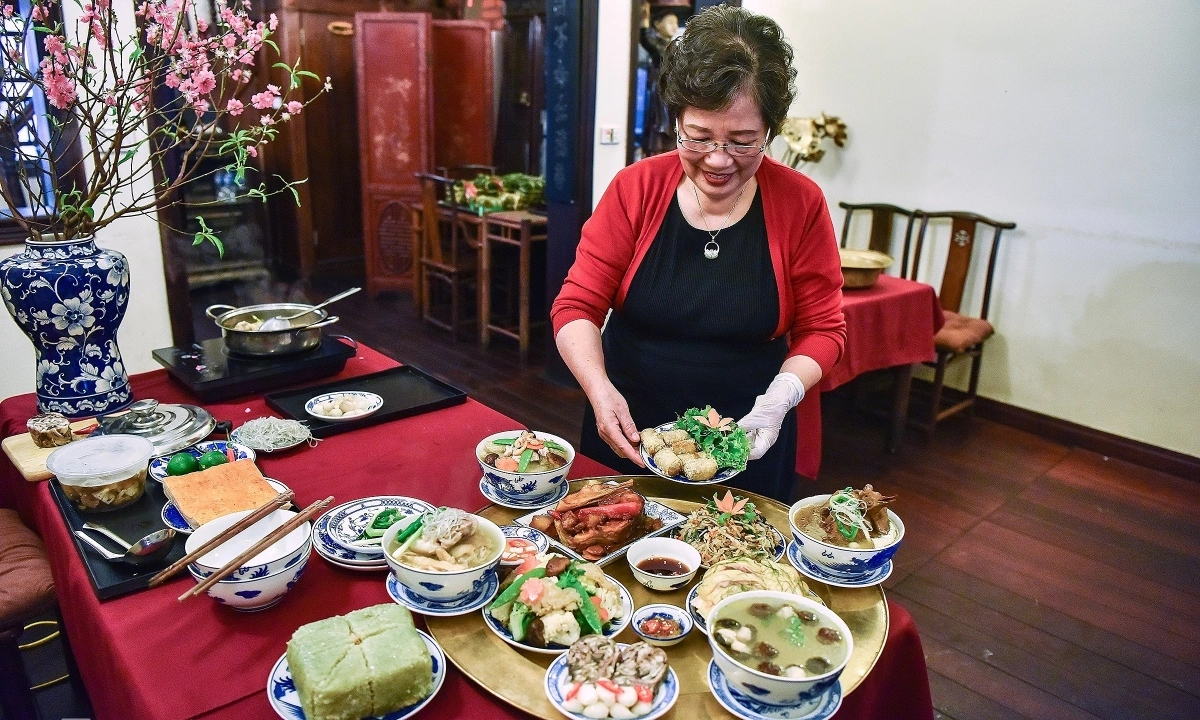
Artisan Anh Tuyet makes Hanoi’s traditional Tet feast. Image: Giang Huy
Regarding the invitation ritual, Mr. Vi said that in the family it is usually done in order from top to bottom. The youngest person in the family is often reminded to invite first, then invite grandparents, parents and siblings in turn. This ritual creates a sense of clarity, thoughtfulness and respect.
According to tradition, after the children and grandchildren have finished inviting, they often have to wait for the grandparents to lift their chopsticks before they can eat. In today’s life, after an invitation, elders often respond with permission: “Stop eating, my child, eat.” The act of invitation, therefore, means asking for permission from the superior.
Explaining that some regions, especially the South, do not invite meals as strictly as the North, researcher Nguyen Hung Vi believes that the reason lies in family structure and living conditions.
In the North, agricultural life is stable so family organization is very strict, there must be enough people to eat. Meanwhile, in the South, the river and garden lifestyle makes living habits more flexible. He cited the image of children in the gardens often running and playing from house to house, eating wherever they met, sleeping there at night. Due to this nature, meal invitations in the South are often not read according to a list from top to bottom but are just general invitations like “Please” or “Let’s eat”.
“An invitation doesn’t mean a place has better education, it’s simply a cultural difference,” he said. In addition, Northern people often invite guests to eat when they suddenly visit their house. He said this was more like a polite greeting instead of actually inviting guests to eat.
Experts emphasize that inviting meals is not a “cumbersome procedure”, no matter how society has changed today. According to him, through invitation, people learn to respect superiors and subordinates, to live consciously and orderly, and that is always necessary at any time.
https://texascriminaldefensegroup.com/lubbock-domestic-violence-lawyer/evidence/
https://texascriminaldefensegroup.com/lubbock-dui-lawyer/defining-driving/
https://texascriminaldefensegroup.com/amarillo-criminal/dwi-lawyer/drug/
https://texascriminaldefensegroup.com/lubbock-dui-lawyer/field-sobriety-testing/
https://texascriminaldefensegroup.com/midland-criminal/sex-crimes-lawyer/child-pornography/
https://texascriminaldefensegroup.com/lubbock-dui-lawyer/stops/
https://texascriminaldefensegroup.com/lubbock-dui-lawyer/second-offense/penalties/
https://texascriminaldefensegroup.com/federal-criminal/sentencing-guidelines/
https://texascriminaldefensegroup.com/amarillo-criminal/drug-lawyer/how-authorities-treat-offenses/
https://texascriminaldefensegroup.com/federal-criminal/appeals-lawyer/
https://texascriminaldefensegroup.com/amarillo-criminal/drug-lawyer/possession/penalties/
https://texascriminaldefensegroup.com/amarillo-criminal/drug-lawyer/possession/building-a-defense/
https://texascriminaldefensegroup.com/lubbock-dui-lawyer/challenging-the-evidence/
https://texascriminaldefensegroup.com/lubbock-domestic-violence-lawyer/civil-and-criminal-actions/
https://texascriminaldefensegroup.com/federal-criminal/sentencing-guidelines/relevant-conduct/
https://texascriminaldefensegroup.com/federal-criminal/sentencing-guidelines/criminal-offenders/
https://texascriminaldefensegroup.com/plainview-criminal/gun-lawyer/
https://texascriminaldefensegroup.com/plainview-criminal/drug-lawyer/possession/
https://texascriminaldefensegroup.com/plainview-criminal/drug-lawyer/
https://texascriminaldefensegroup.com/plainview-criminal/drug-lawyer/intent-to-distribute/
https://texascriminaldefensegroup.com/plainview-criminal/dui-lawyer/second-offense/building-a-defense/
https://texascriminaldefensegroup.com/lubbock-theft-lawyer/burglary/
https://texascriminaldefensegroup.com/lubbock-appeals-lawyer/2255-motions/who-can-file/
https://texascriminaldefensegroup.com/lubbock-appeals-lawyer/when-to-appeal/
https://texascriminaldefensegroup.com/lubbock-appeals-lawyer/writ-of-habeas-corpus/