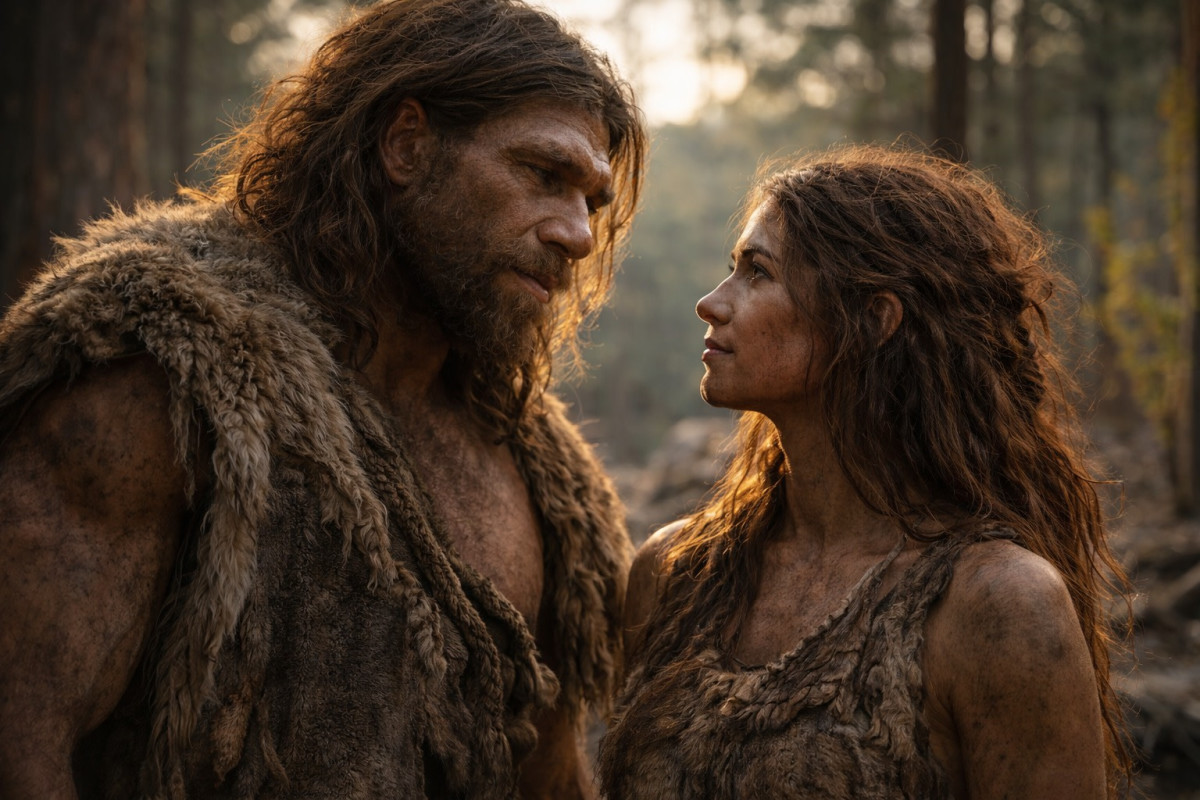
A prehistoric romance under the skin: New genetic research suggests that not all matings between modern humans and Neanderthals were equal. X chromosome analysis indicates that most sexual encounters were between Neanderthal males and modern human females. The finding may explain why we have almost no Neanderthal X chromosome today. But behind the sensation hides complex evolutionary mathematics and scientific caution.
The first scientific bombshell exploded already in 2010, when researchers showed that modern humans, Homo sapiens, and Neanderthals, an ancient human species that lived in Europe and Western Asia and became extinct about 40,000 years ago, not only met but also had children together. It has since been found that most humans outside of Africa have 1% to 2% Neanderthal DNA.
But one detail continued to trouble the researchers. While in many parts of the human genome segments of Neanderthal origin have been found, the X chromosome is almost devoid of them. The X chromosome is a sex chromosome: women have two, men only one along with the Y chromosome. Scientists have called this situation the “archaic desert”, an area of the genome where almost no genetic trace of the Neanderthals remains.
For more than a decade, two main explanations have been proposed. The first argued that Neanderthal genes on the X chromosome were relatively harmful and were therefore gradually eliminated by natural selection. The second explanation suggested that for some biological reason the X chromosome simply passes less easily between related species.
Now a new study offers a completely different explanation, one that relates not only to genetics but to mating patterns and behavior. The researchers analyzed the genomes of modern women and compared them to samples of Neanderthal females, using African populations as controls, since most have almost no Neanderthal DNA. The result was surprising: in the Neanderthals themselves, an excess amount of human DNA was found precisely on the X chromosome.
The possible meaning of this finding is asymmetry in pairings. If most matings occurred between a Neanderthal male and a Homo sapiens female, then their children would receive a human X chromosome from the mother. Over generations, if this pattern repeated itself, the human X would have assimilated into the Neanderthals, while the Neanderthal X would have entered less and less of the gene pool of modern humans.
In other words, not only was there sexual contact between the groups, but it may not have been symmetrical. Neanderthal males and human females met and produced offspring more frequently than the opposite direction.
Why did this happen? This is where the speculation begins. The researchers suggest the possibility of partner preference, meaning that some attraction, biological or social, caused this particular combination to be more common. It is also possible that different migration patterns led to Neanderthal males and modern human females being in the same areas at the same time. There are also those who raise more complex possibilities, including power relations between groups.
However, scientists emphasize that the genetic models are not able to reproduce the social story in full. The X chromosome is known to be evolutionarily complex, and additional selective forces may have influenced the observed patterns. Even if hybrid skeletons of the first or second generation are found in the future, they will only tell about individual cases, and not about the broad demographic picture.
Still, the very possibility of inferring mating patterns from tens of thousands of years ago through mathematical analysis of modern genomes is considered an impressive scientific achievement. Instead of asking only if there was interbreeding between the species, science moves to asking who with whom, how often, and what the long-term evolutionary outcome was. Thus it turns out that one chromosome, relatively small, is able to flood big questions about attraction, meeting between ancestral groups and the way intimate relationships shaped the genes of all of us.
https://newyorklicenseplate.org/vehicle-registration
https://newyorklicenseplate.org/vehicle-registration-fees
https://newyorklicenseplate.org/vehicle-registration-for-new-residents
https://newyorklicenseplate.org/vehicle-registration-renewal
https://northcarolinalicenseplate.org/cancel-vehicle-registration-online
https://northcarolinalicenseplate.org/emissions-testing
https://northcarolinalicenseplate.org/expired-registration
https://northcarolinalicenseplate.org/get-car-title
https://northcarolinalicenseplate.org/inspection-required-for-registration
https://northcarolinalicenseplate.org/insurance-vehicle-registration
https://northcarolinalicenseplate.org/lemon-law-for-used-cars
https://northcarolinalicenseplate.org/vehicle-registration
https://northcarolinalicenseplate.org/vehicle-registration-fees
https://northcarolinalicenseplate.org/vehicle-registration-for-new-residents
https://northcarolinalicenseplate.org/vehicle-registration-renewal
https://northdakotalicenseplate.org/cancel-vehicle-registration-online
https://northdakotalicenseplate.org/cost-car-registration-from-out-of-state
https://northdakotalicenseplate.org/emissions-testing
https://northdakotalicenseplate.org/expired-registration
https://northdakotalicenseplate.org/get-car-title
https://northdakotalicenseplate.org/inspection-required-for-registration
https://northdakotalicenseplate.org/insurance-vehicle-registration
https://northdakotalicenseplate.org/lemon-law-for-used-cars
https://northdakotalicenseplate.org/transfer-car-title-to-family-member
https://northdakotalicenseplate.org/vehicle-registration-for-new-residents