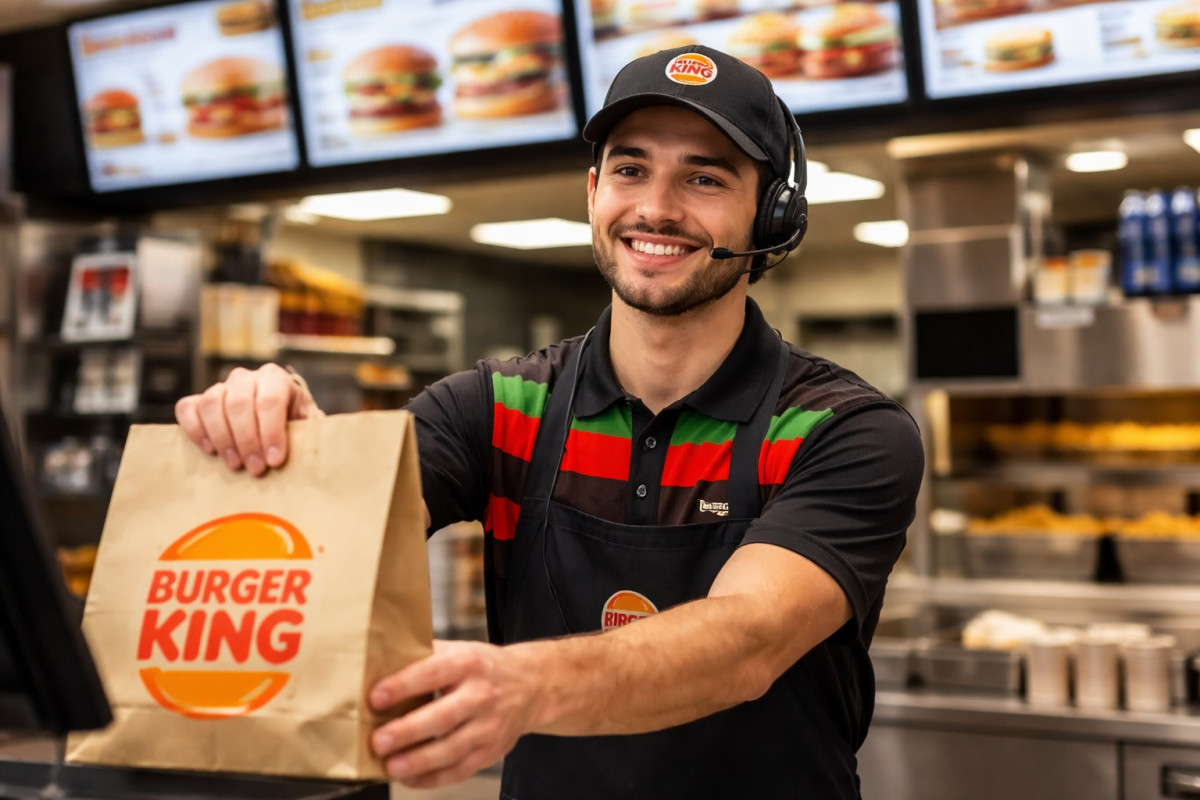
The Burger King chain, one of the largest hamburger chains in the world, will start operating a voice artificial intelligence system that will be integrated directly into the headsets of the branch employees. The system, based on OpenAI technology, is intended to provide an immediate answer to current operational questions, but at the same time it will analyze the way employees speak and measure their level of “friendliness” with customers.
The voice chatbot, known as Patty, will reportedly recognize predefined phrases such as “Welcome to Burger King,” “Please” and “Thank you.” The data will be collected and will allow managers to monitor service performance in each branch. The company states that this is a tool that aims to improve the customer’s experience through training and feedback, and not by means of punishment.
However, the very act of monitoring tone and phrasing raises ethical questions about privacy in the workplace. The company’s executives admitted that they are developing the system so that in the future it can also recognize the tone of voice, and not just certain words. This means moving from simple textual identification to emotional or behavioral analysis, an area that is at the heart of the public debate surrounding the use of artificial intelligence in organizations.
Along with the monitoring function, the system also has distinct operational uses. Employees will be able to ask the assistant how many strips of bacon should be placed on each hamburger, how to clean the milkshake machine or how to handle an equipment malfunction. The system is also connected to the branch’s point-of-sale system, and you can alert managers about shortages in inventory or malfunctions in equipment.
The overall platform is called Burger King Assistant, and it is expected to be deployed in all branches of the chain in the United States by the end of 2026. At this stage, the system that monitors “friendliness” is operating as a pilot in about 500 restaurants. If the experiment is defined as a success, it is likely that the use will be extended to other markets as well.
Burger King’s move joins a broader trend in the retail and fast food industry, in which artificial intelligence enters service centers, inventory management and even automatic cash registers. Other chains already operate voice recognition systems for orders in the car route or chatbots for online customer service. However, direct monitoring of employee speech patterns represents a more advanced stage of technology’s penetration into the workplace.
Supporters of the move claim that in an industry where employee turnover is high and training is short, a digital tool that provides real-time answers and improves service uniformity may also benefit the employees themselves. On the other hand, workers’ rights organizations warn against a situation where every word is measured and graded, especially when it comes to workers who earn minimum wages and work under constant pressure.
https://hindibeststory.com/support/
https://hindibeststory.com/aviator/
https://hindibeststory.com/affiliate-programme/
https://hindibeststory.com/responsible-gaming/
https://hindibeststory.com/about-us/
https://hindibeststory.com/cookies-policy/
https://hindibeststory.com/how-to-bet/
https://hindibeststory.com/terms-and-conditions/
https://hindibeststory.com/privacy-policy/
https://hindibeststory.com/kyc-aml-policy/
https://hindibeststory.com/licence/
https://1xbet-costarika.com/
https://1xbet-costarika.com/registrate/
https://1xbet-costarika.com/ios/
https://1xbet-costarika.com/registro/
https://1xbet-costarika.com/movil/
https://1xbet-costarika.com/casino-en-vivo/
https://1xbet-costarika.com/bono-de-bienvenida/
https://1xbet-costarika.com/verificacion/
https://1xbet-costarika.com/iniciar-sesion/
https://1xbet-costarika.com/mma/
https://1xbet-costarika.com/hockey/
https://1xbet-costarika.com/f1/
https://1xbet-costarika.com/futbol/