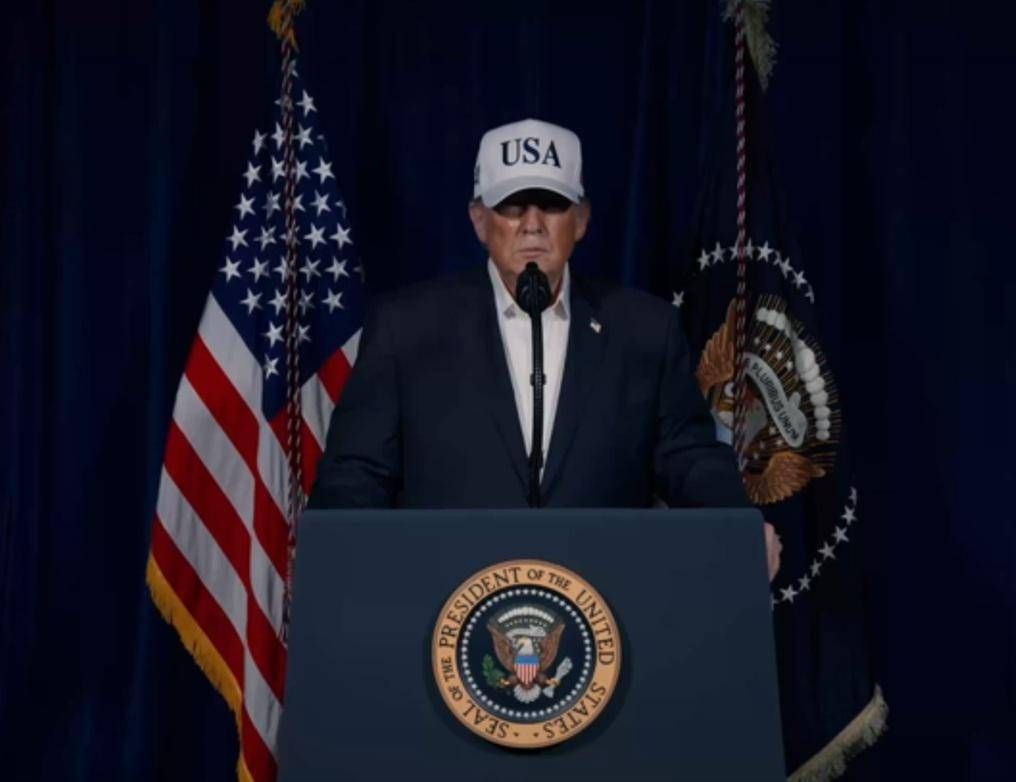
A massive campaign against Iran that will continue for several days: this is the objective of President Donald Trump, who has launched an explicit appeal to the citizens of the Middle Eastern country to free themselves from their oppressive leadership. “They have rejected every opportunity to give up their nuclear ambitions and we can take no more,” Trump said to justify the attack. After his speech in the American night, the American leader is not expected to speak again this Saturday, despite some rumors in the press. Karoline Leavitt, the presidential spokeswoman, said the president had been monitoring the situation at Mar’s residence in Lago, Florida, along with members of his national security team, including Secretary of Defense Pete Hegseth.
Before the attack, Leavitt, the Secretary of State, revealed Marco Rubio informed the “Gang of Eight”which is the small bipartisan group of eight high-ranking members of Congress who are typically briefed by the executive branch on sensitive and classified intelligence matters. “The President and his national security team will continue to monitor the situation closely,” Leavitt wrote. This discussion with the Gang, if confirmed, could silence the criticism of some lawmakers, especially Democrats, who accuse Trump of continuing to act without first going through Congress. As for the Saturday attack, the Trump administration excludes that it will be a long war and speaks of a mission – at least on the American side – aimed primarily at annihilating the country’s nuclear and ballistic capabilities.
At the same time, on Friday, Trump had acknowledged the risk of a prolonged conflict: “I guess you could say there’s always a risk. You know, when there’s a war, there’s a risk in everything, for better or for worse.” In an interview this week, Vice President J.D. Vance — who has previously warned against sending U.S. troops into dangerous areas for uncertain purposes — implied that any operation in Iran would not result in a prolonged conflict similar to the wars in Iraq or Afghanistan. Trump remains confident that his air operation can successfully bring about change in Iran’s government, despite great uncertainties about what and who might replace him and limited historical examples of how air power alone has toppled a country’s leader. In all of this, the American president did not make it clear in his message to the Iranian population how protesters and government opponents can remove Tehran’s leadership.
To the Washington Post, Trump simply said that his main concern is the “freedom” of the Iranian people. “All I want is freedom for the people”he said. Retired American general David Petraeus, on CNN, excludes that there will be soldiers on the ground in a US operation in Iran. “Certainly we could have some limited presence on the ground or other assets, but it would be very limited and in safe areas,” added Petraeus, who was also director of the CIA.
A Pentagon source, consulted by Adnkronos, explains that the decision of the United States and Israel to conduct the attack in the morning rather than during the night, and only a few days after the positive signals that emerged in the diplomatic process, was deliberately designed to take the Iranian leadership by surprise. Especially considering that last June, the attacks occurred in the middle of the night.
“It’s a decision that took everyone here at the White House by surprise,” explains Sara Canals, correspondent for the Spanish radio station Cadena Ser. “However, already yesterday, when he spoke to us journalists, we could perceive a certain frustration in the president’s words. Almost an awareness that the Iranians would never give up their nuclear program with good manners.”
The tactical surprise would have been accentuated by a climate of awareness that diplomacy was still at stake: This Friday, Oman’s foreign minister had said in a social media post that “a peace deal between the United States and Iran is now within reach.”
Trump has never publicly made his case for war, not even during his State of the Union address on Tuesday. Furthermore, the fact that new negotiations had been announced between Washington and Tehran this Monday in Vienna, and that Secretary of State Marco Rubio would travel to Israel next week, had given the feeling that there were still days left before a possible attack.
According to analysts, one factor played a fundamental role in convincing Trump: the arrival of the Gerald Ford aircraft carrier off the coast of Israel this Friday. With this ship, the deployment of the ‘American armada’ was completed – both offensively and defensively – and all that remained was to wait for Trump’s order, which was not long in coming. “The attack, which had already been planned for some time, could only start with the deployment of the last American assets in the region, including air refueling planes and the Gerald Ford aircraft carrier group, after weeks of preparation” confirms Federico Borsari, defense expert at the Center for European Policy Analysis (Cepa).
According to Jacopo Pastorelli, an analyst at the Atlantic Council, the attack would be justified by the belief within the Trump administration that Iran has never been so weak as it is at the moment. “The president’s need was to make US threats ‘credible’“, explains the analyst to Adnkronos. Pastorelli believes that, strategically, the Saturday operation is the continuation of the demonstration of strength and the weakening of China’s allies, first Venezuela, now Iran, which exports around 90% of its crude oil to China.
The president, according to sources inside the White House, made this decision after weeks of deliberations and always leaving the door open to negotiations to reach an agreement with Iran. The straw that would have broken the camel’s back this Thursday would have been Iranian obstinacy in not definitively giving up its nuclear program. Meanwhile, before the attacks, officials were confronted with a series of imperfect options, all a far cry from a mission like the one Trump ordered in January to capture Venezuelan leader Nicolás Maduro in Caracas. The American leader allowed diplomacy to proceed, despite warnings from some senior officials that Iran was notoriously difficult to negotiate with. Then he drew a line.
Many in Trump’s orbit have encouraged him to pursue a deal. His envoys Steve Witkoff and Jared Kushner, for example, after initiating three rounds of indirect talks with the Iranians, had expressed cautious hopes of success. But others were less encouraging. Republican Senator Lindsey Graham has publicly criticized some alleged concessions offered by the Iranians. And Israeli Prime Minister Benjamin Netanyahu, on an urgent visit to Washington this month, said there could hardly have been a more opportune time to strike Iran.
“The perception is that the Iranians were procrastinating. Dwelling. Trying to gain time in the negotiations with the hope of exhausting Washington,” explains Fariba Pajooh, Iranian journalist and professor at Wayne State University in Detroit. “I know the thinking of the Tehran regime. Trump simply lost his patience,” Pajooh explains to Adnkronos.
Throughout this period, Trump had appeared to those around him to be wary of taking the United States into war, much preferring a diplomatic outcome that he could pass off as stronger than the Obama-era nuclear deal from which he withdrew. But he was impatient to reach an agreement, setting tight deadlines that did not allow him to obtain the concessions he expected from Tehran. The last one, lasting ten days, expired this Saturday. This time, Trump kept his word with his ultimatum. (Of Iacopo Luzi)
https://www.ameba.jp/profile/general/gassy9/
https://www.smitefire.com/profile/lolic99-255695?profilepage
https://micro.blog/yaxeh
https://wykop.pl/ludzie/marcus967
https://lnk.bio/nonec1d2334
https://potofu.me/vnzupvwg
https://www.slideserve.com/Svetlana20
https://www.walkscore.com/people/336908220076/hollden
https://www.ganjingworld.com/channel/1ib65q6v6uv6YPET6pLc2lyU51av0c?tab=about
https://www.wanttoknow.nl/author/holland66/
https://leetcode.com/u/neyoha9220/
https://www.equinenow.com/farm/benjaminhart.htm
https://www.royalroad.com/profile/913886
https://app.wedonthavetime.org/profile/mitchell_flowers
https://cgmood.com/saheg-luka
https://www.proko.com/@peter_peters/activity
https://velog.io/@saheg67966/about
https://devpost.com/saheg67966?ref_content=user-portfolio&ref_feature=portfolio&ref_medium=global-nav
https://www.liraland.ua/forum/user/160396/
https://koga.net.pl/30247-makston/profile.html
https://triberr.com/saheg67966
https://sfx.thelazy.net/users/u/baags/
https://anyflip.com/homepage/unjcp#About
https://www.wantedly.com/id/foster_dan
https://doodleordie.com/profile/motamo3