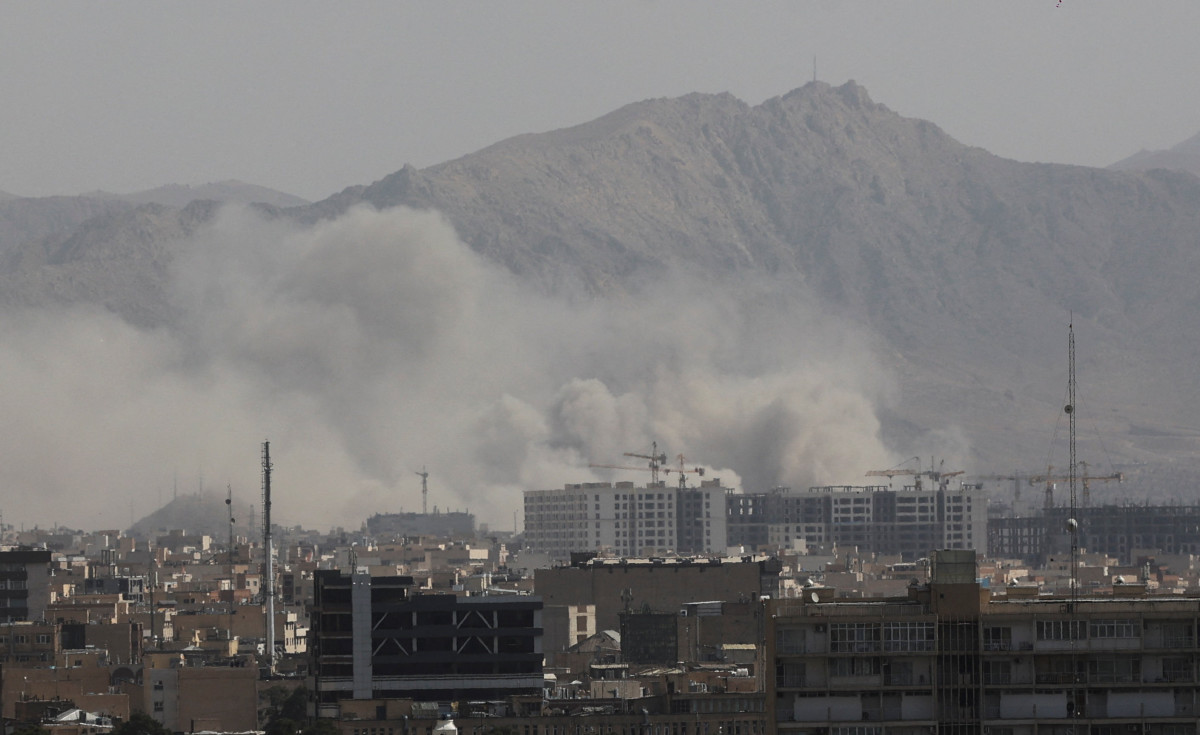
The four models tested were Anthropic’s Claude, Google’s Gemini, xAI’s Grok, and OpenAI’s ChatGPT. Each reacted differently under pressure to decide, and each revealed a different weakness in the way great linguistic models behave when asked for certainty in an uncertain world. Then reality crashed into the simulation.
what happened today
In a separate Reuters report, an Israeli security official was quoted as saying that the operation was coordinated with the United States, had been planned for months, and that the departure date was set weeks in advance. These details are important to understanding the story of the “artificial intelligence that predicted” because they emphasize the obvious: a chatbot did not initiate the attack, did not influence decision-making, and was not exposed to classified planning. He guessed – and the guess merged with reality.
The test of the four models – and what did each of them say?
First documentation of air force strikes in Iran | Photo: IDF spokesman
So who “won”?
In the narrow measure of social networks, Grok “won” because the date he punched corresponded to the day the attacks began. But this adjustment does not make the exercise a predictive service, nor does it verify the logic that led the model. It mainly demonstrates that in a tense news cycle there are several reasonable time windows, and one of the models landed on the one that became reality.
Already on February 25, the Jerusalem Post emphasized the main lesson: as users press models for certainty, they tend to provide more accurate answers – even when the world remains uncertain. Shabbat events simply gave this lesson a date and time.
The connection to Elon Musk
This ecosystem explains why Grok’s reply to February 28 dominated the viral discourse. The crowd sharing breaking news, speculation and screenshots is already on X. A forecast given within the platform spread instantly, and was amplified by the same mechanisms that drive markets, memes and sometimes disinformation.
In this sense, Grok’s “victory” was part technical and part structural: the model guessed a date, and the platform around it turned the guess into a punchline.
https://www.dibiz.com/frspbetca
https://www.beamng.com/members/fairspincaprofile.773846/
https://www.longisland.com/profile/FairspinCaProfile
https://guides.co/g/fairspin-caprofile/723909
https://logopond.com/FairspinCaProfile/profile/788120/
https://www.checkli.com/fairspincaprofile
https://www.slideshare.net/frspbetca?tab=about
https://www.flickr.com/people/204268446@N07/
https://fliphtml5.com/homepage/FairspinCaProfile/fairspincaprofile/
https://pubhtml5.com/homepage/uconj/preview
https://www.universe.com/users/fairspin-caprofile-9MD61K
https://gifyu.com/fairspincaprofi
https://www.magcloud.com/user/fairspincaprofile
https://www.pubpub.org/user/fairspin-caprofile
https://experiment.com/users/ffairspincaprofile
https://triberr.com/FairspinCaProfile
https://www.fanart-central.net/user/FairspinCaProfile/profile
https://www.openstreetmap.org/user/FairspinCaProfile
https://myspace.com/fairspincaprofile
https://www.mixcloud.com/FairspinCaProfile/
https://wakelet.com/wake/O6TrmZq-wItIC9gLywmLT