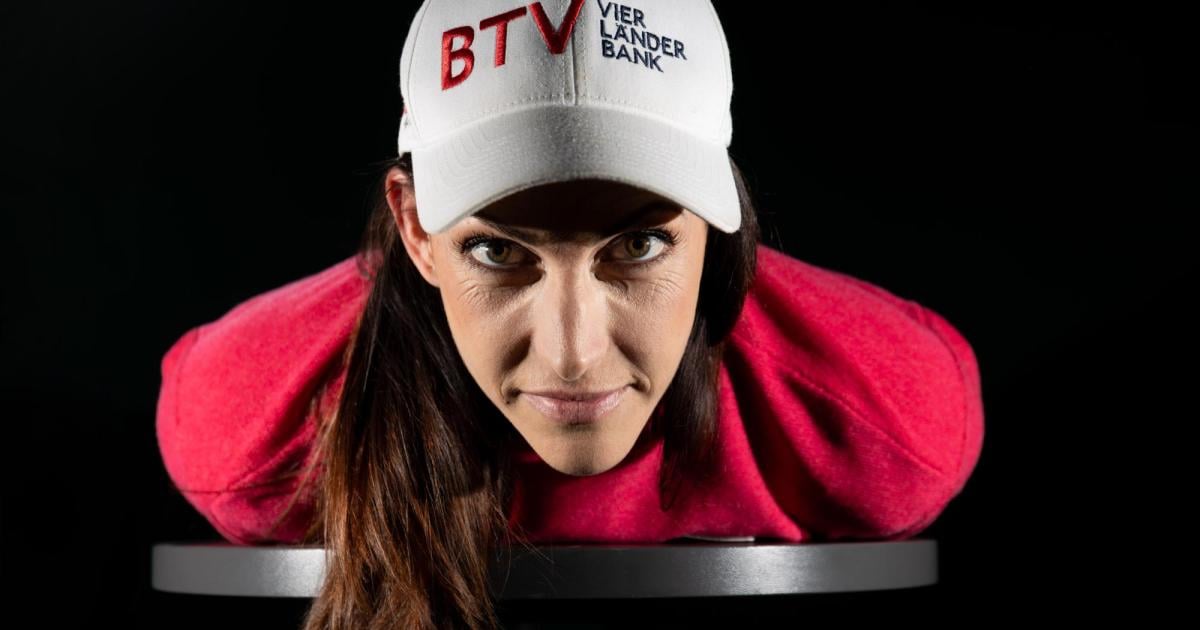
The golden one is always and everywhere. Skeleton Olympic champion Janine Flock she wears it proudly around her neck – also as a sign that her extraordinary career is already well rounded.
KURIER: What is your life like as an Olympic champion?
Janine Flock: I haven’t fully realized it myself yet. Since I’ve been home, my life has been organized. We had a few medal celebrations and I was also able to visit a few schools, so much appreciation and joy comes back from the success.
Are performing in schools moments where you realize the importance of success?
Yes, yes. I was in that situation myself when I looked up to people. This is tangible for the children when they see the medal. And if some children get excited about the sport, it’s definitely worth it.
Open/close copyright notice
© kurier / Martin Stachl
Has a chapter in the book of your life been written with the golden one?
Definitely. I finished writing Olympic history with this medal; those were my last Games. To end the chapter like this at the age of 16 and with four Olympic Games is really nice.
Did you have a score to settle with the Olympic Games before Cortina?
That’s how it was always communicated. But we consciously wanted to describe it differently, positively.
In 2018 you had your sights set on gold in Pyeongchang and came fourth. Did this have to happen to make Cortina 2026 possible?
There is a reason behind everything that happens. 2018 certainly gave me motivation and the push I needed. We have developed a lot as a team. There is something in every defeat that you can take with you. You just have to find it.
For a detailed sports talk with skeleton Olympic champion Flock
Then, as this time, you were the half-time leader. Did this experience help you?
That was definitely a small part that helped. But we also created the framework conditions in advance. We had more coaches on the track than ever before. It makes a big difference if the environment is right, if the structures are improved.
Who are the key people in your team?
My partner Matthias, with whom I work on the material, national coach Michael Grünberger, athletic trainer Walter Hable, who has been writing the training plans for four years. It takes partners, sponsors and also family. Over the course of my career, I have been lucky with my companions. I had good teachers.
You once mentioned a lack of self-confidence as one of your weaknesses. Where does this come from, what do you do about it?
Basically, I was always a quiet person who always had to struggle with insecurities. I think this is natural and affects many people. Over time I got to know each other better. What are my values, how do I want to shape my team and achieve my performance? You have to deal with yourself a lot and be brave to leave your comfort zones.
Open/close copyright notice
© kurier / Martin Stachl
How difficult was that?
Very difficult. You have to commit to something. Before doing so, think about whether it makes sense and is necessary. But it feels good when you do it. You have to fall for it and make mistakes.
Is the image of a professional athlete full of self-confidence wrong? Aren’t they all people with a lot of doubt?
Yes, yes. For me it was always hard work to gain security. For this I always needed good advisors around me. It is also important to be open to allowing development.
You said you had a good gut feeling about the ice track. What exactly is this sensorium?
This is difficult to describe. You have to control and steer the sled at high speeds. It takes experience – what creates pressure, what does the centrifugal force do. On the other hand, you have to let go and get involved with the feeling. Everything happens so quickly. It’s a mix of control and trust. I believe that you can train the feeling if you get involved in it in everyday life and observe things.
Do you have time to think while driving?
Yes, on a long straight, for example. Thoughts come and go straight away, every now and then you get stuck in your thoughts and then you have overslept a passage. You have to be sharp and attentive.
How important is social media for you to be able to present yourself?
For us, these are good platforms for gaining visibility. But for me, sport was always number 1. You can share professional and private matters and I know straight away what I share about my private life. If I feel good about it, that’s it.
There was criticism after your photo shoot for Playboy four years ago.
This wasn’t thoughtless, but well thought out. You often cannot influence what is then written.
What will you do in the future?
I’m living in the moment and currently enjoying. I already have my sporting goals – like the World Championships in Lillehammer. The fire still burns, the goal is there.
Who is Janine Flock without a skeleton?
I will definitely stay involved in the sport and would like to give something back.
https://docs.stephtransition.fr/s/2R7dJDEgP
https://able2know.org/user/sebastianrojas/
https://allmyfaves.com/omaralkhatib
https://www.awwwards.com/omar-ai-khatib/
https://pad.lamyne.org/s/9Vcujmce7
https://bsky.app/profile/eliteseoconsulting.bsky.social
https://www.bizmaker.org/san-francisco/business-services/a-final-message
https://notes.jimmyliu.dev/s/xA7JT9tU3
https://ckan.tirana.al/es/user/social-media-marketing-service
https://data.tomorrowscities.org/user/carnet-a2-valencia
https://hanson.net/users/sebastianrojas
https://pad.fablab-siegen.de/s/kjL5xyRY6
https://hackmd.chuoss.co.jp/s/SJH2-xyY-g
https://www.bitchute.com/channel/OdCkBg3qJnQQ
https://md.ccc-mannheim.de/s/r1Jhbg1Y-g
https://www.addonbiz.com/listing/london-greater-london-united-kingdom-best-london-removals/
https://pad.hxx.cz/s/kg1GRl_gyZ
https://doc.dcrich.net/s/l5Ql9snxjG
https://www.flux.ai/redotpay-referral-code-rjvq1-get-10-dollar-bonus-on-signup-2026?sv=bb2ac999
https://telegra.ph/Casinos-y-apuestas-online-12-10
https://simpsonflyfishing.com/forums/topic/el-impacto-de-los-influencers-en-la-popularidad-del-juego/
https://ckan.sister.it/user/agencia-marketing-barcelona
https://docs.erraticbits.ca/s/mrBivOgiCN
https://docs.lokavaluto.fr/s/8vMd6Y55Z
https://docs.lokavaluto.fr/s/iHdpVVYrR