Writing|A precursor to writing could have developed in Europe long before cuneiform writing.
Converging signs and symbols have been found on objects over 40,000 years old in Europe. They are organized. That’s why they could be considered precursors to the ability to write.
The people of the Aurignac culture carved more than 20 different symbols on objects: stars, circles and lines in certain periods, but also other signs.
The signs were not carved randomly, a computer comparison of the signs also revealed.
The study was published by the journal PNAS of the American Academy of Sciences.
Literacy perhaps began to develop much earlier than has been thought. It can be seen in the symbols and signs that Stone Age people carved into the objects of their time.
Early modern humans apparently used different symbols for communication as early as 40,000 years ago, before the end of the ice age.
These strings have the same intricacy and density of information as early cuneiform writing.
Arrowheads has been considered the oldest way for people to write and record things.
Cuneiform writing and its predecessors have only been found in the Middle East tens of thousands of years later than the Early Stone Age, around 3,200 BC. about, says the website Science Alert.
If the computer-based comparison of characters is confirmed, the beginning of the art of writing should be brought forward by even more than 30,000 years.
A recent examination shows that the language of the signs is statistically as complicated as the writings that preceded cuneiform around 3,500 BCE, writes Scientific American.
The information is not only encoded in the number of different characters, but also in how the characters are combined, say the researchers.
Modern man the first groups arrived in Europe an estimated 45,000 years ago.
They used to carve not only various figures but also simple symbols on implements such as pendants and tools as well as ivories and horns. Such were, for example, lines, crosses, dots and stars.
Thousands of objects marked in this way have been found in the area of present-day Germany alone.
The Ancestors of the people who lived there belonged of the Aurignac culture to a large area. It affected all of Europe around 43,000-34,000 years ago.
The influence of that culture extended from the Middle East and the western parts of Russia through the whole of continental Europe, all the way to present-day Portugal and the Atlantic.
The Germans linguists and archaeologists have systematically compiled and studied the inscriptions of the Europeans of that time.
Signs are perhaps an early precursor to writing. This is what a linguist at Saarland University claims Christian Bentz and Archaeologist of the Berlin State Museums Ewa Dutkiewicz. The study was published in the American Academy of Sciences in the journal PNAS.
Bentz and Dutkiewicz and their team found regularities in the markings found on objects in European museums and archaeological collections. A computerized comparison of the marks confirmed the same.
A wise man so didn’t just randomly daub marks on the surfaces of objects or the walls of caves.
Researchers cite examples. One source is a large collection of artifacts found in caves in the Swabian region of southwestern Germany.
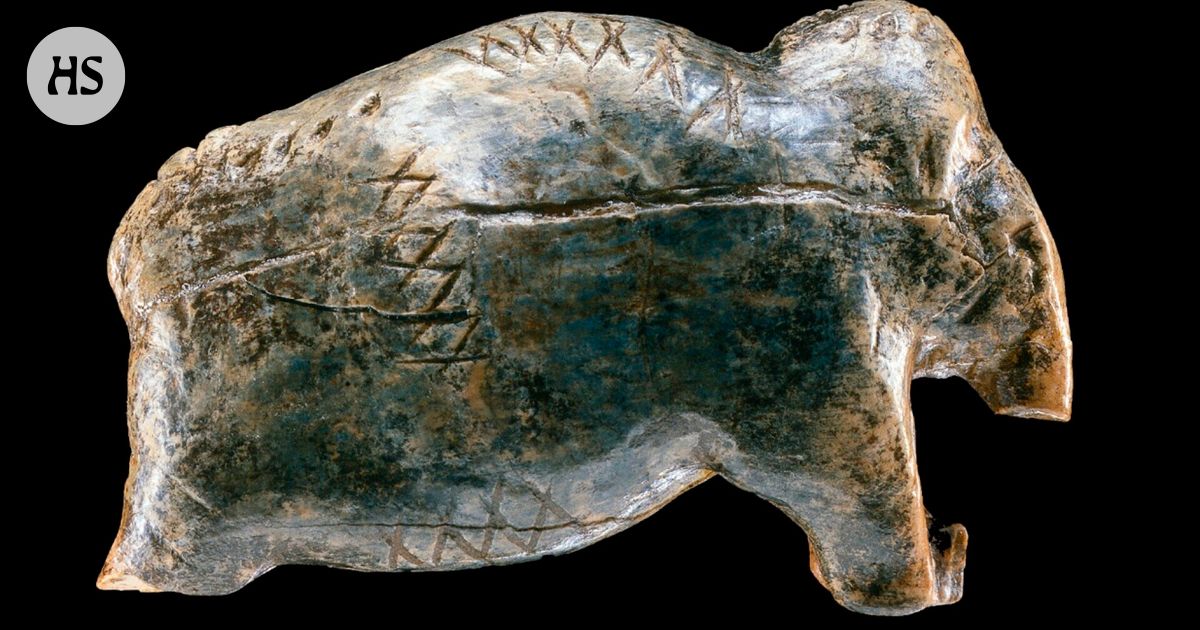
Dots and notches have been systematically carved into different ivories. Some kind of calendar?
The side of the ivory mammoth is carved with dots and notches in rows of 12 or 13 characters each. It could have been a calendar, says Dutkiewicz In New Scientist magazine.
Crosses were commonly used signs, but for some reason they were not made on figures that depicted people. Crosses were common on objects depicting animals, especially horses and mammoths.
Points, on the other hand, were never engraved on the side of the tools.
“This is a repeated, very systematic and clearly distinguishable use of characters. The characters appear in episodes,” describes Dutkiewicz.
“Many of the objects fit in the palm of your hand. You can see that they carried objects with them. They resemble tablets that gave rise to cuneiform writing.”
The signs were also preserved from generation to generation for thousands of years.
Hundreds of markings are engraved on figures, flutes and various tools.
Researchers found a total of more than 3,000 separate inscriptions on 260 sites in Stone Age objects, says website Phys.org.
There were more than 20 symbols in use. The researchers divided them into different categories, for example, according to the object on which the sign was engraved.
The most common is the V-shaped notch. Lines, crosses and dots are also popular. Other symbols, such as the Y-shape and star-shaped signs, have been used less frequently.
Linguists measured the repetition, difference and how much meaning the sign could carry. The starting point was information-theoretic.
The signs used are not complicated. Therefore, they cannot be considered writing in the true sense of the word.
However, the measurements clearly showed that the marks did not occur randomly.
For example, there was more information in the signs of human and animal figures than in the tools.
No one knows what the signs meant. However, it can be understood that they were important to the people of their time. Stone Age people clearly used them to convey information. Maybe they also recorded their thoughts in them.
Researchers compare the use of signs to the emojis of today’s mobile phones, such as emoticons and the like.
“We have only scratched the surface,” says Dutkiewicz.
Emo’s of the time?
Read more: The ancient cuneiform writing also originated from the figurative language of clay seals
Read more: The first alphabet is 500 years older than thought, researchers estimate – four clay pots were discovered in a Syrian grave
Read more: The ability to write prevents people from thinking, the philosopher Socrates speculated – This is how reading also became a treat for non-elite people
Correction March 3 at 10:25 AM: Early modern humans apparently used different symbols to communicate before the end of the last Ice Age, not before the Ice Age as initially stated.
https://admin.phacility.com/p/RuslanMahmudov/
https://appyet.com/forum/index.php?threads/what-is-the-best-online-casino-in-europe-2025-%E2%80%93-my-personal-experience.6129/
https://www.hdforums.com/forum/groups/arizona-riders-group-d2984-recommended-casino-games.html
https://able2know.org/user/turanhajiyev/
https://intua.net/forums/index.php?p=/discussion/9433/which-online-casino-would-you-recommend
https://idev.games/profile/SamirHasanovers
https://exchange.prx.org/series/60624-pin-up-casino-azrbaycan-rsmi-giris-2026
https://steemit.com/pinup/@rodrigosalinases/pin-up-casino-az-rbaycan-r-smi-giris-2026
https://www.thehockeypaper.co.uk/forums/users/jalalkarimov
https://www.hollywoodfringe.org/projects/7379?review_id=63726&tab=reviews
https://www.fordforum.com/forum/off-topic-6/worth-going-bay-bengal-casinos-50226/
https://www.ewebdiscussion.com/threads/take-your-one-win.242620/
https://peakd.com/pinup/@walterhansen/pin-up-casino-azerbaycan-resmi-giris-2026
https://www.bricklink.com/aboutMe.asp?u=NihatAslanov
https://www.bookkeepers.org.uk/Forum/?user=NurlanHuseynli
https://www.thesims3.com/mypage/eminrahimli/myBlog
https://schoolido.lu/user/MuradQuliyev/
https://awaydayradio.co.uk/forums/topic/great-casino-hotels-in-niagara-falls/
https://www.naaccr.org/forums/users/moliv97677creteanu-com/
https://forum.codeigniter.com/member.php?action=profile&uid=224303
https://www.fusioncash.net/forum.php?topic=99721.0
https://hashnode.com/@elshanbagirov
https://kumu.io/TuralRahimov/pin-up-casino-az%C9%99rbaycanda-r%C9%99smi-giris-2026#azerbaijan
https://www.sqaacademy.org.uk/tag/index.php?tc=1&tag=Question%20Paper
https://forum.melanoma.org/user/jahangirzeynalov/profile/