Spare parts|New materials have extended the service life. The combination of titanium, ceramic and plastic seems to work.
Today, artificial hip joints last 25 years or longer, according to an international study published in the medical journal Lancet.
Professor Keijo Mäkelä of the University of Turku says that 92 percent of modern artificial joints last a quarter of a century in use, while previous models only lasted a good decade.
The reason for the improved durability is the advanced materials, especially the combinations of titanium, ceramic and cross-linked polyethylene.
Hip artificial joints are becoming common among Finns. They were installed approx 13,000 in 2024 alone. In total, artificial joints have largely been installed in Finland more than 250,000.
Positive information from the point of view of artificial joint patients and health care is that artificial joints last even better.
Modern artificial joints seem to function without difficulty 25 years after surgery and even longer. This is what an extensive international study in the medical journal says In Lancet.
The assessment of the improved durability of artificial joints is based on a summary of studies conducted on the subject, i.e. a so-called meta-analysis.
According to it, 92 percent of modern artificial joints last a quarter of a century. The earlier models from a few decades ago lasted well over a decade.
‘”Ten years was a really short time,” says the professor of orthopedics and traumatology at the University of Turku Keijo Mäkelä. He was involved in an international study.
The durability of the artificial joint is important. Wear and tear of parts and dislodgement of joint parts can lead to a new surgery. Their results are not always as good as the first surgery.
More than 1,500 hip replacement surgeries were performed in 2024. The most common reasons for the surgeries were According to THL’s statistics infection, dislocation, femur fracture and dislocation.
“However, repeat operations have decreased over the years compared to how much primary operations have increased,” says Mäkelä.
However, the number of infections has not decreased. According to Mäkelä, infection is currently the most common reason for repeat surgery.
The reason the improvement in the durability of artificial joints is mainly due to the fact that the materials have developed.
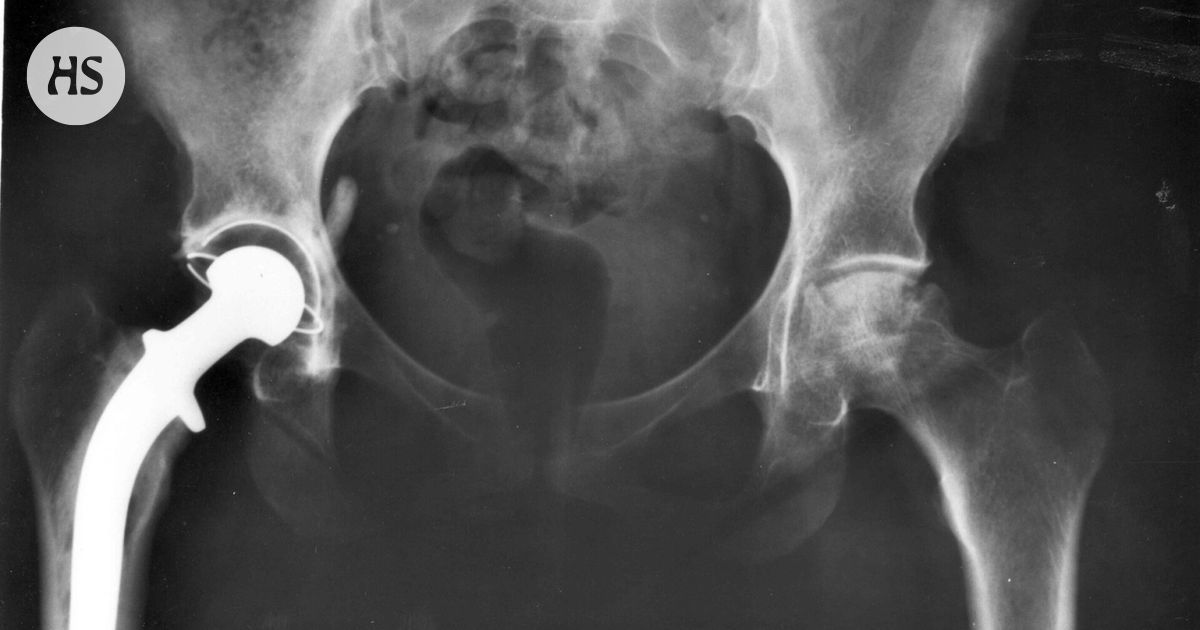
The artificial hip joint has a titanium stem to be installed in the femur. Titanium attaches to bone even without cement because the bone grows into the titanium.
There is a metal or ceramic knob at the end of the stem, which replaces the spherical head of the patient’s own femur.
The hip usually has a titanium cup for the knob, to which a sliding surface corresponding to the cartilage is installed.
An artificial joint usually has to be installed because the cartilage has worn away due to an injury, excessive stress, or the congenitally incorrect structure of the joint.
The ceramic knob against the plastic sliding surface has proven to be durable.
Artificial cartilage, i.e. the sliding surface, can nowadays be made of metal, ceramic or plastic. Today, the plastic is cross-linked durable polyethylene. It was introduced in 1998 and became common in ten years.
Even in the 1990s and early 2000s, plastics could wear out quickly.
“The body started to destroy the microscopic pieces of plastic and at the same time the bones,” Mäkelä describes.
Now according to a recent study, the three durable combinations are a ceramic knob on a plastic sliding surface, a metal knob on a plastic sliding surface, and a ceramic knob on a ceramic sliding surface.
Common around the world is, for example, a chrome-cobalt knob against plastic. However, they want to get rid of the metal knob in Europe because of the possible toxicity of chromium cobalt, says Mäkelä.
A metal knob against a metal sliding surface can be problematic if the metal sheds particles into the tissues.
“In the years 2001–2013, artificial joints with a metal-metal sliding surface were used in Finland, which caused an epidemic of reoperations.”
Such metal artificial joints could cause, for example, metallosis and muscle necrosis. According to Mäkelä, the joint affected by metallosis is black or gray, like “machine shop waste”. Muscle necrosis means that the muscle becomes necrotic due to local cobalt poisoning.
A ceramic knob can vibrate against a ceramic sliding surface.
Instead, a ceramic knob against a plastic sliding surface has proven also durable in Aalto University’s mechanical wear test.
Fresh the meta-analysis included data on a total of 1.9 million total arthroplasties.
The duration of the artificial joint also depended on the patient’s age, general health and bone quality. Use also affects the durability of the artificial joint.
https://casino-oceanspin.at
https://oceanspincasino-de.de
https://oceanspincasinos.de
https://oceanspincasino1.de
https://oceanspincasino7.de
https://oceanspincasinoonline.de
https://oceanspincasino-online.de
https://oceanspin-casino-de.de
https://oceanspin-casinos.de
https://oceanspin-casino-online.de
https://casinooceanspin.de
https://getdmenu.com/2026/02/25/dijital-oyun-dunyasinda-yenilik-trendleri-ve-gelecek-yonleri-3906/
https://www.deborakrizak.com/?p=119171
https://getdmenu.com/2026/02/25/tasarimin-gucu-kullanici-deneyiminde-yeni-standart-2948/
https://getdmenu.com/2026/02/25/gercek-krupiyelerle-etkilesim-live-casino-sahnesinde-dorukta-5867/
https://simpleweddings.com.au/canli-masalarin-enerjisini-dijital-ortamda-hisset-5985/
https://simpleweddings.com.au/kavbet-dijital-trendleri-yakalayan-modern-bir-deneyim-sunar-7469/
https://simpleweddings.com.au/matbet-mobil-dunyasinda-keyifli-oyun-saatleri-2084/
https://simpleweddings.com.au/ses-detaylari-ve-isik-1king-casino-atmosferini-tamamliyor-8764/
https://simpleweddings.com.au/online-platformlarda-marka-guveni-istikrarin-anahtari-9113/
https://getdmenu.com/2026/02/25/canli-oyunlar-gercek-atmosferin-sanal-yansimasi-4490/
https://www.deborakrizak.com/?p=119170
https://getdmenu.com/2026/02/25/mobil-oyunlarla-anlik-heyecan-ve-kolay-erisim-birlesiyor-3085/
https://www.deborakrizak.com/?p=119169
https://www.deborakrizak.com/?p=119163