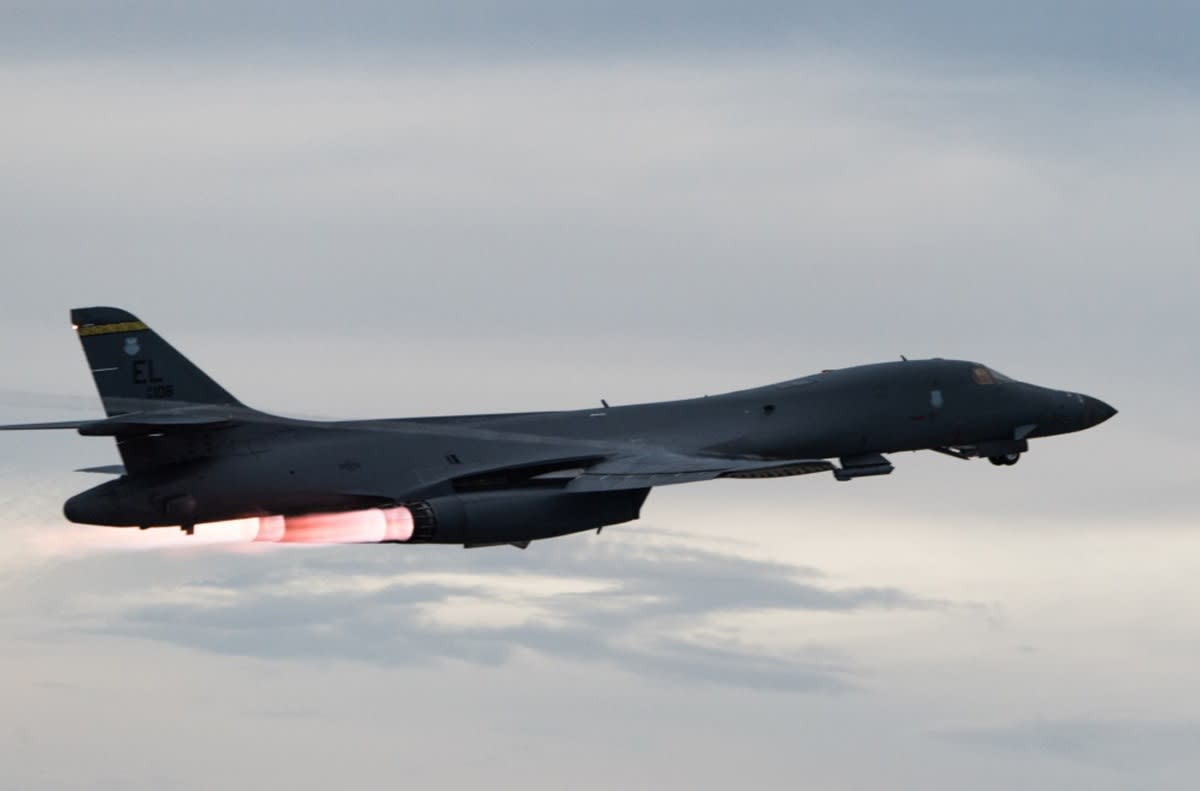
The use of the B-1 Lancer bomber in the latest strike in Iran highlights the strategic importance of this aircraft, which was designed and engineered to penetrate deep into protected enemy territory under the cloak of speed and low altitude. The plane, developed by the Rockwell International company, began its journey as an ambitious project in the seventies of the last century, although it was initially canceled by the American government due to budget considerations and a change in the perception of the global nuclear threat.
Only in the early 1980s, under the administration of President Reagan, did the project come back to life in an improved version that received the operational designation B1B, when the main goal of the engineers was to create a plane that could fly at a very low altitude at high speed and thus evade radar systems that search for high-altitude targets. Its structure includes wings with variable geometry, which allows it to achieve impressive stability and maneuverability even when loaded with tons of bombs and fuel. With its wings spread wide, the plane can take off from relatively short runways and fly efficiently with low fuel consumption, but when they are retracted, it is able to cross the sound barrier and reach speeds of over 1,200 kilometers per hour.
Against the background of security tensions, this capability gives the bomber a significant advantage over more modern stealth aircraft such as the Bee-2, which depend entirely on their special shape and expensive radar-absorbing coating to survive in enemy skies. Although the Bee-2 is considered almost perfect stealth, it is limited in its speed and internal storage space, while the Bee-1 Lancer can carry a much larger amount of armament and fly significantly faster. Advanced radar technology, it remains vulnerable due to its slow speed, but the B-1 Lancer can simply accelerate and move away from the area at a supersonic speed that most fighter jets struggle to match when fully armed.
The Lancer is a large plane, with a length of almost 45 meters and a wingspan that reaches 41 meters in the open state, data that make it a formidable war machine in the sky. Four crew members sit inside the cockpit, including an aircraft commander, a pilot and two weapons systems officers who are responsible for the operation of the precision armament and the complex self-defense systems.
Moreover, the entry of the plane into the Iranian arena at the present time is not accidental, since it is the only tool in the American arsenal capable of carrying the heaviest bunker-penetrating bombs in very large quantities. The aircraft is capable of carrying 34 tons of munitions in three internal bomb bays and another 23 tons on external hang points, bringing its total carrying capacity to an unprecedented 57 tons of explosives and precision missiles.
The cost of the plane is estimated at almost 300 million dollars per unit, an amount that reflects the complex electronic systems installed in it and its ability to operate in almost any weather conditions and at any distance from the base. Although the aircraft entered operational service decades ago, it underwent a comprehensive series of upgrades that included the replacement of all computer and digital communication systems. Today, the plane is connected by a secure data network to all the other forces in the field, which allows it to receive target updates in real time when it is already in the air on its way to the Iranian destination, a critical figure when it comes to mobile targets such as ballistic missile launchers.
In addition to the armament capabilities, the structural and mission difference between it and the stealthy B-2 is especially noticeable in the way it penetrates enemy territory without prior detection. While the Bee 2 looks like a flying wing designed to passively hide from radar, the Bee 1 is built like a giant fighter with rounded lines designed to reduce its radar reflection, giving it a much smaller radar signature than its actual physical size. When the Lancers attacked at night, they did so using autonomous surface tracking navigation systems, a capability that allows them to fly only tens of meters above the surface of the ground
This low flight allows the plane to hide behind mountain ranges and penetrate enemy territory without being detected by long-range radar systems, making it very difficult for Iranian defense systems to intercept it in time. It is this combination of low flight, supersonic speed and a tremendous amount of precision weaponry that makes it the weapon of choice for the US administration for the mission of destroying the Iranian missile industry as promised.
The attack was intended to directly damage the Iranian ballistic missile capabilities in a way that would prevent future launches towards strategic targets in the Middle East. The bombers used smart bombs and long-range cruise missiles capable of flying hundreds of kilometers independently, allowing the plane to stay out of the lethal range of Iranian anti-aircraft systems and still hit the target with an accuracy of a few centimeters.
The fact that each individual bomber can carry dozens of such missiles makes it firepower equivalent to an entire squadron of smaller fighter jets, which saves fueling and logistics resources on long-range flights. The plane’s structure consists mostly of aluminum and titanium, materials designed to withstand the heavy loads of fast flight at low altitude, where the air is thick and the resistance is very great. The fuselage was designed to withstand enormous physical stresses, allowing the pilots to perform sharp maneuvers despite the huge size of the craft while escaping from threats.
From the logistical aspect, the maintenance of this machine is considered one of the most challenging in the Air Force, with each hour of flight requiring tens of hours of work on the ground by skilled technical teams and weapons system experts. Its engines, made by General Electric, provide enormous thrust that allows the plane to reach a maximum takeoff weight of over 210 tons, an amazing figure considering its agility in the air. Despite the great technological complexity, its operational reliability stands at almost 80% in times of emergency, which allows commanders to trust it in sensitive and distant operations such as the night attack deep in Iran.
The aircraft is an integral part of the strategic trinity of the United States, and its success in the latest mission against the Iranian missile industry proves that its original design was correct and strong enough to face modern field challenges. The President’s statement on the destruction of the Iranian military industry took effect tonight when the B1 planes returned to their base after completing the massive weapons drop on the targets predetermined in the operational plan.
Beyond the physical capabilities, the aircraft’s ability to stay over the target area for a long time thanks to huge internal fuel tanks gives it a significant tactical advantage in continuous and complex systems. When the crew is in the air for many hours, they can refuel mid-air and continue the mission non-stop, allowing flexibility unmatched by any other aircraft of this size. In the Iranian arena, the presence of the Lancer provides not only a physical attack capability but also constitutes a powerful psychological weapon, since the knowledge that a single aircraft is capable of wiping out an entire facility above or below the surface of the earth is a very significant deterrent for the decision makers in Tehran. The latest upgrades that include advanced laser-based target identification systems ensure that the strike is accurate and minimizes unwanted environmental damage, enabling surgical action even with massive and lethal means.
The use of these bombers tonight made it clear to the world that the United States will not be satisfied with just political statements, and that it possesses the operational tools capable of carrying out the threat and deploying complex military infrastructures wherever they are on the globe. The targets attacked tonight included missile depots, solid fuel production facilities and command and control bunkers, all of which were severely damaged by the precision munitions dropped from the B-1 aircraft. This campaign is expected to continue as long as the Iranian threats persist, with the supersonic bombers continuing to be the spearhead of air power and deterrence in the skies of the Middle East.
https://pinup-azcasino.com
https://pinup-azcasino.com/apk
https://pinup-azcasino.com/app
https://pinup-azcasino.com/bonus
https://pinup-azcasino.com/casino
https://pinup-azcasino.com/deposit
https://pinup-azcasino.com/download
https://pinup-azcasino.com/faq
https://pinup-azcasino.com/legal
https://pinup-azcasino.com/login
https://pinup-azcasino.com/mirror
https://pinup-azcasino.com/mobile
https://pinup-azcasino.com/payments
https://pinup-azcasino.com/problems
https://pinup-azcasino.com/promocodes
https://pinup-azcasino.com/reviews
https://pinup-azcasino.com/slots
https://pinup-azcasino.com/support
https://pinup-azcasino.com/withdrawal
https://pinup-azonline.com
https://pinup-azonline.com/apk
https://pinup-azonline.com/app
https://pinup-azonline.com/bonus
https://pinup-azonline.com/casino
https://pinup-azonline.com/deposit