The NIC National Innovation Center report points out that AI can contribute up to 130 billion USD to the Vietnamese economy by 2040. Artificial intelligence tools are assessed as being able to help optimize work, handle complex tasks and free people from boring jobs. However, the comprehensive application of AI is only in the group of large enterprises – which play a leading role in the market. For the SME group – accounting for about 98% of businesses in the market, the application of AI is somewhat limited.
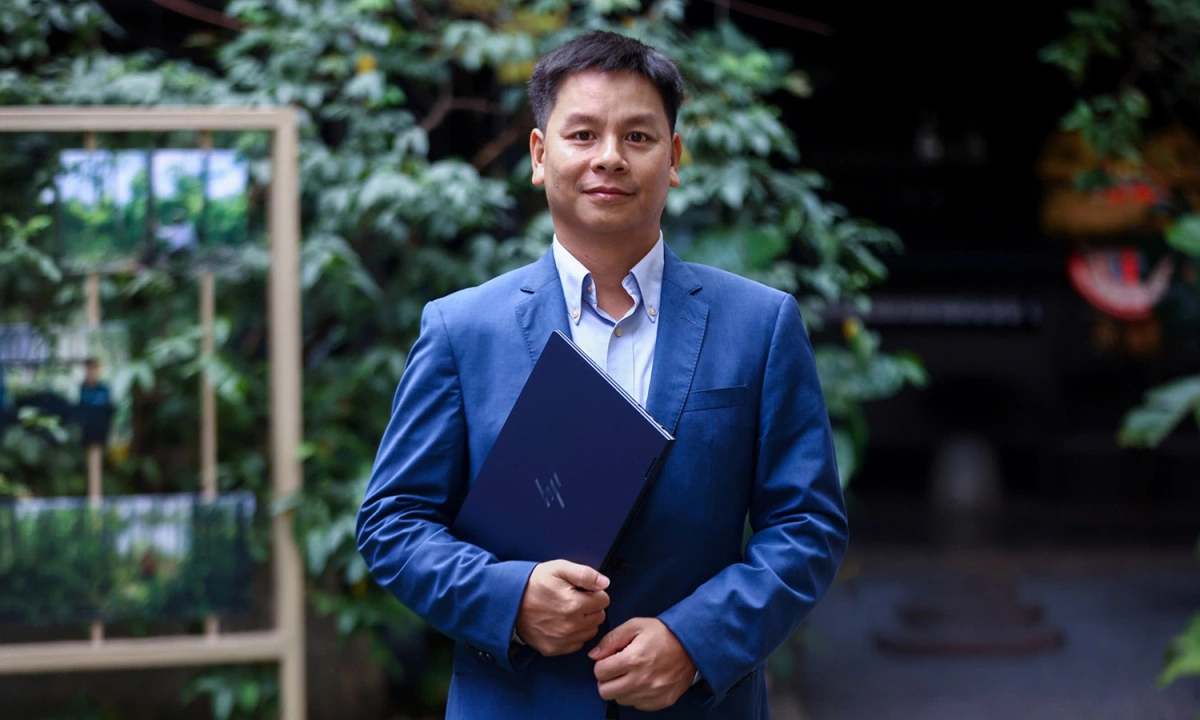
Talking about the role of AI in SMEs, Mr. Nguyen Minh Duc – CEO of HP Vietnam, commented on the current situation, benefits, and how artificial intelligence on personal devices can change the way businesses work and operate.
– AI transformation is being talked about a lot. But with SMEs – the majority group in the economy, in your opinion, how is the application of AI going?
– According to a recent report, 29% of SME businesses in Southeast Asia have applied AI in their operations and another 41% are planning to deploy it in the near future. In Vietnam alone, nearly 44% of SMEs identify AI as a top priority technology investment. It can be seen that the potential for SMEs to apply AI is huge.
However, SMEs applying AI are still at a fairly basic stage of use. For Vietnamese SMEs, although the level of readiness of workers for AI is quite high – according to some studies, about 80% of employees are ready to use AI, but the application is still fragmented. Businesses often use AI for independent tasks such as summarizing text, making slides, and handling some individual daily tasks, but have not yet integrated it into a seamless system for operations.
In large enterprises, AI can act as a “digital employee” taking care of repetitive tasks. This has not yet come true in SME businesses. AI is still a support tool for each individual and has not yet become part of the overall operating process.
– In your opinion, what makes it difficult for SMEs to apply AI?
– This bottleneck comes from many factors, but first and foremost is the perception and vision of the business owner. When leaders understand the efficiency that AI can bring to business operations, they will be willing to invest.
The second factor is resource limitations, which is difficult for SMEs to avoid. This is also the reason why technology businesses and suppliers like HP need to offer products and solutions that are more suitable for the investment capabilities of small and medium-sized enterprises, instead of models that are too complicated or high-cost like in large enterprises.
In addition, many SMEs using AI applications are not fully guaranteed security and confidentiality, mainly due to limited resources. This poses potential risks, especially with data related to finance, operations and customer information.
– He just mentioned the role of technology businesses. In your opinion, what role do technology businesses, including HP, play in the process of supporting SMEs?
– As mentioned, for SMEs, the problem is not only whether there is AI or not, but the cost, efficiency and safety of use. Therefore, technology businesses need to offer solutions suitable to the scale and resources of small and medium enterprises.
One approach that we see great potential for is bringing AI directly to personal devices (laptops, tablets…). Currently, AI processing power on personal computers has increased rapidly thanks to the development of specialized chips for artificial intelligence. By comparison, the AI processing ability on a laptop today can be equivalent to ChatGPT models from 2-3 years ago.
There are many benefits from integrating AI directly into personal devices. The first is cost. When AI runs directly on the device, businesses can significantly reduce subscription costs for cloud AI platforms. Second is efficiency. AI tasks for daily work can be processed right on the machine, regardless of the connection or external system. That is, workers can handle many tasks without the Internet, anywhere such as cafes, airports, restaurants or while on the move.
More important is the issue of information security. For many SMEs, financial, operational or customer data is a core asset. When AI is processed directly on the device, data does not have to be exported, giving businesses better control and reducing risk.
– So, what benefits can integrating AI into HP personal devices bring?
– HP has developed AI on personal devices early and owns the most diverse AI PC portfolio in the world. In 2022, we completed the acquisition of the conference audio equipment brand Poly (now HP Poly). Integrating solutions from Poly and AI on personal devices creates efficiency for online meetings – a popular trend today.
When meeting, we all want to become professional in the eyes of our partners. AI today can help improve images, make sound clearer, automatically track speakers, and make online meetings more professional. Even when we move, AI will closely follow the movement, helping the speaker stay clear on the screen.
Devices also have built-in AI assistants, allowing users to explore, search for information, synthesize, analyze and optimize performance in real time. Local virtual assistant can help summarize documents, manage battery, adjust performance, receive technical support via conversational interface… We also have the Wolf Security security platform that allows data protection, remote data deletion, identification of spam emails, malware…
– According to him, In-depth analysis applications using AI What job positions will it be suitable for?
– Positions that regularly work with data and reports will see the most obvious results, such as accounting, finance, marketing or analysis departments. AI is currently doing well in tasks related to data analysis, information synthesis and basic content design.
In the coming time, AI applications will continue to expand as data is increasingly updated and trained continuously. Let’s emphasize that AI is not a static system, but will evolve according to the way businesses use and provide data to it.
– Direction What are your next steps for the AI ecosystem?
– With HP, we are implementing a strategy Future of Work. This means that all HP products brought to market in the near future must be ready for the way people work in the future.
An important direction is how devices can “see each other” and automatically connect and work seamlessly with each other. Instead of users having to spend a lot of time on manual connection operations, the devices will automatically identify and coordinate with each other.
Take a simple example when we bring a computer into a meeting room. Currently, users often have to open the application, find the link, enter the meeting code before being able to join. In the future, computers will be personal devices. When users enter the meeting room, the camera system can recognize their face and automatically connect their computer to the meeting without needing to perform any additional operations. Users do not have to waste time on intermediate steps, everything happens more naturally.
Similarly, with devices such as printers, instead of having to perform many connection steps, the devices can automatically recognize and connect to each other when the user brings the computer closer, making the working process more seamless and convenient.
Businesses need to determine that the greatest value AI brings is saving time and reducing complexity in daily work. When devices automatically connect and operate together, users can focus on their main work instead of handling technical operations.
– In short, AI can create many changes in the way businesses operate. But according to you, where do SMEs start to adapt to AI?
– Each business will have a different approach, depending on the field, scale and business model. However, in our experience, the most important step is still the awareness of the business owner. They must be ready and determined to transform.
To support, HP currently has training programs to help partners and business leaders better understand AI, including classes we call AI Masterclass. We invite many experts and large business leaders to share to help participants understand how AI is developing in the world and in Vietnam, thereby identifying suitable applications for their businesses.
After there is awareness at the leadership level, the next step is to raise awareness among employees, so they understand how AI can support their work. Businesses can start from simple, repetitive tasks with many reports. These are the areas that are most easily seen as effective when applying AI in the early stages.
Depending on the field such as logistics, retail or legal, each business will have different AI applications. It is important to implement it step by step, in accordance with actual operations, instead of trying to apply it too quickly or too widely.
– In parallel with AI, sustainable development is the requirement of the coming period. In your opinion, how do Vietnamese SMEs view sustainable development?
– In Vietnam, there is a positive signal that the Government has soon made commitments on environmental protection, including participating in COP26, committing to Net Zero by 2050. This is an important direction that businesses, including SMEs, cannot stand aside.
Besides, young people in Vietnam today have a very high awareness of environmental protection. Clearly, right from school, each young person is encouraged to bring their own water bottle to limit the use of plastic bottles. This trend creates positive pressure for businesses to pay more attention to ESG and sustainable development.
With the combination of the Government’s commitment, workers’ awareness and responsibility from large businesses, I believe that Vietnamese SMEs will pay more attention to sustainable products and solutions in the coming time.
– So what strategies does HP have to join the flow of sustainable development?
– Right from the product, we use environmentally friendly materials such as recycled aluminum frames. Since 2019, we have used 2.2 million tons of recycled and circular materials in product development. This year, HP’s goal is to use 90% recycled metal. By 2030, businesses commit to reducing CO2 emissions by 50%.
At the same time, cooperation with WWF is one of HP’s major commitments on a global scale. Through this cooperation, HP and WWF are jointly managing and conserving about 500,000 acres of forest worldwide, equivalent to more than 200,000 hectares.
Not only stopping at protecting forests, these programs also aim to support communities living in those areas to develop sustainably, ensuring long-term livelihoods associated with environmental protection.
In Vietnam alone, HP’s goal in Vietnam is to preserve about 12,000 hectares of forest. Along with that, we also support about 1,000 households in these areas to work towards sustainable development.
– The world of technology is constantly changing and competition is becoming more and more fierce. In your opinion, what is HP’s advantage in the coming period?
– HP’s biggest advantage is its experience serving a diverse group of customers, from large businesses to individual consumers. We also have ecosystems in many fields such as computers, printers and meeting equipment.
HP has data and experience deploying for large businesses globally, and has a large market share in products serving common users. This helps us clearly understand the needs of each customer group and develop products that are suitable for actual use, instead of purely pursuing technology.
https://groups.google.com/g/7kisherelala/c/TYvVnfk74pw
https://gitlab.com/alexgrant2315/pinco_uz
https://sites.google.com/view/pincouz
https://medium.com/@sandydikson90/ж-pinco-casino-ш-с—ъсжшж-fb6c87cc58ce
https://bots.ondiscord.xyz/lists/tGLHkkTKY
https://rentry.co/tdnb3pb5
https://pbase.com/suzannej/pinco_casino
https://triplemonitorbackgrounds.com/pinco_uz/
https://www.guildquality.com/crew/post/69031
https://padlet.com/anndeal/casino-games-reviews-11vuerh2yjae/wish/XGyBQbX4J54PWL6K
https://blankslate.io/?note=1271687
https://www.thesims3.com/myBlog.html?persona=burianchik&showBlogMasterPopup=false
https://gitea.com/Kontrara/-/projects
https://wakelet.com/wake/18AgjHq0PPp2w5OggWUBH
https://game-zoom.ru/igry-pohozhie-na-ikariam.html
https://www.fusioncash.net/forum.php?topic=96163.0
https://socpublic.com/account/forum_post.html?id=33081&page=1
https://github.com/issues/assigned?q=%D0%BA%D0%B0%D0%B7%D0%B8%D0%BD%D0%BE&page=2&issue=duckplease%7CWhat-do-you-think%7C3
https://codeberg.org/amandaalisia3/asterixA/issues/61
https://www.pinterest.com/gussst671/_profile/
https://tawk.to/eb8e5f40c95a6d7b96ff5e1120b0acff53ea2980?_gl=1*u24qzx*_ga*ODczODAxMzQ0LjE3NjU5MzEyNDg.*_ga_ZJL9LF36Z8*czE3NzA5Nzc1NjkkbzUkZzEkdDE3NzA5NzgwMDEkajYwJGwwJGgw
https://steemit.com/letbet/@capitanike/letbet-budushee-industrii-onlain-igr
https://2ch.org/sp/res/3191991.html
https://amdm.ru/qa/post/7256/
https://bookclubs.com/books/-1067723