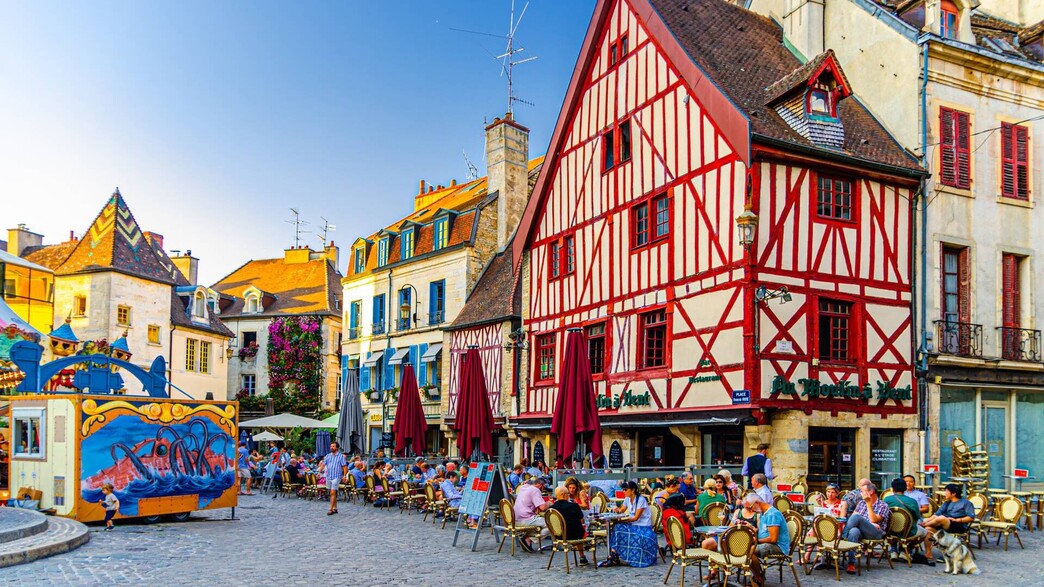
Dijon is the capital of the Burgundy region in central France, and is considered one of the country’s hidden gems. Although it is a city best known for its famous Dijon mustard, it has much more to offer: a combination of fascinating history, architecture, vibrant culture and excellent cuisine. Many tourists tend to focus on other cities in France, but Dijon offers everything that France knows how to offer with a minimum of tourist crowds. Beyond that, the city is an ideal destination for those interested in exploring the Burgundy region, one of the most picturesque and exciting regions in France.
The historic heart of Burgundy
Dijon was the capital of the Duchy of Burgundy, one of the most powerful duchies in Europe until the 15th century. The great influence of the dukes is evident in the city to this day from the impressive palace, through the 15th century Philippe Le Bon tower, from which panoramic views of the city can be seen, to the traditional wooden houses and narrow boulevards, which retain the charm of the Middle Ages. All these make Dijon one of the most special and picturesque cities in France.
Among the famous sites in the city, you can find the Notre Dame Church, next to which is a statue of the bat, a symbol of good luck in the city. According to local legend, if you touch the statue with your left hand you will get good luck. In addition, if you are a history buff, the Dijon Museum of Nationalism offers a fascinating visit experience with works of art from the Renaissance and Baroque periods, along with changing exhibitions on different topics.
Beyond the familiar sites, Dijon is also full of hidden corners. For example, the crypt of the Cathedral of Saint-Bénny, the underground part of the cathedral, offers a glimpse of the period after the Gallo-Roman period. The crypt is built in an interesting style and introduces visitors to the history of the city which begins in the 6th century AD. The Well of Moses is also a spectacular site, a grotesque statue from the 14th century that symbolizes the burial of Duke Philip the Red.
The historic center of Dijon is small and easy to navigate. The city is also known as a car-free city, which makes visiting it pleasant and comfortable. The streets are narrow, most of them accessible only to pedestrians, and you can walk around the city at a leisurely pace. For those who want to get away from the hustle and bustle of the city, you can enter the Arcoboz Botanical Gardens, a beautiful garden located a short distance from the center, where you can relax and admire the plants and flowers.
The city’s Jewish heritage
Dijon also has a rich and important Jewish history. The city has been an important center for Jews since the 12th century, when the dukes of Burgundy gave the Jews protection and many benefits. In the 14th century, the Jewish community in the city was dispersed following deportation. For hundreds of years, there were no Jews in the city, and only at the end of the 18th century, after the arrival of Jewish refugees from Alsace, the community was renewed.
The Jewish community was prosperous at the beginning of the 20th century. In 1879, the synagogue of Dijon was established, and until World War II it was used by most of the city’s Jewish residents. In 1940, when the Nazis invaded France, the Germans used the synagogue as stables for horses, but did not destroy it, thanks to the efforts of Father Felix Kier, a Catholic priest who later became the mayor, who protected the synagogue and hid the Jewish religious items in his home. However, during the war, most of the Jewish community in the city was destroyed, including Rabbi Eli Seifer, who was also a member of the underground.
After the end of World War II, the Jewish community in Dijon began to rebuild, especially with the arrival of Jews from North Africa in the 1960s. Today there is a Jewish community of about 225 families in the city. The synagogue of Dijon today stands as a symbol of the renewal of the Jewish community in the city, and is located at 5 Rue de la Synagogue.
The city also offers a reminder of the city’s Jewish heritage with the names of streets such as Rue du Rabbin Elie Cyper, named after the rabbi who was active during World War II, and tells the story of the city’s Jewish ghetto.
The gastronomy capital of Burgundy
There is no doubt that Dijon is also a city of good food. Beyond the famous Dijon mustard that has become associated with the city, Dijon offers an abundance of regional foods such as Appois cheese and delices de Burgundy, alongside fine Burgundy wine. The wines here, especially Pinot Noir and Chardonnay, are considered world leaders.
If you are a wine lover, don’t miss the Route des Grands Crus, the famous wine road that leads east from the city, to one of Burgundy’s leading wineries. Those interested in getting to know the wine culture in depth can also visit the International Center for Gastronomy and Wine, a modern museum that includes workshops and exhibitions dealing with the cuisine and wine of Burgundy.
Dijon also offers visitors the Les Halles de Dijon market, built according to the design of Gustave Eiffel, where you can find a large variety of fresh foods, cheeses and wines from the region, and enjoy traditional delicacies such as pies, breads and cakes.
When should you visit and how much does it cost?
The most recommended time to visit Dijon is between May and September, when the weather is warm and the streets are full of life. The autumn months, especially September and October, are also a great time to visit as this is the time of the harvest celebrations, and there are plenty of events taking place around the city. If you are a wine lover, don’t miss the time celebrating the new wine of Burgundy.
There are no direct flights from Israel to Dijon, but getting there is very convenient via Paris:
- Flight and train (the recommended way): Fly to Charles de Gaulle Airport (CDG) in Paris. From there, you can take the high-speed train (TGV) directly from the station at the airport or from the Gare de Lyon station in central Paris. The trip takes only about an hour and a half.
- Rented car: For those planning a trip along the wine routes, you can rent a car in Paris and drive about 3 hours south on the A6 highway.
- Transportation in the city: The city center is compact and ideal for walking. There is also a modern and very efficient tram (electric) system.
- City Pass: If you plan to visit many museums and wineries, you should consider buying a ticket that grants free entry to the sites and free travel on public transportation.
Dijon offers a variety of accommodation options, from hostels to boutique hotels in historic buildings:
- Budget hotels: Around NIS 350-500 per night. Look for chains like Ibis or small hotels outside the historic center.
- Mid-range hotels: Around NIS 600-900 per night. 4 star hotels in the heart of the old city.
- prestige: 5-star hotels in buildings from the 17th century may cost 1,200 shekels or more per night.
Dijon is the culinary capital of France, and you should not miss the local mustard and the “beef bourguignon” dish. At lunch time (Menu du Jour) you can find a business menu at an affordable price of NIS 80-120 in most restaurants. Dinner in a good restaurant, including wine and main course, will cost around NIS 180-300 per person.
https://gimns.org/
https://pinup-yukle.com/
https://pin-up-azerbaycan.info/
https://pinup.nanaimo-airport.com/
https://demilecpolska.pl
https://kasynoopole.pl
https://kasynogdansk.pl
https://kasynokatowice.pl
https://kasynolodz.pl
https://kasynokrakow.pl
https://kasynoszczecin.pl
https://psb.pptakmirulislam.com/index.php/2024/03/05/song-bac-tro-choi-song-bac-1xbet-danh-cho-nguoi-viet-thien-duong-choi-game-truc-tuyen-voi-hang-ngan-lua-chon-game-va-co-hoi-trung-thuong-lon/
https://shreepharmasupply.com/
https://hbs-menuiserie.fr/
https://www.keepandshare.com/discuss2/43391/versus-casino-apuestas-honduras-2026-mi-experiencia-real-y-opini-n-honesta
https://www.thuum.org/viewthread.php?thread=23490
https://www.joindota.com/users/2325008-nelsonsuazo
https://backloggery.com/SabirAliyev
https://app.roll20.net/users/17531961/brian-s
https://comicvine.gamespot.com/profile/vusalmammadov/
https://paizo.com/people/RahidMammadov#newPost
https://www.joindota.com/users/2324482-parvizrahimli
https://bitcointalk.org/index.php?action=profile;u=3748914
https://backloggery.com/RahilJabbarov
https://www.1001fonts.com/users/OrxanRahimli/