Newly published research shows that in the period 2000-2020, Earth’s days lengthened at a rate of about 1.33 milliseconds per century.
The study, conducted by a team of scientists from the University of Vienna and the Swiss Federal Institute of Technology (ETH Zurich), looked at 3.6 million years of Earth’s history, from the end of the Pliocene, to see how unusual the speed of 1.33 milliseconds was.
According to expert Mostafa Kiani Shahvandi at the Department of Meteorology and Geophysics at the University of Vienna, a member of the research team, the redistribution of Earth’s mass is similar to a figure skater who will spin slower when reaching out and faster when keeping his hands close to his body. “We don’t know whether there were periods in the past where climate increased day length at a similar rate,” Shahvandi said.
In theory, the Earth needs 24 hours to complete one rotation around its axis. In reality, days may be slightly longer or shorter due to the influence of the Moon’s gravity and geophysical processes taking place deep within the Earth, on the surface and in the atmosphere.
However, many studies show a larger trend at work. Climate change caused by human activity causes the Earth to warm and ice to melt, releasing water that has been frozen for thousands of years, causing global sea levels to rise. This leads to the Earth’s mass being redistributed, slowing down the speed at which the Earth rotates. As a result, in the period 2000-2020, Earth’s days lengthened at a rate of about 1.33 milliseconds per century.
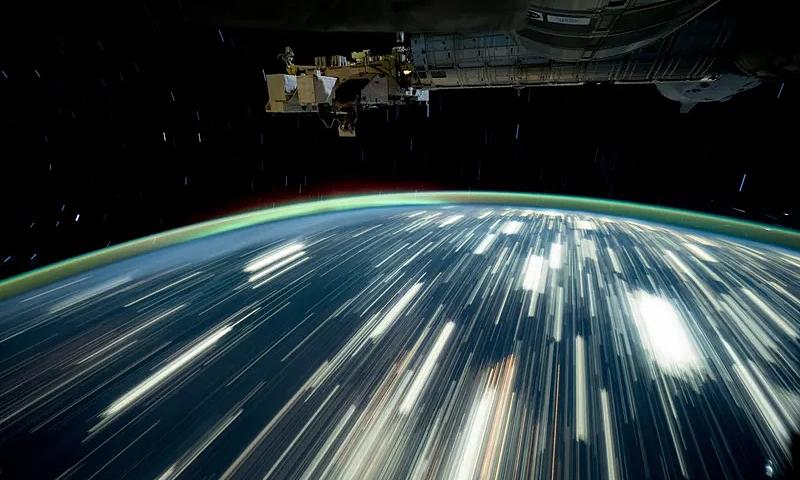
City lights on Earth flash by in a photo taken by NASA astronaut Don Pettit from the International Space Station (ISS) in October 2024. Image: ISS/NASA
To find out, Shahvandi and his colleagues studied fossil foraminifera – tiny single-celled marine creatures with shells. “From the chemical composition of foraminiferal fossils, we can infer sea level fluctuations, then calculate corresponding changes in day length,” he explains.
As a result, 1.33 milliseconds per century is the fastest day lengthening rate during the past 3.6 million years. Only once, about 2 million years ago, did the rate of change in day length come close to this record. With predictions of global warming and ice melting in the coming decades, the research team believes that the record will still be broken.
“By the end of the 21st century, climate change is expected to affect day length more strongly than the Moon. Even if only by a few milliseconds, this change could cause problems in many fields such as precise spatial navigation, which requires accurate information about the Earth’s rotation,” said Benedikt Soja, professor of Space Geodesy at ETH Zurich.
It is very difficult for humans to perceive a deviation of 1.33 milliseconds in daily life. However, misalignment can cause trouble for technologies that rely heavily on timekeeping, such as GPS satellites and complex financial networks.
https://gardenaeliteroofing.com/tile-roof-installation
https://gardenaeliteroofing.com/asphalt-shingle-roof-installation-and-repair
https://gardenaeliteroofing.com/emergency-roof-repair
https://gardenaeliteroofing.com/contact
https://gardenaeliteroofing.com/aboout
https://norwalkeliteroofing.com/roof-replacement
https://norwalkeliteroofing.com/residential-roof-installation
https://norwalkeliteroofing.com/commercial-roof-installation
https://norwalkeliteroofing.com/roof-repair
https://norwalkeliteroofing.com/tile-roof-installation
https://norwalkeliteroofing.com/roof-inspection
https://norwalkeliteroofing.com/contact
https://arcadiaeliteroofs.com/roof-replacement
https://arcadiaeliteroofs.com/gutter-installation-and-repair
https://arcadiaeliteroofs.com/roof-maintenance-programs
https://arcadiaeliteroofs.com/contact